
Ask questions which are clear, concise and easy to understand.
Ask QuestionPosted by Yogesh Panwar 7 years, 3 months ago
- 1 answers
Posted by Deepak Jaiswal 6 years, 4 months ago
- 1 answers
Sia ? 6 years, 4 months ago
Given system of equations are:
{tex}2x + y = 6{/tex} ...(i)
{tex}2x - y + 2 = 0{/tex} ...(ii)
Graph of the equation {tex}2x + y = 6:{/tex}
We have,
{tex}2x + y = 6{/tex} {tex} \Rightarrow {/tex} {tex}y = 6 - 2x{/tex}
When x = 0, we have y = 6 - 2(0) = 6
When x =3, we have y = 6 - 2(3) = 6 - 6 = 0
Thus, we have the following table giving two points on the line represented by the equation {tex}2x + y = 6{/tex}
| x | 0 | 3 |
| y | 6 | 0 |
Graph of the equation {tex}2x - y + 2 = 0{/tex}:
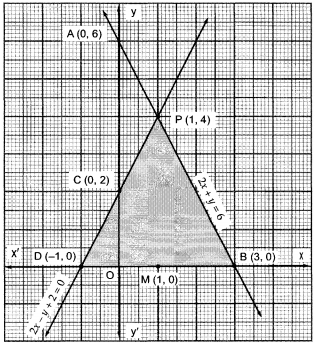
We have,
{tex}2 x - y + 2 = 0 {/tex}{tex} \Rightarrow {/tex} y = 2x + 2
When x = 0, we have y = 2(0) + 2 = 2
When x = -1, we have y = 2(-1) + 2 = 2 - 2 = 0
Thus, we have the following table giving two points on the line representing the given equation
| x | 0 | -1 |
| y | 2 | 0 |
Thus, x = 1, y = 4 is the solution of the given system of equations. Draw PM perpendicular from P on x-axis
Clearly, we have
PM = y-coordinate of point P(1, 4)
{tex} \Rightarrow{/tex} PM=4
and, DB = 4
{tex} \therefore{/tex} Area of the shaded region =Area of {tex} \triangle{/tex}PBD
{tex}\Rightarrow{/tex} Area of the shaded region {tex}= \frac { 1 } { 2 } ( \text { Base } \times \text { Height } ){/tex}
{tex}\Rightarrow{/tex} Area of the shaded region {tex}= \frac { 1 } { 2 } ( D B \times P M ){/tex}
{tex}\Rightarrow{/tex} Area of the shaded region {tex}= \left( \frac { 1 } { 2 } \times 4 \times 4 \right) \text { sq. units } = 8 s q. units.{/tex}
Posted by Anurag Shendure 7 years, 3 months ago
- 0 answers
Posted by Sejal Jha 7 years, 3 months ago
- 1 answers
Yogesh Panwar 7 years, 3 months ago
Posted by Saahil R 7 years, 3 months ago
- 1 answers
Posted by Shivam Chaudhary 7 years, 3 months ago
- 1 answers
Posted by Deepak Singh 6 years, 4 months ago
- 1 answers
Sia ? 6 years, 4 months ago
We have
{tex}2x^2 + x - 4 = 0{/tex}
{tex}4x^2 + 2x - 8 = 0{/tex} [multiplying both sides by 2]
{tex}4x^2 + 2x = 8{/tex}
{tex}\Rightarrow ( 2 x ) ^ { 2 } + 2 \times 2 x \times \frac { 1 } { 2 } + \left( \frac { 1 } { 2 } \right) ^ { 2 } = 8 + \left( \frac { 1 } { 2 } \right) ^ { 2 }{/tex} [adding {tex}\left( \frac { 1 } { 2 } \right) ^ { 2 }{/tex} on both sides]
{tex}\Rightarrow \left( 2 x + \frac { 1 } { 2 } \right) ^ { 2 } = \left( 8 + \frac { 1 } { 4 } \right) = \frac { 33 } { 4 } = \left( \frac { \sqrt { 33 } } { 2 } \right) ^ { 2 }{/tex}
{tex}\Rightarrow{/tex} 2x + {tex}\frac{1}{2} = \pm \left( \frac { \sqrt { 33 } } { 2 } \right){/tex} [taking square root on both sides]
{tex}\Rightarrow{/tex} {tex}2x +{/tex} {tex}\frac { 1 } { 2 } = \frac { \sqrt { 33 } } { 2 }{/tex} or 2x + {tex}\frac { 1 } { 2 } = \frac {- \sqrt { 33 } } { 2 }{/tex}
{tex}\Rightarrow 2x=\frac{\sqrt{33}}{2}-\frac{1}{2}\ or \ 2x=-\frac{\sqrt{33}}{2}-\frac{1}{2}{/tex}
{tex}\Rightarrow x=\frac{\sqrt{33}-1}{4}\ \ or \ \ x=\frac{-(\sqrt{33}+1)}{4}{/tex}
Posted by Ankit Kanyal 7 years, 3 months ago
- 0 answers
Posted by Royal Boy Alok 7 years, 3 months ago
- 1 answers
Kichcha Ragu 7 years, 3 months ago
Posted by Aman Kumar 7 years, 3 months ago
- 2 answers
Posted by Aman Kumar 6 years, 4 months ago
- 1 answers
Sia ? 6 years, 4 months ago
{tex}3x - 4y = 7\ and\ 5x + 2y = 3{/tex}
The given system of linear equation is {tex}3x - 4y = 7\ and\ 5x + 2y = 3{/tex}
Now, {tex}3x - 4y = 7{/tex}
{tex}y = \frac { 3 x - 7 } { 4 }{/tex}
When x = 1 then, y = -1
When x = -3 then y = -4
| x | 1 | -3 |
| y | -1 | -4 |
Now, 5x + 2y = 3
{tex}y = \frac { 3 - 5 x } { 2 }{/tex}
When x = 1 then, y = -1
When x = 3 then y = -6
Thus, we have the following table
| x | 1 | 3 |
| y | -1 | -6 |
Graph of the given system of equations are
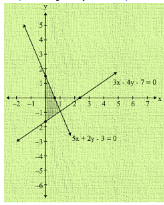
Clearly the two lines intersect at A(1, -1)
Hence, x = 1 and y = -1 is the solution of the given system of equations.
Posted by Varsha Tripathi 7 years, 3 months ago
- 0 answers
Posted by Uma R 6 years, 4 months ago
- 1 answers
Sia ? 6 years, 4 months ago
Three digits numbers that are divisible by 11 are :-
110, 121, 132,.............., 990
Clearly ,above sequence is an A.P.
Here,
a (First term) = 110
d (common difference) = 11
an = 990
We know that, in A.P.
an = a + (n - 1)d
Or, 990 = 110 + (n - 1) {tex}\times{/tex} 11
Or, 990 = 110 + 11n - 11
Or, 990 = 99 + 11n
Or, 891 = 11n
Or, n = 81
Also,
Sn = {tex}\frac n 2{/tex} (a + an)
Or, S81 = {tex}\frac{{81}}{2}(110 + 990){/tex}
Or, S81 = 81 {tex}\times{/tex}550
Or, S81 = 44550.
Posted by Pransh Yadav 6 years, 4 months ago
- 1 answers
Sia ? 6 years, 4 months ago
Let a = 4q + r : 0 {tex}\leq r < 4{/tex}
{tex}\therefore a = 4 q = 2 ( 2 q ) \text { an even integer }{/tex}
{tex}a = 4 q + 1 = 2 ( 2 q ) + 1 \text { an odd integer }{/tex}
{tex}a = 4 q + 2 = 2 ( 2 q + 1 ) \text { an even integer }{/tex}
{tex}a = 4 q + 3 = 2 ( 2 q + 1 ) + 1 \text { an odd integer }{/tex}
{tex}\therefore {/tex} Every positive odd integer is of the form
{tex}( 4 q + 1 ) o r ( 4 q + 3 ) \text { for some integer }{/tex}
Posted by Rajeev Kumar 7 years, 3 months ago
- 0 answers
Posted by Sahil Kumar 6 years, 4 months ago
- 1 answers
Sia ? 6 years, 4 months ago
According to the question,we are given that,
{tex}S _ { n } = \frac { 3 n ^ { 2 } } { 2 } + \frac { 5 n } { 2 } = \frac { 3 n ^ { 2 } + 5 n } { 2 }{/tex}
{tex}\Rightarrow S _ { n - 1 } = \frac { 3 ( n - 1 ) ^ { 2 } + 5 ( n - 1 ) } { 2 }{/tex}
{tex}= \frac { 3 \left( n ^ { 2 } - 2 n + 1 \right) + 5 n - 5 } { 2 }{/tex}
{tex}= \frac { 3 n ^ { 2 } - 6 n + 3 + 5 n - 5 } { 2 }{/tex}
{tex}= \frac { 3 n ^ { 2 } - n - 2 } { 2 }{/tex}
Now,
nth term = Tn=Sn-Sn-1={tex}= \frac { 3 n ^ { 2 } + 5 n } { 2 } - \frac { 3 n ^ { 2 } - n - 2 } { 2 } = \frac { 3 n ^ { 2 } + 5 n - 3 n ^ { 2 } + n + 2 } { 2 }{/tex}={tex}\frac{{6n + 2}}{2}{/tex}=3n+1
25th term=T25=3(25)+1=75+1=76.
Posted by Prachi Upadhyay 6 years, 4 months ago
- 1 answers
Sia ? 6 years, 4 months ago
The required number when divides 615 and 963, leaves remainder 6, this means 615 - 6 = 609 and 963 - 6 = 957 are completely divisible by the number.
Therefore,
The required number = H.C.F. of 609 and 957.
By applying Euclid’s division lemma
957 = 609 {tex}\times{/tex} 1+ 348
609 = 348 {tex}\times{/tex} 1 + 261
348 = 216 {tex}\times{/tex} 1 + 87
261 = 87 {tex}\times{/tex} 3 + 0.
Therefore, H.C.F. of 957 and 609 is = 87.
Hence, the largest number which divides 615 and 963 leaving remainder 6 in each case is 87.
Posted by Priyank Gupta 7 years, 3 months ago
- 1 answers
Amrita Choudhary 7 years, 3 months ago
Posted by Samruddhi Jain 7 years, 3 months ago
- 2 answers
Amrita Choudhary 7 years, 3 months ago
Amrita Choudhary 7 years, 3 months ago
Posted by Krish Bansal 7 years, 3 months ago
- 1 answers
Amrita Choudhary 7 years, 3 months ago
Posted by Nisha Saraswat 7 years, 3 months ago
- 0 answers
Posted by Ayushi Agrawal 7 years, 3 months ago
- 1 answers
Posted by Tanishq Kumar Tejasv 5 years, 8 months ago
- 0 answers
Posted by Shilpa Jain 7 years, 3 months ago
- 1 answers
Jatin Garg 7 years, 3 months ago
Posted by Gouni Vidhyun 7 years, 3 months ago
- 1 answers
Posted by Aacif Aacif 7 years, 3 months ago
- 1 answers
Posted by Deepak Sengar 6 years, 4 months ago
- 1 answers
Sia ? 6 years, 4 months ago
Let the sum of first n terms of an A.P. is Sn, where first term i.e. a = 8 and the common difference i.e. d = 20.
and let the sum of first 2n terms of another A.P. is S'2n whose first term i.e. A= –30 and the common difference i.e. D = 8.
According to the question, Sn = S’2n
⇒ {tex}\frac { n } { 2 }{/tex} [2a + (n - 1)d] = {tex}\frac { 2 n } { 2 }{/tex} [2A + (2n - 1)D]
⇒ [2(8) + (n - 1)20] = 2[2(–30) + (2n - 1)8]
⇒ 16 + 20n - 20 = 2[-60 + 16n – 8]
⇒ 16 + 20n – 20 = 2[–68 + 16n]
⇒ 20n – 4 = –136 + 32n
⇒ –32n + 20n = –136 + 4
⇒ –12n = –132
⇒ n = {tex}\frac { 132 } { 12 }{/tex} = 11
Hence, the value of n is 11.

myCBSEguide
Trusted by 1 Crore+ Students

Test Generator
Create papers online. It's FREE.

CUET Mock Tests
75,000+ questions to practice only on myCBSEguide app

Vaishnavi Rajkumar 7 years, 3 months ago
2Thank You