
Ask questions which are clear, concise and easy to understand.
Ask QuestionPosted by Aastha Kochar 7 years, 3 months ago
- 4 answers
Abhay Sharma 7 years, 3 months ago
Posted by Raghu Jangra 7 years, 3 months ago
- 0 answers
Posted by Sami Sri N 7 years, 3 months ago
- 0 answers
Posted by Mohit Macpherson 7 years, 3 months ago
- 0 answers
Posted by Gyanesh Kumar Karn 7 years, 3 months ago
- 0 answers
Posted by Mobassir Khan 7 years, 3 months ago
- 1 answers
Posted by Vansh Singh 6 years, 4 months ago
- 1 answers
Sia ? 6 years, 4 months ago
Let R and I are rational number and irrational number respectively.
Assume that sum of R and I is a rational number and equal to P<u1:p></u1:p>
So R + I =P<u1:p></u1:p>
or I =P - R......., (1)<u1:p></u1:p>
As P and R both are rational number so P - R is also a rational number.<u1:p></u1:p>
Hence from (1) I is a rational number<u1:p></u1:p>
But this contradict that I is an irrational number.<u1:p></u1:p>
This contradiction has come because we assumed that R+ I is a rational number.<u1:p></u1:p>
Therefore the sum of irrational number and rational number is always an irrational number.<u1:p></u1:p>
Posted by Raj Ranjan 6 years, 4 months ago
- 1 answers
Sia ? 6 years, 4 months ago
Let the numerator and denominator of fraction be x and y respectively.
Then, the fraction is {tex}\frac xy{/tex}.
As per first condition
The sum of the numerator and denominator of a fraction is 4 more than twice the numerator.
x + y = 2x + 4
{tex}\Rightarrow{/tex} -x + y = 4........(i)
According to the second condition,
If the numerator and denominator are increased by 3, they are in the ratio 2 : 3.
{tex}\frac { x + 3 } { y + 3 } = \frac { 2 } { 3 }{/tex}
{tex}\Rightarrow{/tex} 3x + 9 = 2y + 6
{tex}\Rightarrow{/tex}3x - 2y = -3.......(ii)
Multiply (i) by -2, we get
-2x + 2y = 8 ......... (iii)
Adding (ii) and (iii) , we get
and 3x - 2x = -3 + 8
{tex}\Rightarrow{/tex} x = 5
Substituting x = 5 in (i), we get
5 - y = 4
y = 9
Hence, the required fraction is {tex}\frac{5}{9}{/tex}
Posted by Anurag Maurya 7 years, 3 months ago
- 4 answers
Posted by Rahul Gupta 7 years, 3 months ago
- 1 answers
Posted by Vishnu Priya 7 years, 3 months ago
- 1 answers
Posted by Suraj Yadav 7 years, 3 months ago
- 1 answers
Posted by Raushan Singh 6 years, 4 months ago
- 1 answers
Sia ? 6 years, 4 months ago
The given numbers are 1251,9377 and 15628
Subtracting the remainders 1,2 and 3 from 1251,9377 and 15628 respectively we get
1251 - 1 = 1250,
9377 - 2 = 9375
15628 - 3 = 15625.
Therefore the said number= HCF(1250,9375,15625)
Now on applying Euclid's lemma on 1250 and 9375 we get
9375 = 1250 {tex}\times{/tex} 7 + 625
1250 = 625 {tex}\times{/tex}2+0
Hence HCF (1250 , 9375 )= 625.
Now on applying Euclid's lemma on 15625 and 625 we get
15625=625 {tex}\times{/tex} 25+0
Hence, HCF (1250, 9375,15265)= 625.
Thus, the said number = 625.
Posted by Shivãm Gurjãr 7 years, 3 months ago
- 0 answers
Posted by Priyanshi Agrawal 7 years, 3 months ago
- 1 answers
Satish Kumar 7 years, 3 months ago
Posted by Pratham Arora 7 years, 3 months ago
- 4 answers
Aaryan Dhamija 7 years, 3 months ago
Nikita Gupta 7 years, 3 months ago
Posted by Kiara Verma 6 years, 4 months ago
- 1 answers
Sia ? 6 years, 4 months ago
According to the question,we are given that,
PA = QA
⇒ PA2 = QA2
⇒ (3 – 2)2 + (8 + 4)2 = (–10 – 2)2 + (y + 4)2
⇒ 12 + 122 = (–12)2 + y2 + 16 + 8y
⇒ y2 + 8y + 16 – 1 = 0
⇒ y2 + 8y + 15 = 0
⇒ y2 + 5y + 3y + 15 = 0
⇒ y(y + 5) + 3(y + 5) = 0
⇒ (y + 5) (y + 3) = 0
⇒ y + 5 = 0 or y + 3 = 0
⇒ y = –5 or y = –3
So, the co–ordinates are P(3, 8), Q1(–10, –3), Q2(–10, –5).
Now, {tex}P Q _ { 1 } ^ { 2 }{/tex} = (3 + 10)2 + (8 + 3)2 = 132 + 112
⇒ {tex}P Q _ { 1 } ^ { 2 }{/tex} = 169 + 121
⇒ {tex}P Q _ { 1 } = \sqrt { 290 }{/tex} units
and {tex}P Q _ { 2 } ^ { 2 }{/tex} = (3 + 10)2 + (8 + 5)2 = 132 + 132
= 132[1 + 1]
⇒{tex}P Q _ { 2 } ^ { 2 }{/tex}= 132 × 2
⇒ {tex}P Q _ { 2 } = 13 \sqrt { 2 }{/tex} units
Hence, y = –3, –5 and PQ = {tex}\sqrt { 290 }{/tex} units and {tex}13 \sqrt { 2 }{/tex}units.
Posted by Riya Garg 7 years, 3 months ago
- 3 answers
Posted by Ayush Chauhan 7 years, 3 months ago
- 1 answers
Posted by Jai Jindal 7 years, 3 months ago
- 1 answers
Posted by Hritik Asthana 7 years, 3 months ago
- 0 answers
Posted by Nitish Payal 6 years, 4 months ago
- 1 answers
Sia ? 6 years, 4 months ago
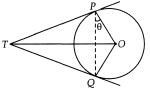
Let {tex}\angle O P Q \text { be } \theta{/tex}
{tex}\therefore \quad \angle T P Q = \left( 90 ^ { \circ } - \theta \right){/tex}
Since TP = TQ (Tangents)
{tex}\therefore \quad \angle T Q P = \left( 90 ^ { \circ } - \theta \right){/tex}
(Opposite angels of equal sides)
Now, {tex}\angle T P Q + \angle T Q P + \angle P T Q{/tex} = 180o
{tex}\Rightarrow 90 ^ { \circ } - \theta + 90 ^ { \circ } - \theta + \angle P T Q{/tex} {tex}= 180 ^ { \circ }{/tex}
{tex}\Rightarrow \quad \angle P T Q = 180 ^ { \circ } - 180 ^ { \circ } + 2 \theta{/tex}
{tex}\Rightarrow \quad \angle P T Q = 2 \theta{/tex}
Hence {tex}\angle P T Q = 2 \angle O P Q{/tex}
Posted by Sweta Verma 7 years, 3 months ago
- 4 answers
Jai Jindal 7 years, 3 months ago
Posted by Kumkum Sharma 7 years, 3 months ago
- 1 answers
Posted by Vinay Pal 7 years, 3 months ago
- 2 answers
Posted by Sahil Ujal 7 years, 3 months ago
- 1 answers
Posted by Nikita Kekati 7 years, 3 months ago
- 0 answers
Posted by Ragini Gupta 7 years, 3 months ago
- 1 answers

myCBSEguide
Trusted by 1 Crore+ Students

Test Generator
Create papers online. It's FREE.

CUET Mock Tests
75,000+ questions to practice only on myCBSEguide app

Rishi Raj 7 years, 3 months ago
0Thank You