
Ask questions which are clear, concise and easy to understand.
Ask QuestionPosted by Ajay Basfore 7 years, 3 months ago
- 0 answers
Posted by Sachin Kumar 7 years, 3 months ago
- 1 answers
Posted by Nikhil Garg 7 years, 3 months ago
- 2 answers
Posted by Anuj Uniyal 7 years, 3 months ago
- 0 answers
Posted by Shashwath Venkatesh 7 years, 3 months ago
- 0 answers
Posted by Ayush Saxena 7 years, 3 months ago
- 1 answers
Miru Mahesh 7 years, 3 months ago
Posted by Pushpdeep Singh 7 years, 3 months ago
- 0 answers
Posted by Shrivatsun Shrivatsun 7 years, 3 months ago
- 0 answers
Posted by Arun Kumar 7 years, 3 months ago
- 5 answers
Anjali Pokhariya 7 years, 3 months ago
Anantha P 7 years, 3 months ago
Posted by Om Rajput 7 years, 3 months ago
- 4 answers
Posted by Krishna Arya 6 years, 6 months ago
- 1 answers
Sia ? 6 years, 6 months ago
Let speed of ritu in still water = x km/h
Speed of stream = y km/h
Then downstream speed of ritu = x + y
Upstream speed of ritu = x - y
According to question
{tex}\frac{20}{x+y}=2{/tex}
{tex}\Rightarrow{/tex} x +y = 10 .... (1)
Also,
{tex}\frac{4}{x-y}=2{/tex}
{tex}\Rightarrow{/tex} x - y = 2 ..... (2)
Add (1) and (2)
2x = 12
{tex}\Rightarrow{/tex} x = 6
From (1), we get
6 + y = 10
{tex}\Rightarrow{/tex} y = 4
Therefore, Speed of ritu in still water = 6km/h
Speed of stream = 4km/h
Posted by Kartik Patel 7 years, 3 months ago
- 1 answers
Posted by Shivam Pandey 7 years, 3 months ago
- 0 answers
Posted by Gulshan Pratap Singh 7 years, 3 months ago
- 0 answers
Posted by Gulshan Pratap Singh 6 years, 6 months ago
- 1 answers
Sia ? 6 years, 6 months ago
Diameter of semicircular sheet is 28 cm. It is bent to from an open conical cup. The radius of sheet becomes the slant height of the cup. The circumference of the sheet becomes the circumference of the base of the cone.
{tex}\therefore \;l = {/tex} Slant height of conical cup = 14 cm.
Let r cm be the radius and h cm be the height of the conical cup circumference of conical cup of the semicircular sheet
{tex}\therefore \;2\pi r = \pi \times 14 \Rightarrow r = 7cm{/tex}
Now, {tex}{l^2} = {r^2} + {h^2} \Rightarrow h = \sqrt {{l^2} - {r^2}}{/tex}
{tex}= \sqrt {{{(14)}^2} - {{(7)}^2}} = \sqrt {196 - 49}{/tex}{tex}= \sqrt {147} = 12.12cm{/tex}
{tex}\therefore{/tex} Capacity of the cup
{tex} = \frac{1}{3}\pi {r^2}h = \frac{1}{3} \times \frac{{22}}{7} \times 7 \times 7 \times 12.12{/tex}
= 622.16 cm3
Posted by Devyani Khairnar 7 years, 3 months ago
- 1 answers
Posted by Aditya Asati 7 years, 3 months ago
- 0 answers
Posted by Xyz Abc 7 years, 3 months ago
- 0 answers
Posted by J Star 7 years, 3 months ago
- 0 answers
Posted by Sneha Dobriyal 7 years, 3 months ago
- 0 answers
Posted by Kishan Kumar 7 years, 3 months ago
- 2 answers
Sneha Dobriyal 7 years, 3 months ago
Posted by Diya Charaya 6 years, 6 months ago
- 1 answers
Sia ? 6 years, 6 months ago
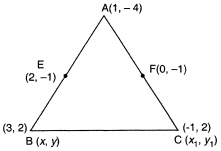
Let E be the midpoint of AB.
{tex}\therefore \quad \frac { x + 1 } { 2 } = 2{/tex} or x = 3
and {tex}\frac { y + ( - 4 ) } { 2 } = - 1{/tex} or, y = 2
or, B(3, 2)
Let F be the mid-point of AC.Then,
{tex}0=\frac{x_1+1}{2}{/tex} or {tex}x_1=-1{/tex}
and {tex}\frac { y _ { 1 } + ( - 4 ) } { 2 }{/tex} = -1 or, y1 = 2
or, C= (-1, 2)
Now the co-ordinates are A(1, - 4), B(3,2), C (-1,2)
Area of triangle
{tex}= \frac { 1 } { 2 } \left[ x _ { 1 } \left( y _ { 2 } - y _ { 3 } \right) + x _ { 2 } \left( y _ { 3 } - y _ { 1 } \right) + x _ { 3 } \left( y _ { 1 } - y _ { 2 } \right) \right]{/tex}
{tex}= \frac { 1 } { 2 } [ 1 ( 2 - 2 ) + 3 ( 2 + 4 ) - 1 ( - 4 - 2 ) ]{/tex}
{tex}= \frac { 1 } { 2 } [ 0 + 18 + 6 ]{/tex}
= 12 sq units.
Posted by Prince Hundal 5 years, 8 months ago
- 1 answers
Posted by Anne Lathwal 7 years, 3 months ago
- 0 answers
Posted by #Aditi~ Angel???? 7 years, 3 months ago
- 2 answers
Kapil Jaswal 7 years, 3 months ago
Posted by Nandini Sharma 6 years, 6 months ago
- 1 answers
Sia ? 6 years, 6 months ago
{tex}\frac{1}{2a + b + 2x}{/tex} = {tex}\frac{1}{2a}{/tex} + {tex}\frac{1}{b}{/tex} + {tex}\frac{1}{2x}{/tex}
{tex}\Rightarrow{/tex} {tex}\frac{1}{2a + b + 2x}{/tex} - {tex}\frac{1}{2x}{/tex} = {tex}\frac{1}{2a}{/tex} + {tex}\frac{1}{b}{/tex}
{tex}\Rightarrow{/tex}{tex}\frac { 2 x - 2 a - b - 2 x } { ( 2 a + b + 2 x ) ( 2 x ) }{/tex} = {tex}\frac{b + 2a}{2a \times b}{/tex}
{tex}\Rightarrow{/tex} {tex}\frac { - ( 2 a + b ) } { ( 2 a + b + 2 x ) 2 x }{/tex} = {tex}\frac{b + 2a}{2ab}{/tex}
{tex}\Rightarrow{/tex}{tex}\frac { - 1 } { 4 a x + 2 b x + 4 x ^ { 2 } }{/tex} = {tex}\frac{1}{2ab}{/tex}
{tex}\Rightarrow{/tex} {tex}4x^2 + 2bx + 4ax = -2ab{/tex}
{tex}\Rightarrow{/tex} {tex}4x^2 + 2bx + 4ax + 2ab = 0{/tex}
{tex}\Rightarrow{/tex} {tex}2x(2x + b) + 2a(2x + b) = 0{/tex}
{tex}\Rightarrow{/tex} (2x + b)(2x + 2a) = 0
{tex}\Rightarrow{/tex} x = -{tex}\frac{b}{2}{/tex} or x = -a

myCBSEguide
Trusted by 1 Crore+ Students

Test Generator
Create papers online. It's FREE.

CUET Mock Tests
75,000+ questions to practice only on myCBSEguide app
