
Ask questions which are clear, concise and easy to understand.
Ask QuestionPosted by Krishna Priya Vijayan 6 years, 6 months ago
- 1 answers
Sia ? 6 years, 6 months ago
By the question we have,
(p + 1)x2- 6(p + 1)x + 3(p + 9) = 0.
Here, a = p + 1, b = -6(p + 1) and c = 3(p + 9)
We know that, D = b2 - 4ac
= [-6(p + 1)]2 - 4(p + 1)[3(p + 9)]
= 36(p2 + 2p + 1) - (4p + 4)(3p + 27)
= 36p2 + 72p + 36 - (12p2 + 108p + 12p + 108)
= 36p2 + 72p + 36 - 12p2 - 120p - 108
= 24p2 - 48p - 72
As we know that when quadratic equation has real and equal roots, its discrimnant is equal to zero i.e.,
D = b2 - 4ac = 0
{tex}\Rightarrow{/tex} 24p2 - 48p - 72 = 0
{tex}\Rightarrow{/tex} p2 - 2p - 3 = 0
{tex}\Rightarrow{/tex} p2 - 3p + p - 3 = 0
{tex}\Rightarrow{/tex} p(p - 3) + 1(p - 3) = 0
{tex}\Rightarrow{/tex} (p - 3)(p + 1) = 0
{tex}\Rightarrow{/tex} p - 3 = 0 or p + 1 = 0
{tex}\Rightarrow{/tex} p = 3 or p = -1
After substituting the values of p in the given equation, the two equations will be of the form
4x2 - 24x + 36 = 0 or 0x2 - 0x + 24= 0
Since, 0x2 - 0x+24= 0 is not a quadratic equation, therefore we neglect it here.
Now Consider the remaining one i.e., 4x2 - 24x + 36 = 0
{tex}\Rightarrow{/tex} x2 - 6x + 9 = 0
{tex}\Rightarrow{/tex} x2 - 3x - 3x + 9 = 0
{tex}\Rightarrow{/tex} x(x - 3) - 3(x -3) 0
{tex}\Rightarrow{/tex} (x - 3)(x - 3) = 0
{tex}\Rightarrow{/tex} (x - 3)2 = 0
{tex}\Rightarrow{/tex} x - 3 = 0
{tex}\Rightarrow{/tex} x = 3
Hence the values of x are 3,3.
Posted by Krishna Priya Vijayan 7 years, 3 months ago
- 0 answers
Posted by Sumayya Sumi 7 years, 3 months ago
- 1 answers
Posted by Krishna Priya Vijayan 7 years, 3 months ago
- 1 answers
Posted by Mohamed Junaid 7 years, 3 months ago
- 0 answers
Posted by Kanika Solanki 6 years, 4 months ago
- 1 answers
Sia ? 6 years, 4 months ago
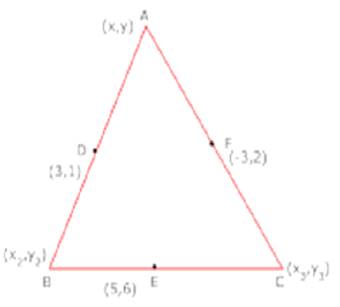
Let vertices of {tex} \triangle ABC{/tex} be A(x1, y1), B(x2, y2) and C(x3, y3)
By mid-points formula
{tex}\frac{{{x_2} + {x_3}}}{2} = 3 \Rightarrow {x_2} + {x_3} = 6{/tex} ...... (i)
{tex}\frac{{{y_2} + {y_3}}}{2} = 1 \Rightarrow {y_2} + {y_3} = 2{/tex} ...... (ii)
{tex}\frac{{{x_3} + {x_1}}}{2} = 5 \Rightarrow {x_3} + {x_1} = 10{/tex} ..... (iii)
{tex}\frac{{{y_3} + {y_1}}}{2} = 6 \Rightarrow {y_1} + {y_3} = 12{/tex} ..... (iv)
{tex}\frac{{{x_1} + {x_2}}}{2} = - 3 \Rightarrow {x_1} + {x_2} = - 6{/tex} ..... (v)
{tex}\frac{{{y_1} + {y_2}}}{2} = 2 \Rightarrow {y_1} + {y_2} = 4{/tex} ...... (vi)
Adding (i), (iii) and (v)
2(x1 + x2 + x3) = 10
{tex} \Rightarrow {/tex} x1 + x2 + x3 = 5 ...... (vii)
Adding (ii),(iv)and (vi)
2(y1 + y2 + y3) = 18
y1 + y2 + y3 = 9 ....... (viii)
Subtracting (i), (iii) and (v) from (vii)
We get, x1 = -1, x2 = -5, x3 = 11
Subtracting (ii), (iv) and (vi) from eq. (viii)
We get, y1 = 7, y2 = -3, y3 = 5
Posted by Jyoti Das 7 years, 3 months ago
- 1 answers
Ishu Ishu 7 years, 3 months ago
Posted by #Aditi~ Angel???? 7 years, 3 months ago
- 1 answers
Posted by Harsh Saini 7 years, 3 months ago
- 0 answers
Posted by Pratyush Pal 7 years, 3 months ago
- 0 answers
Posted by Satendar Gurjar 7 years, 3 months ago
- 1 answers
Posted by Anupriya Tyagi 7 years, 3 months ago
- 1 answers
Myra Hi 7 years, 3 months ago
Posted by #Aditi~ Angel???? 7 years, 3 months ago
- 0 answers
Posted by Kashish Parmar 7 years, 3 months ago
- 1 answers
Posted by Kamboj Kamboj 7 years, 3 months ago
- 1 answers
Anjali Pokhariya 7 years, 3 months ago
Posted by Veera Arun 7 years, 3 months ago
- 1 answers
Vedant Raizada 5 years, 10 months ago
Posted by Ravi Rawat 7 years, 3 months ago
- 1 answers
Azhad Jamal 7 years, 3 months ago
Posted by Manan Singh 7 years, 3 months ago
- 1 answers
Isha Pareek 7 years, 3 months ago
Posted by Swati Rajput 7 years, 3 months ago
- 1 answers
Posted by Kishan Upadhyay 6 years, 6 months ago
- 1 answers
Sia ? 6 years, 6 months ago
tan A = {tex}=\frac{1}{\cot A}{/tex}
{tex}\Rightarrow{/tex} tan2 A = {tex}\frac{1}{\cot ^{2} A}{/tex}
{tex}\Rightarrow{/tex} sec2 A - 1 = {tex}\frac{1}{\cot ^{2} A}{/tex}
{tex}\Rightarrow{/tex} sec2 A = {tex}\frac{1}{\cot ^{2} A}{/tex}+ 1
{tex}\Rightarrow{/tex} sec2 A = {tex}\frac{1+\cot ^{2} A}{\cot ^{2} A}{/tex}
{tex}\Rightarrow{/tex} sec A = {tex}\sqrt{\frac{1+\cot ^{2} A}{\cot ^{2} A}}{/tex}
{tex}\Rightarrow{/tex} {tex}\frac{1}{\cos A}=\sqrt{\frac{1+\cot ^{2} A}{\cot ^{2} A}}{/tex}
{tex}\Rightarrow{/tex} cos A = {tex}\sqrt{\frac{\cot ^{2} A}{1+\cot ^{2} A}}{/tex} {tex}=\frac{\cot A}{\sqrt{1+\cot ^{2} A}}{/tex}
{tex}\therefore{/tex} cos A = {tex}\frac{\cot A}{\sqrt{1+\cot ^{2} A}}{/tex}
Posted by Shamrin Shamrin 5 years, 8 months ago
- 0 answers
Posted by Deepak Kumar 7 years, 3 months ago
- 1 answers

myCBSEguide
Trusted by 1 Crore+ Students

Test Generator
Create papers online. It's FREE.

CUET Mock Tests
75,000+ questions to practice only on myCBSEguide app

Sia ? 6 years, 6 months ago
we have to find that non-zero value of k, for which the quadratic equation kx2 +1 - 2(k - l)x +x{tex}^2{/tex} = 0 has equal roots.
Given, {tex}k x ^ { 2 } + 1 - 2 ( k - 1 ) x + x ^ { 2 } = 0{/tex}
{tex}( k + 1 ) x ^ { 2 } - 2 ( k - 1 ) x + 1 = 0{/tex}
For equal roots {tex}D = b ^ { 2 } - 4 a c = 0{/tex}
Here, a= k + 1,b = -2 (k -1), c = 1
{tex}4 ( k - 1 ) ^ { 2 } - 4 ( k + 1 ) \times 1 = 0{/tex}
or, {tex}4 k ^ { 2 } - 8 k + 4 - 4 k - 4 = 0{/tex}
or, {tex}4 k ^ { 2 } - 12 k = 0{/tex}
or, {tex}4 k ( k - 3 ) = 0{/tex}
{tex}\therefore {/tex} k=3 [k=0 is rejected as it is coefficient of {tex}x^2{/tex}]
0Thank You