
Ask questions which are clear, concise and easy to understand.
Ask QuestionPosted by Lisa Bharti 7 years, 3 months ago
- 3 answers
Posted by Tahir Khan 7 years, 3 months ago
- 1 answers
Posted by Bharat Saini 7 years, 3 months ago
- 0 answers
Posted by Cv Kashyap 7 years, 3 months ago
- 0 answers
Posted by Shalini Pant 7 years, 3 months ago
- 1 answers
Rituraj Pandey 7 years, 3 months ago
Posted by Devraj Pandey 7 years, 3 months ago
- 0 answers
Posted by Gulshan Pratap Singh 6 years, 6 months ago
- 1 answers
Sia ? 6 years, 6 months ago
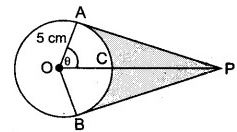
{tex}\cos \theta = \frac { 1 } { 2 } \text { or, } \theta = 60 ^ { \circ }{/tex}
Reflex {tex}\angle A O B = 240 ^ { \circ }{/tex}
{tex}\therefore A D B = \frac { 2 \times 3.14 \times 5 \times 240 } { 360 } = 20.93 \mathrm { cm }{/tex}
Hence length of elastic in contact = 20.93 cm
Now, {tex}A P = 5 \sqrt { 3 } \mathrm { cm }{/tex}
a ({tex}\triangle O A P{/tex}) = {tex}\;\frac12\times\mathrm{base}\times\mathrm{height}\;=\;\frac12\times5\times5\sqrt3\;=\frac{25\sqrt3}2{/tex}
Area {tex}( \Delta O A P + \Delta O B P )= 2\times\;\frac{25\sqrt3}2 = 25 \sqrt { 3 } = 43.25 \mathrm { cm } ^ { 2 }{/tex}
Area of sector OACB = {tex}\;\frac{\mathrm\theta}{360}\times\mathrm{πr}^2\;{/tex}
= {tex}\frac { 25 \times 3.14 \times 120 } { 360 } = 26.16 \mathrm { cm } ^ { 2 }{/tex}
Shaded Area = 43.25 - 26.16 = 17.09 cm2
Posted by Mahima Xess 7 years, 3 months ago
- 3 answers
Posted by Jashua Sam 7 years, 3 months ago
- 2 answers
Posted by Akash Rai 5 years, 8 months ago
- 5 answers
Vivek Kumar 7 years, 3 months ago
Posted by Vanshika Mishra 7 years, 3 months ago
- 1 answers
Mansi Gupta 7 years, 3 months ago
Posted by Yuvraj Singh 6 years, 6 months ago
- 1 answers
Sia ? 6 years, 6 months ago
{tex}2x + y = 2{/tex} ...(i)
{tex}2y - x = 4{/tex} ...(ii)
from (i), {tex}2x + y = 2 {/tex}
| 1 | 0 | 2 |
| 0 | 2 | -2 |
from (ii), {tex}2y - x = 4 {/tex}
<th scope="row">x</th> <th scope="row">y</th>| 0 | -4 | 2 |
| 2 | 0 | 3 |
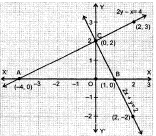
Area {tex}\triangle{/tex} = {tex}\frac{1}{2}{/tex}AB {tex}\times{/tex} CO
={tex}\frac{1}{2}{/tex} {tex}\times{/tex}5 {tex}\times{/tex} 2
=5 square units.
Posted by Gurdip Singh 7 years, 3 months ago
- 3 answers
Rameshwar Singh 7 years, 3 months ago
Posted by #Aditi~ Angel???? 7 years, 3 months ago
- 1 answers
Rakesh Kumar Tiwari 7 years, 3 months ago
Posted by Neha Sharma 7 years, 3 months ago
- 2 answers
Posted by Ayush Singh 6 years, 6 months ago
- 1 answers
Sia ? 6 years, 6 months ago
x = cosec A + cos A and y = cosec A - cos A
Thus, we have
x + y = cosec A + cos A + cosec A - cos A = 2 cosec A
x - y = cosec A + cos A - cosec A + cos A = 2 cos A
L.H.S = {tex}\left( \frac { 2 } { x + y } \right) ^ { 2 } + \left( \frac { x - y } { 2 } \right) ^ { 2 } - 1{/tex}
{tex}= \left( \frac { 2 } { 2 \cos e c A } \right) ^ { 2 } + \left( \frac { 2 \cos A } { 2 } \right) ^ { 2 } - 1{/tex}
{tex}= \left( \frac { 1 } { \text{cosec} A } \right) ^ { 2 } + ( \cos A ) ^ { 2 } - 1{/tex}
= (sin A)2 + (cos A)2 - 1
= sin2A + cos2A - 1
= 1 - 1
= 0
= R.H.S
Posted by Golu M 7 years, 3 months ago
- 1 answers
Posted by Rashid Iqbal 7 years, 3 months ago
- 3 answers
Posted by Aman Dwivedi 7 years, 3 months ago
- 1 answers
Om Zankat 7 years, 3 months ago
Posted by Reza Ali 7 years, 3 months ago
- 0 answers
Posted by Mukesh Verma 7 years, 3 months ago
- 0 answers
Posted by Anjali Pokhariya 6 years, 4 months ago
- 1 answers
Sia ? 6 years, 4 months ago
A(1, -2), B(2, 3), C(a, 2) and D(-4, -3)are the vertices of a parallelogram.
{tex}\Rightarrow{/tex}AB = CD and AD = BC
Consider AD = BC
{tex}\Rightarrow{/tex}AD2 = BC2
{tex}\Rightarrow{/tex}(-4 -1)2 + (-3 + 2)2 = (a - 2)2 + (2 - 3)2
{tex}\Rightarrow{/tex}(-5)2 = (a - 2)2
{tex}\Rightarrow{/tex} a - 2 = -5
{tex}\Rightarrow{/tex} a = -3
Area of {tex}\Delta A B C = \frac { 1 } { 2 } | 1 ( 3 - 2 ) + 2 ( 2 + 2 ) - 3 ( - 2 - 3 ) |{/tex}
{tex}= \frac { 1 } { 2 } | 1 + 8 + 15 |{/tex}
{tex}= \frac { 1 } { 2 } \times 24{/tex}
= 12 sq. units.
Diagonal of a parallelogram divides it into two equal triangles.
Area of parallelogram ABCD = 2 {tex}\times{/tex}12=24 sq. units
{tex}\Rightarrow {/tex} AB {tex}\times{/tex}Height = 24
{tex}\Rightarrow {/tex} AB{tex}\times{/tex}Height = 24
{tex}\Rightarrow \left[ \sqrt { ( 2 - 1 ) ^ { 2 } + ( 3 + 2 ) ^ { 2 } } \right] \times \text { Height } = 24{/tex}
{tex}\Rightarrow [ \sqrt { 1 + 25 } ] \times \text { Height } = 24{/tex}
{tex}\Rightarrow \text { Height } = \frac { 24 } { \sqrt { 26 } } = \frac { 12 \times \sqrt { 2 } \times \sqrt { 2 } } { \sqrt { 13 } \times \sqrt { 2 } }{/tex}
{tex}= \frac { 12 \sqrt { 2 } } { \sqrt { 13 } }{/tex}
Posted by Sandeep Jandely 7 years, 3 months ago
- 1 answers
Posted by Sajal Patel 6 years, 4 months ago
- 1 answers
Sia ? 6 years, 4 months ago
Steps of construction:
- Draw a circle with the help of a bangle.
- Take two non-parallel chords AB and CD of this circle.
- Draw the perpendicular bisectors of AB and CD. Let these intersect at O.
Then O is the centre of this circle drawn. - Take a point P outside the circle.
- Join PO and bisect it. Let M be the mid-point of PO.
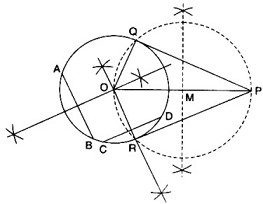
- Taking M as centre and MO as radius, draw a circle. Let it intersect the given circle at the points Q and R.
- Join PQ and PR.
Then, PQ and PR are the required two tangents.
Then {tex}\angle PQO{/tex} is an angle in the semicircle and therefore,
{tex}\angle PQO = 90^\circ {/tex}
{tex} \Rightarrow PQ \bot OQ{/tex}
Since OQ is a radius of the given circle, PQ has to be a tangent to the circle.
Similarly, PR is also a tangent to the circle.
Posted by Giriv Sharma 7 years, 3 months ago
- 0 answers
Posted by Goutham Dinesh 7 years, 3 months ago
- 3 answers
Posted by Harsh Naik 5 years, 8 months ago
- 3 answers

myCBSEguide
Trusted by 1 Crore+ Students

Test Generator
Create papers online. It's FREE.

CUET Mock Tests
75,000+ questions to practice only on myCBSEguide app

Yashoda Bhati 7 years, 3 months ago
1Thank You