
Ask questions which are clear, concise and easy to understand.
Ask QuestionPosted by Akarsh Jinesh Jain 7 years, 2 months ago
- 1 answers
Cystal Flame 7 years, 2 months ago
Posted by Akarsh Jinesh Jain 7 years, 2 months ago
- 0 answers
Posted by Hariom Upadhyay 7 years, 2 months ago
- 0 answers
Posted by Rashi Kamboj 7 years, 2 months ago
- 2 answers
Ankita Singh 7 years, 2 months ago
Posted by Mohit Chauhan 7 years, 2 months ago
- 2 answers
Yogita Ingle 7 years, 2 months ago
Empirical relation between mean, median and mode:
Mode = 3 median - 2 mean
Posted by Sahitha?? Sharma 6 years, 6 months ago
- 1 answers
Sia ? 6 years, 6 months ago
Since (-5) is a root of given quadratic equation 2x2 + px + 15 =0,then,
{tex}2 ( - 5 ) ^ { 2 } + p ( - 5 ) - 15 = 0{/tex}
{tex}50 - 5 p - 15 = 0{/tex}
{tex}5 p = 35 \Rightarrow p = 7{/tex}
Now {tex}p \left( x ^ { 2 } + x \right) + k = 0{/tex} has equal roots
{tex}p x ^ { 2 } + p x + k = 0{/tex}
So {tex}( b ) ^ { 2 } - 4 a c = 0{/tex}
{tex}( p ) ^ { 2 } - 4 p \times k = 0{/tex}
{tex}( 7 ) ^ { 2 } - 4 \times 7 \times k = 0{/tex}
28k = 49
{tex}k = \frac { 49 } { 28 } = \frac { 7 } { 4 }{/tex}
hence p = 7 and {tex}k = \frac { 7 } { 4 }{/tex}
Posted by Swastik M.R Khalote 7 years, 2 months ago
- 1 answers
Yogita Ingle 7 years, 2 months ago
6x2 - 7x - 3 = 0
6x2 - 9x + 2x - 3 = 0
3x (2x - 3) + 1 (2x - 3) = 0
(3x + 1) (2x - 3) = 0
3x + 1 = 0 or 2x - 3 = 0
3x = -1 or 2x = 3
x = -1/3 or x = 3/2
Posted by Divyanshi Singh 7 years, 2 months ago
- 4 answers
Divyanshi Singh 7 years, 1 month ago
Divyanshi Singh 7 years, 1 month ago
Posted by Manish Dhakad 7 years, 2 months ago
- 1 answers
Posted by Avinav Kumar 7 years, 2 months ago
- 1 answers
S Aniruddh 7 years, 2 months ago
Posted by Sumit Kumawat 7 years, 2 months ago
- 1 answers
Posted by Saurabh Singh Harariya 7 years, 2 months ago
- 4 answers
Kannu Kranti Yadav 7 years, 2 months ago
Pratik Khulge 7 years, 2 months ago
Harsh Naik 7 years, 2 months ago
Posted by Harshita Thakur 7 years, 2 months ago
- 0 answers
Posted by Abhishek H Patil Abhishek 7 years, 2 months ago
- 1 answers
Saurav Suman 7 years, 2 months ago
Posted by Abhay Kumar 7 years, 2 months ago
- 1 answers
Neetu Yadav 7 years, 2 months ago
Empirical Relationships between the three measure of central tendency
2 Mean = 3 Median -Mode
Posted by Pradeep Kumar 7 years, 2 months ago
- 1 answers
Mohammad Khan 7 years, 2 months ago
Posted by Varun Rawat 6 years, 6 months ago
- 1 answers
Sia ? 6 years, 6 months ago
L.H.S. = {tex}{(a - b)^2}{\cos ^2}\frac{c}{2} + {(a + b)^2}{\sin ^2}\frac{c}{2}{/tex}
{tex} = ({a^2} + {b^2} - 2ab){\cos ^2}\frac{c}{2}{/tex}{tex} + ({a^2} + {b^2} + 2ab){\sin ^2}\frac{c}{2}{/tex}
{tex} = {a^2}{\cos ^2}\frac{c}{2} + {b^2}{\cos ^2}\frac{c}{2} - 2ab\;{\cos ^2}\frac{c}{2}{/tex}{tex} + {a^2}{\sin ^2}\frac{c}{2} + {b^2}{\sin ^2}\frac{c}{2} + 2ab\;{\sin ^2}\frac{c}{2}{/tex}
{tex} = {a^2}\left( {{{\cos }^2}\frac{c}{2} + {{\sin }^2}\frac{c}{2}} \right){/tex}{tex} + {b^2}\left( {{{\cos }^2}\frac{c}{2} + {{\sin }^2}\frac{c}{2}} \right){/tex}{tex} = 2ab\left( {{{\cos }^2}\frac{c}{2} - {{\sin }^2}\frac{c}{2}} \right){/tex}
= a2 + b2 - 2 ab cosC
{tex} = {a^2} + {b^2} - 2ab\left( {\frac{{{a^2} + {b^2} - {c^2}}}{{2ab}}} \right){/tex}
= a2 + b2 - a2 - b2 + c2
=c2 R.H.S.
Posted by Sambit Pratap 6 years, 6 months ago
- 1 answers
Sia ? 6 years, 6 months ago
Let us assume that there is a positive integer n for {tex}\sqrt{n-1}+\sqrt{n+1}{/tex}which is rational and equal to {tex}\frac pq{/tex}, where p and q are positive integers and (q {tex}\neq{/tex} 0).
{tex}\sqrt { n - 1 } + \sqrt { n + 1 } = \frac { p } { q }{/tex}......(i)
or, {tex}\frac { q } { p } = \frac { 1 } { \sqrt { n - 1 } + \sqrt { n + 1 } }{/tex}
on multiplication of numerator and denominator by {tex}\sqrt{n-1}-\sqrt{n+1}{/tex} we get
{tex}= \frac { \sqrt { n - 1 } - \sqrt { n + 1 } } { ( \sqrt { n - 1 } + \sqrt { n + 1 } ) ( \sqrt { n - 1 } - \sqrt { n + 1 } ) }{/tex}
{tex}= \frac { \sqrt { n - 1 } - \sqrt { n + 1 } } { ( n - 1 ) - ( n + 1 ) } = \frac { \sqrt { n - 1 } - \sqrt { n + 1 } } { - 2 }{/tex}
or, {tex}\sqrt { n + 1 } - \sqrt { n - 1 } = \frac { 2 q } { p }{/tex} ........(ii)
On adding (i) and (ii), we get
{tex}2 \sqrt { n + 1 } = \frac { p } { q } + \frac { 2 q } { p } = \frac { p ^ { 2 } + 2 q ^ { 2 } } { p q }{/tex}
{tex}\sqrt{n+1}\;=\frac{p^2+2q^2}{2pq}{/tex}...............(iii)
From (i) and (ii),
{tex}\style{font-family:Arial}{\sqrt{n-1}\;=\frac{p^2-2q^2}{2pq}}{/tex}........(iv)
In RHS of (iii) and (iv) {tex}\frac{p^2+2q^2}{2pq}\;and\;\frac{\displaystyle p^2-2q^2}{\displaystyle2pq}\;are\;rational\;number\;because\;p\;and\;q\;are\;positive\;integers{/tex}
But it is possible only when (n + 1) and (n - 1) both are perfect squares.
Now n+1-(n-1)=n+1-n+1=2
Hence they differ by 2 and two perfect squares never differ by 2.
So both (n + 1) and (n -1 ) cannot be perfect squares.
Hence there is no positive integer n for which {tex}\style{font-family:Arial}{\sqrt{n-1\;}+\sqrt{n+1}}{/tex} is rational
Posted by Vishal Prakash 7 years, 2 months ago
- 0 answers
Posted by Sarang Solanki 7 years, 2 months ago
- 0 answers
Posted by Meena Kumari 7 years, 2 months ago
- 2 answers
Posted by Sarang Solanki 7 years, 2 months ago
- 0 answers
Posted by Reshu Saraswat 6 years, 6 months ago
- 1 answers
Sia ? 6 years, 6 months ago
Given: ABCD is a parallelogram whose diagonals are AC and BD.
To prove: AB2 + BC2 + CD2 + DA2 = AC2 + BD2
Construction: Draw AM {tex} \bot {/tex} DC and BN {tex} \bot {/tex} D(Produced)
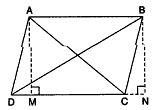
Proof: In right triangle AMD and BNC.
AD = BC ..............Opp.sides of a ||gm
AM = BN ............Both are altitudes of the same parallelogram to the same base
{tex}\therefore {/tex} {tex}\triangle {/tex} AMD {tex}\cong{/tex} {tex}\triangle {/tex} BNC ................RHS congruence criterion
{tex}\therefore {/tex} MD = NC .........(1).........CPCT
In right triangle BND,
{tex}\because {/tex} {tex}\angle{/tex} N=90°
{tex}\therefore {/tex} BD2 = BN2 + DN2 .............By Pythagoras theorem
= BN2 + (DC + CN)2
= BN2 + DC2 + CN2 + 2DC.CN
= (BN2 + CN2) + CN2 + 2DC.CN
= BC2 + DC2 + 2DC.CN ..........(2)
In right triangle BNC with {tex}\angle{/tex}N = 90o
BN2+CN2 = BC2 ......By Pythagoras theorem
In right triangle AMC
{tex}\because {/tex} {tex}\angle{/tex} M=90o
{tex}\therefore {/tex} AC2 = AM2 + MC2
= AM2 = (DC - DM)2
= AM2 + DC2 + DM2 - 2DC.DM
= (AM2 + DC2) + DC2 - 2DC.DM
= AD2 + DC2 - 2DC.DM
{tex}\because {/tex} In right triangle AMD with {tex}\angle{/tex} M=90°
AD2 = AM2 + DM2 ..........[By Pythagoras theorem]
= AD2 + AB2 - DC.CN .......From(1)
Adding (3) and (2) ,we get
AC2 + BD2 = (AD2 + AB) + (BC2 + DC) = AB2 + BC2 + BC2 + CD2 + DA2
Posted by Shikayna Panday 7 years, 2 months ago
- 6 answers

myCBSEguide
Trusted by 1 Crore+ Students

Test Generator
Create papers online. It's FREE.

CUET Mock Tests
75,000+ questions to practice only on myCBSEguide app

Sia ? 6 years, 6 months ago
P(man will speak the truth) = {tex}\frac {3 } { 8 }{/tex}
P(man will not speak the truth) = {tex}1 - \frac { 3 } { 8 } = \frac { 5 } { 8 }{/tex}
when a number other than 6 comes up the probability of man’s reporting it is a six is-
the probability of man not speaking the truth ={tex}\frac { 5 } { 8 }{/tex}
0Thank You