
Ask questions which are clear, concise and easy to understand.
Ask QuestionPosted by Sp Rp 7 years, 2 months ago
- 0 answers
Posted by Ambika Singh 7 years, 2 months ago
- 1 answers
Posted by Rahul Rathore 7 years, 2 months ago
- 0 answers
Posted by Manish Soni 7 years, 2 months ago
- 2 answers
Anuj Karan 7 years, 2 months ago
Posted by Sherlock Holmes 7 years, 2 months ago
- 2 answers
Posted by Ashish Choudhary 7 years, 2 months ago
- 2 answers
Posted by Rikku Mahto 7 years, 2 months ago
- 2 answers
Posted by Prince Sharma 6 years, 6 months ago
- 1 answers
Sia ? 6 years, 6 months ago
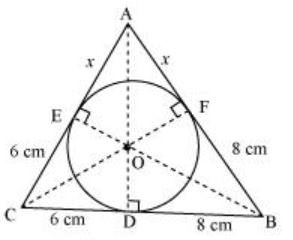
Let the sides BC, CA, AB of {tex}\triangle{/tex}ABC touch the incircle at D, E, F respectively.
Join the centre O of the circle with A, B, C, D, E, F
Since, tangents to a circle from an external point are equal
{tex}\therefore{/tex} CE = CD = 6 cm
BF = BD = 8 cm
AE = AF = x cm (say)
OE = OF = OD = 4 cm [Radii of the circle]
AB = (x + 8) cm and AC = (x + 6) cm and CB = 6 + 8 = 14 cm
Area of {tex}\triangle{/tex}OAB = {tex}\frac12{/tex}(8 + x) × 4 = (16 + 2x) cm2 ........(i)
area of {tex}\triangle{/tex}OBC = {tex}\frac12{/tex}×14 × 4 = 28 cm2 ............(ii)
area of {tex}\triangle{/tex}OCA = {tex}\frac12{/tex}(6 + x) × 4 = (12 + 2x) cm2 ...........(iii)
{tex}\therefore{/tex} area of {tex}\triangle{/tex}ABC = 16 + 2x + 12 + 2x + 28 = (4x + 56) cm2 ...........(iv)
Again, perimeter of {tex}\triangle{/tex}ABC = AC + AB + BC
= 6 + x + (8 + x) + (6 + 8)
= 28 + 2x = 2(14 + x) cm
S = {tex}\frac{2(14+x)}2{/tex} = 14 + x
Area of {tex}\triangle{/tex}ABC = {tex}\begin{array}{l}\sqrt{s(s-a)(s-b)(s-c)\;}\;\\\end{array}{/tex}
{tex}=\sqrt{(14+\;x)(14+\;x-14)(14+\;x-6-x)(14+\;x-8-x)\;}{/tex}
{tex}=\sqrt{(14\;+x)48x}{/tex}
{tex}\;\sqrt{672x+\;48x^2}{/tex}...........(v)
{tex}\therefore{/tex} (4x + 56) = {tex}\sqrt{672x+\;48x^2}{/tex}[By 4 and 5]
{tex}\Rightarrow{/tex} (4x + 56)2 = 672x + 48x2
{tex}\Rightarrow{/tex} 16(x + 14)2 = 16(42x +3x2)
{tex}\Rightarrow{/tex} (x + 14)2 = (42x +3x2)
{tex}\Rightarrow{/tex} x2 + 28x + 196 = 3x2 + 42x
(x + 14) (x -7) = 0
x = 7 , x = -14
But x = -14 is not possible
{tex}\therefore{/tex} x = 7
AB = x + 8 = 7 + 8 = 15 cm
and AC = x + 6 = 7 + 6 = 13 cm
Posted by Dev Poddar 7 years, 2 months ago
- 1 answers
Posted by Sunil Nagpal 7 years, 2 months ago
- 4 answers
Posted by Prince Gujjar 7 years, 2 months ago
- 1 answers
Posted by Nancy Rajput 7 years, 2 months ago
- 4 answers
Animesh Pawar 7 years, 2 months ago
Posted by Ritik Kumar Singh 7 years, 2 months ago
- 4 answers
Shalu Gupta 7 years, 2 months ago
Abhijeet Admane 7 years, 2 months ago
Posted by Prasanna Rout 6 years, 6 months ago
- 1 answers
Sia ? 6 years, 6 months ago
Let B(-4, 3) and C(4, 3) be the given two vertices of an equilateral triangle.
Let A(x, y) be the third vertex.
Then, we have
AB = BC = AC
Consider AB = BC
{tex}\Rightarrow {/tex} AB2 = BC2
{tex}\Rightarrow{/tex} (-4 - x)2 + (3 - y)2 = (4 + 4)2 + (3 - 3)2
{tex}\Rightarrow{/tex}16 + x2 + 8x + 9 + y2 - 6y = 64
{tex}\Rightarrow{/tex} x2 + y2 + 8x - 6y = 39 .....(i)
Consider AB = AC
{tex}\Rightarrow{/tex} AB2 = AC2
{tex}\Rightarrow{/tex} (-4 - x)2 + (3 - y)2 = (4 - x)2 + (3 - y)2
{tex}\Rightarrow{/tex} 16 + x2 + 8x = 16 + x2 - 8x
{tex}\Rightarrow{/tex} 16x = 0
{tex}\Rightarrow{/tex} x = 0
Consider BC = AC
{tex}\Rightarrow{/tex} BC2 = AC2
{tex}\Rightarrow{/tex} (4 + 4)2 + (3 - 3)2 = (4 - x)2 + (3 - y)2
{tex}\Rightarrow{/tex} 82 + 0 = (4 - 0)2 + (3 - y)2
{tex}\Rightarrow{/tex} 64 = 16 + (3 - y)2
(3 - y)2 = 48
3 - y = {tex}\pm 4 \sqrt { 3 }{/tex}
y = 3 {tex} \pm 4 \sqrt { 3 }{/tex}
Thus, the coordinates of third vertex when origin lies in the interior of a triangle = {tex}( 0,3 - 4 \sqrt { 3 } ){/tex}
Posted by Ojasvi Bhaiya 6 years, 6 months ago
- 1 answers
Sia ? 6 years, 6 months ago
Suppose x and y be two cars starting from points A and B respectively.
Let the speed of the car X be x km/hr and that of the car Y be y km/hr.
Case I: When two cars move in the same directions:
Suppose two cars meet at point Q, then,
Distance travelled by car X = {tex}AQ{/tex}
Distance travelled by car Y = {tex}BQ{/tex}
Distance travelled by car X in 8 hours = 8x km.
{tex}AQ = 8x{/tex}
Distance travelled by car Yin 8 hours = 8y km.
{tex}BQ = 8y{/tex}
Clearly {tex}AQ - BQ = AB{/tex}
{tex}8x - 8y = 80{/tex}
{tex}\Rightarrow {/tex} {tex}x - y = 10{/tex} ...(i)
Case II: When two cars move in opposite direction
Suppose two cars meet at point P, then,
Distance travelled by X car X = AP
Distance travelled by Y car Y = BP
we can write it as 1 hour = {tex}\frac{{20}}{{60}}{/tex}hours.
Therefore, Distance travelled by a car Y in {tex}\frac{4}{3}{/tex}hrs = {tex}\frac{4}{3}{/tex}x km.
AP + BP = AB
{tex}\frac{4}{3}x{/tex} km + {tex}\frac{4}{3} y{/tex} km = 80
{tex}\frac{4}{3}{/tex}{tex}(x + y) = 80{/tex}
{tex}( x + y ) = 80{/tex} × {tex}\frac{3}{4}{/tex}
{tex}x + y = 60{/tex} ...(ii)
By solving equations (i) and (ii), we get, {tex}x = 35.{/tex}
By substituting x = 35 in equation (ii), we get
{tex}x + y = 60{/tex}
{tex}35 + y = 60{/tex}
{tex}y = 60 - 35{/tex}
{tex}y = 25.{/tex}
Hence, speed of car X {tex}= 35\ km/hr.{/tex}
Speed of car Y ={tex} 25\ km/hr.{/tex}
Posted by Xyz Xyz 7 years, 2 months ago
- 3 answers
Posted by Hariom Patel 7 years, 2 months ago
- 1 answers
Sia ? 6 years, 6 months ago
Check NCERT solutions here : <a href="https://mycbseguide.com/ncert-solutions.html">https://mycbseguide.com/ncert-solutions.html</a>
Posted by Hariom Patel 7 years, 2 months ago
- 1 answers
Sia ? 6 years, 6 months ago
Check NCERT solutions here : <a href="https://mycbseguide.com/ncert-solutions.html">https://mycbseguide.com/ncert-solutions.html</a>
Posted by Sushil Kumar 7 years, 2 months ago
- 2 answers
Posted by Vishal Pratap 7 years, 2 months ago
- 2 answers
Anubhav Kumar Singh 7 years, 2 months ago
Yogita Ingle 7 years, 2 months ago
To find the largest number which divides 615 and 963 leaving remainder 6 in each case i.e. HCF.
Consider HCF be x.
In order to make 615 and 963 completely divisible by x, we need to deduct the remainder 6 from both the cases.
609 = 3 x 3 x 29
957= 3 x 11 x 29
⇒ x = 3 x 29 = 87
∴ largest number which divides 615 and 963 leaving remainder 6 in each case is 87.
Posted by Srihari Addala 6 years, 6 months ago
- 1 answers
Sia ? 6 years, 6 months ago
According to the question,
{tex}x^2 + y^2 = (asin\theta + bcos\theta)^2 + (acos\theta - bsin\theta)^2{/tex}
= {tex}a^2sin^2\theta+b^2cos^2\theta+2abcos\theta sin\theta+a^2cos^2\theta+b^2sin^\theta -2ab sin\theta cos\theta{/tex}
= a2(sin2{tex}\theta{/tex} + cos2{tex}\theta{/tex}) + b2(cos2{tex}\theta{/tex} + sin2{tex}\theta{/tex})
{tex}= a^2 + b^2{/tex} [{tex}\because{/tex} sin2{tex}\theta{/tex} + cos2{tex}\theta{/tex} = 1].
{tex}\therefore{/tex} {tex}x^2 + y^2 = a^2 + b^2.{/tex}
Posted by Aman Maheshwari 6 years, 6 months ago
- 1 answers
Sia ? 6 years, 6 months ago
We have, abx2 + (b2 -ac) x-bc = 0
{tex}\implies{/tex}abx2 + b2 x - acx - bc = 0
{tex}\implies{/tex}bx ( ax+b) - c (ax + b) = 0
{tex}\implies{/tex}(ax + b) (bx - c) = 0
Either ax+b = 0 or bx - c = 0
{tex}\implies x = -{b \over a},\, {c \over b}{/tex}
Hence, {tex}x = -{b \over a},\, {c \over b}{/tex} are the required solutions.
Posted by Srihari Addala 7 years, 2 months ago
- 0 answers
Posted by Aman Maheshwari 7 years, 2 months ago
- 2 answers
Yogita Ingle 7 years, 2 months ago
An = a + (n - 1)d
241 = 7 + (n - 1)6
241 - 7 = (n - 1)6
234 = (n - 1)6
234/6 = n - 1
39 = n - 1
n = 40
Now middle term =n/2=20
An = 7 + (20 - 1)6
= 7 + 19 × 6
=7 + 114
=121
Posted by Srihari Addala 7 years, 2 months ago
- 0 answers
Posted by Sagar Jogi 5 years, 8 months ago
- 6 answers
Sagar Jogi 7 years, 2 months ago
Mohd Shahid 7 years, 2 months ago
Sagar Jogi 7 years, 2 months ago
Yogita Ingle 7 years, 2 months ago
Yes x3 + x2 is a polynimail. It is not a quadratic equation because degree is 3.
Posted by Divanshu Rawat 7 years, 2 months ago
- 4 answers
Posted by Diwakar Binjola 7 years, 2 months ago
- 1 answers

myCBSEguide
Trusted by 1 Crore+ Students

Test Generator
Create papers online. It's FREE.

CUET Mock Tests
75,000+ questions to practice only on myCBSEguide app
