
Ask questions which are clear, concise and easy to understand.
Ask QuestionPosted by Rishi Singh 7 years, 2 months ago
- 0 answers
Posted by Gokulram Jeyaraman 7 years, 2 months ago
- 1 answers
Posted by Harsh Singh 6 years, 6 months ago
- 1 answers
Sia ? 6 years, 6 months ago
Let us suppose that AB be the tower and BC be flagpole
Let us suppose that O be the point of observation.Then, OA = 9 m
According to question it is given that
{tex}\angle A O B = 30 ^ { \circ } \text { and } \angle A O C = 60 ^ { \circ }{/tex}
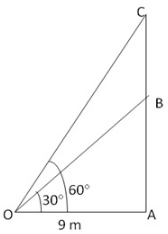
From right angled {tex}\triangle \mathrm { BOA }{/tex}
{tex}\frac { A B } { O A } = \tan 30 ^ { \circ }{/tex}
{tex}\Rightarrow \frac { A B } { 9 } = \frac { 1 } { \sqrt { 3 } } \Rightarrow A B = 3 \sqrt { 3 }{/tex}
From right angled {tex}\Delta O A C{/tex}
{tex}\frac { A C } { O A } = \tan 60 ^ { \circ }{/tex}
{tex}\frac { A C } { 9 } = \sqrt { 3 } \Rightarrow A C = 9 \sqrt { 3 } \mathrm { m }{/tex}
{tex}\therefore{/tex} BC = (AC - AB) {tex}= 6 \sqrt { 3 } \mathrm { m }{/tex}
Thus {tex}A B = 3 \sqrt { 3 } m = 5.196 m{/tex} and {tex}B C = 6 \sqrt { 3 } m = 10.392 m{/tex}
Hence, height of the tower is 5.196m and the height of the flagpole is 10.392 m
Posted by Rohan Kumar 7 years, 2 months ago
- 3 answers
Harsh Jain 7 years, 2 months ago
Yogita Ingle 7 years, 2 months ago
x2 - 2kx - 6 = 0
(3)2 - 2k(3) - 6 = 0
9 - 6k - 6 = 0
-6k - 3 = 0
- 6k = 3
k = 3/-6
k = -1/2
Posted by Manpreet Kaur 7 years, 2 months ago
- 1 answers
Posted by Harshitha Harshi 7 years, 2 months ago
- 2 answers
Ashmit Gupta 7 years, 2 months ago
Posted by Gangadhar Sahoo 6 years, 6 months ago
- 1 answers
Sia ? 6 years, 6 months ago
First find the HCF of 65 and 117 by Using Euclid's division algorithm,
117 = 65{tex}\times{/tex} 1 + 52
65 = 52{tex}\times{/tex} 1 + 13
52 = 13{tex}\times{/tex} 4 + 0
So, HCF of 117 and 65 = 13
HCF = {tex}65m + 117n{/tex}
For, {tex}m= 2{/tex} and {tex}n = -1{/tex},
HCF = 65{tex}\times{/tex} 2 + 117{tex}\times{/tex} (-1)
= 130 - 117
= 13
Hence, the integral values of m and n are 2 and -1 respectively and the HCF of 117 and 65 is 13.
Posted by Aslam Khan 7 years, 2 months ago
- 1 answers
Aslam Khan 7 years, 2 months ago
Posted by Aryan Raj 7 years, 2 months ago
- 4 answers
Posted by Suraj Chettri 7 years, 2 months ago
- 3 answers
Aslam Khan 7 years, 2 months ago
Pallavi Balotiya 7 years, 2 months ago
Posted by Gaurav Sharma 7 years, 2 months ago
- 2 answers
Posted by Aman Chaubey 7 years, 2 months ago
- 1 answers
Posted by Aayushi Gupta 7 years, 2 months ago
- 2 answers
Vishal Singh 7 years, 2 months ago
Posted by Aatif Hassan 6 years, 6 months ago
- 1 answers
Sia ? 6 years, 6 months ago
{tex}5x + 2y = 2k{/tex}
{tex}2(k + 1)x + ky = (3k + 4){/tex}
These are of the form
{tex}a_1x + b_1y + c_1 = 0 , a_2x + b_2y + c_2 = 0{/tex}
where,
{tex}a_1= 5 ,b_1= 2, c_1 = -2k,{/tex}
{tex}a_2= 2(k +1) ,b_2= k ,c_2 = -(3k + 4){/tex}
For infinitely many solutions, we must have
{tex}\frac { a _ { 1 } } { a _ { 2 } } = \frac { b _ { 1 } } { b _ { 2 } } = \frac { c _ { 1 } } { c _ { 2 } }{/tex}
This holds only when
{tex}\frac { 5 } { 2 ( k + 1 ) } = \frac { 2 } { k } = \frac { - 2 k } { - ( 3 k + 4 ) }{/tex}
{tex}\Rightarrow \frac { 5 } { 2 ( k + 1 ) } = \frac { 2 } { k } = \frac { 2 k } { ( 3 k + 4 ) }{/tex}
Now, the following cases arises:
Case 1:
{tex}\frac { 5 } { 2 ( k + 1 ) } = \frac { 2 } { k }{/tex}[Taking I and II]
{tex}\Rightarrow 5 k = 4 ( k + 1 ) \Rightarrow 5 k = 4 k + 4{/tex}
k = 4
Case 2:
{tex}\frac { 2 } { k } = \frac { 2 k } { ( 3 k + 4 ) }{/tex}[Taking II and III]
{tex}\Rightarrow{/tex}2(3k + 4) = 2k2 {tex}\Rightarrow{/tex}6k + 8 = 2k2
{tex}\Rightarrow{/tex} {tex}2k^2 - 6k + 8 = 0{/tex}
{tex}\Rightarrow{/tex} {tex}2(k^2 - 3k + 4)= 0{/tex}
{tex}\Rightarrow{/tex}{tex}k^2 - 3k - 4 = 0{/tex}
{tex}\Rightarrow{/tex}{tex}k^2 - 4k + k - 4 = 0{/tex}
{tex}\Rightarrow{/tex}k(k - 4) + 1(k - 4) = 0
{tex}\Rightarrow{/tex}(k - 4)(k + 1) = 0
(k - 4) = 0 or k + 1 = 0
{tex}\Rightarrow{/tex} k = 4 or k = -1
Case 3:
{tex}\frac { 5 } { 2 ( k + 1 ) } = \frac { 2 k } { ( 3 k + 4 ) }{/tex}[Taking I and II]
{tex}\Rightarrow 15 k + 20 = 4 k ^ { 2 } = 4 k{/tex}
{tex}\Rightarrow{/tex}4k2 + 4k - 15k - 20 = 0
{tex}\Rightarrow{/tex} 4k2 - 11k - 20 = 0
{tex}\Rightarrow{/tex}4k2 - 16k + 5k - 20 =0
{tex}\Rightarrow{/tex}4k(k - 4) + 5(k - 4) = 0
{tex}\Rightarrow{/tex}(k - 4)(4k + 5) = 0
{tex}\Rightarrow k = 4 \text { or } k = \frac { - 5 } { 4 }{/tex}
Thus, k = 4, is the common value of which there are infinitely many solutions.
Posted by S. Meena 7 years, 2 months ago
- 1 answers
Posted by Dheeraj Saini 6 years, 6 months ago
- 1 answers
Sia ? 6 years, 6 months ago
We have to prove that,{tex}\frac{{\sin \theta - \cos \theta + 1}}{{\sin \theta + \cos \theta - 1}} = \frac{1}{{\sec \theta - \tan \theta }}{/tex} using identity {tex}sec^2\theta=1+tan^2\theta{/tex}
LHS = {tex}\frac{{\sin \theta - \cos \theta + 1}}{{\sin \theta + \cos \theta - 1}} {/tex}{tex} = \frac{{\tan \theta - 1 + \sec \theta }}{{\tan \theta + 1 - \sec \theta }}{/tex} [ dividing the numerator and denominator by {tex}\cos{\theta}{/tex}.]
{tex} = \frac{{(\tan \theta + \sec \theta)-1 }}{{(\tan \theta - \sec \theta )+1}}{/tex}{tex}=\frac{\{{(\tan\theta+\sec\theta)-1\}}(tan\theta-\sec\theta)}{\{{(\tan\theta-\sec\theta)+1\}}(\tan\theta-\sec\theta)}{/tex} [ Multiplying and dividing by {tex}(\tan{\theta}-\sec{\theta}){/tex}]
{tex}=\frac{{(\tan^2\theta-\sec^2\theta)-}(tan\theta-\sec\theta)}{\{{(\tan\theta-\sec\theta)+1\}}(\tan\theta-\sec\theta)}{/tex} [{tex}\because (a-b)(a+b)=a^2-b^2{/tex}]
{tex} = \frac{{-1-\tan \theta + \sec \theta }}{{(\tan \theta - \sec \theta+1)(\tan{\theta}-\sec{\theta}) }}{/tex}[{tex}\because \tan^2\theta-\sec^2\theta=-1{/tex}]
{tex}=\frac{-(\tan\theta-\sec\theta+1)}{(\tan\theta-\sec\theta+1)(\tan\theta-\sec\theta)}{/tex}{tex}=\frac{-1}{\tan{\theta}-\sec{\theta}}{/tex}
{tex} = \frac{1}{{\sec \theta - \tan \theta }}{/tex}=RHS
Hence Proved.
Posted by Meenu Gupta 7 years, 2 months ago
- 0 answers
Posted by Chandan Kumar 7 years, 2 months ago
- 1 answers
Posted by Pratik Raj 7 years, 2 months ago
- 4 answers
Posted by Suraj Bishoy 7 years, 2 months ago
- 3 answers
Posted by Aslam Khan 7 years, 2 months ago
- 5 answers
Posted by Aman Tyagi 7 years, 2 months ago
- 1 answers

myCBSEguide
Trusted by 1 Crore+ Students

Test Generator
Create papers online. It's FREE.

CUET Mock Tests
75,000+ questions to practice only on myCBSEguide app
