
Ask questions which are clear, concise and easy to understand.
Ask QuestionPosted by Rishi Raj 6 years, 6 months ago
- 1 answers
Sia ? 6 years, 6 months ago
We have,
{tex}\frac{1}{{(x - 1)(x - 2)}} + \frac{1}{{(x - 2)(x - 3)}}{/tex} {tex}+ \frac{1}{{(x - 3)(x - 4)}} = \frac{1}{6}{/tex}
{tex}\Rightarrow{/tex}{tex} (x - 3)(x - 4) + (x - 1)(x - 4) + (x - 1)(x - 2) = {/tex}{tex}\frac{1}{6}{/tex}{tex}(x - 1)(x - 2)(x - 3)(x - 4){/tex}
[{tex}\because{/tex} Multiplying both sides by (x -1)(x - 2)(x - 3)(x - 4)]
{tex}\Rightarrow{/tex} {tex}x^2 - 4x - 3x + 12 + x^2 - 4x - x + 4 + x^2 - 2x - x + 2 ={/tex} {tex}\frac{1}{6}{/tex}{tex}[(x - 1)(x - 2)(x - 3)(x - 4)]{/tex}
{tex}\Rightarrow{/tex} {tex}3x^2 - 15x + 18 ={/tex} {tex}\frac{1}{6}{/tex}{tex}(x - 1)(x - 2)(x - 3)(x - 4){/tex}
{tex}\Rightarrow{/tex} {tex}3(x^2 - 5x + 6) ={/tex} {tex}\frac{1}{6}{/tex}{tex}(x - 1)(x - 2)(x - 3)(x - 4){/tex}
{tex}\Rightarrow{/tex} {tex}18[x^2 - 3x - 2x + 6] = (x - 1)(x - 2)(x - 3)(x - 4){/tex}
{tex}\Rightarrow{/tex} {tex}18[x(x - 3) - 2(x - 3)] = (x - 1)(x - 2)(x - 3)(x - 4){/tex}
{tex}\Rightarrow{/tex} {tex}18(x - 3)(x - 2) = (x - 1)(x - 2)(x - 3)(x - 4){/tex}
{tex}\Rightarrow{/tex} 18 = (x - 1)(x - 4)
{tex}\Rightarrow{/tex} 18 = x2 - 4x - 1x + 4
{tex}\Rightarrow{/tex} x2 - 5x + 4 - 18 = 0
{tex}\Rightarrow{/tex} x2 - 5x - 14 = 0
In order to factorize x2 - 5x - 14, we have to find two numbers 'a' and 'b' such that.
a + b = - 5 and ab = -14
Clearly, -7 + 2 = -5 and (-7)(2) = -14
{tex}\therefore{/tex} a = -7 and b = 2
Now,
x2 - 5x - 14 = 0
{tex}\Rightarrow{/tex} x2 - 7x + 2x - 14 = 0
{tex}\Rightarrow{/tex} x(x - 7) + 2(x - 7) = 0
{tex}\Rightarrow{/tex} (x - 7)(x + 2) = 0
{tex}\Rightarrow{/tex} x - 7 = 0 or x + 2 = 0
{tex}\Rightarrow{/tex} x = 7 or x = -2
Posted by Ishesh Kumar 6 years, 6 months ago
- 1 answers
Sia ? 6 years, 6 months ago
Graph of {tex}4x - 5y + 16 = 0{/tex}
{tex}4x - 5y + 16 = 0{/tex} {tex}\Rightarrow{/tex} {tex}5y = 4x + 16{/tex}
{tex}\Rightarrow \quad y = \frac { ( 4 x + 16 ) } { 5 }{/tex}.......(i)
Table for {tex}4x - 5y +16 = 0.{/tex}
| x | -4 | 1 | 6 |
| y | 0 | 4 | 8 |
Now, plot the points A (-4, 0), B(1, 4) and C(6, 8) on the graph paper.
Join AB and BC to get the graph line ABC. Extend it on both ways.
Thus, the line ABC is the graph of 4x - 5y +16 = 0.
Graph of {tex}2x + y - 6 =0{/tex}
{tex}2x + y - 6 = 0{/tex} {tex}\Rightarrow{/tex} {tex}y = (6 - 2x){/tex}. ... (ii)
Table for {tex}2x + y - 6 = 0.{/tex}
| x | 0 | 2 | 3 |
| y | 6 | 2 | 0 |
On the same graph paper as above, plot the points P(0,6), Q(2,2) and R(3,0).
Join PQ and QR to get the graph line PQR. Extend it on both ways.
Thus, the line PQR is the graph of 2x + y - 6 = 0.
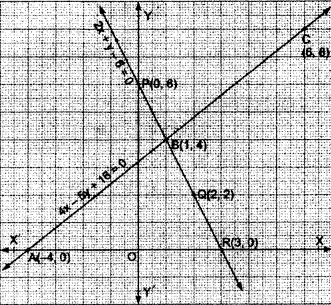
The two graph lines ABC and PQR intersect at the point B(1,4). x = 1 and y = 4 is the solution of the given system of equations.
These lines form {tex}\triangle{/tex}BAR with the x-axis, whose vertices are B(l, 4), A (-4, 0) and R(3, 0).
The two graph lines ABC and PQR intersect at the point B(1, 4).
{tex}\therefore{/tex} x = 1 and y = 4 is the solution of the given system of equations.
These lines form {tex}\triangle{/tex}BAR with the x-axis, whose vertices are B(1, 4), A (-4, 0) and R(3, 0).
Posted by Aakanksha Goyal 7 years, 2 months ago
- 0 answers
Posted by Vaibhav Bhardwaj 6 years, 4 months ago
- 1 answers
Sia ? 6 years, 4 months ago
LHS {tex}=\frac{\tan A}{\left(1+\tan ^{2} A\right)^{2}}+\frac{\cot A}{\left(1+\cot ^{2} A\right)^{2}}{/tex}
{tex}=\frac{\tan A}{\left(\sec ^{2} A\right)^{2}}+\frac{\cot A}{\left(\ cosec ^{2} A\right)^{2}}{/tex}
{tex}=\frac{\sin A}{\cos A}{/tex} . cos4 A {tex}+\frac{\cos A}{\sin A}{/tex} . sin4 A
= sin A cos3 A + cos A sin3 A
= cos A sin A (cos2 A + sin2 A)
= sin A cos A = RHS
Posted by Vaibhav Bhardwaj 6 years, 6 months ago
- 1 answers
Sia ? 6 years, 6 months ago
Join OP, Suppose OP meets the circle at Q. Join AQ.
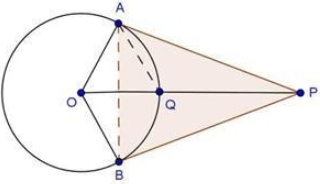
We have,
OP = diameter
{tex} \Rightarrow{/tex} OQ + PQ = diameter
{tex} \Rightarrow{/tex} PQ = diameter - radius
{tex} \Rightarrow{/tex} PQ = radius.
Therefore, OQ = PQ = radius.
Thus, OP is the hypotenuse of right triangle OAP and Q is the mid-point of OP.
Now,
In {tex} \triangle{/tex}OPA,
{tex} \sin \angle OPA = \frac{{OA}}{{OP}} = \frac{r}{{2r}}{/tex} [Give OP is the diameter of the circle]
{tex} \Rightarrow \sin \angle OPA = \frac{1}{2} = \sin 30^\circ{/tex}
{tex} \Rightarrow \angle OPA = 30^\circ{/tex}
Similarly, it can be proved that {tex} \angle OPB = 30^\circ {/tex}.
Now, {tex} \angle APB = \angle OPA + \angle OPB{/tex} {tex}= 30^\circ + 30^\circ = 60^\circ{/tex}
In {tex} \triangle{/tex}PAB,
PA = PB [Lengths of tangents drawn from an external point to a circle are equal]
{tex}\Rightarrow \angle PAB = \angle PBA{/tex} ....(i) [Equal sides have equal angles opposite to them]
{tex} \angle PAB + \angle PBA + \angle APB = 180^\circ {/tex} [Angle sum property]
{tex}\Rightarrow \angle PAB + \angle PAB = 180^\circ - 60^\circ = 120^\circ {/tex} [Using (i)]
{tex} \Rightarrow 2\angle PAB = 120^\circ{/tex}
{tex} \Rightarrow \angle PAB = 60^\circ{/tex} ....(ii)
From (i) and (ii)
{tex} \angle PAB = \angle PBA = \angle APB = 60^\circ {/tex}
{tex}{/tex} Therefore, {tex} \triangle{/tex}PAB is an equilateral triangle.
Posted by Piyush Garg 7 years, 2 months ago
- 5 answers
Posted by Kishan Singh 6 years, 6 months ago
- 1 answers
Sia ? 6 years, 6 months ago
We have to prove that,{tex}\frac{{\sin \theta - \cos \theta + 1}}{{\sin \theta + \cos \theta - 1}} = \frac{1}{{\sec \theta - \tan \theta }}{/tex} using identity {tex}sec^2\theta=1+tan^2\theta{/tex}
LHS = {tex}\frac{{\sin \theta - \cos \theta + 1}}{{\sin \theta + \cos \theta - 1}} {/tex}{tex} = \frac{{\tan \theta - 1 + \sec \theta }}{{\tan \theta + 1 - \sec \theta }}{/tex} [ dividing the numerator and denominator by {tex}\cos{\theta}{/tex}.]
{tex} = \frac{{(\tan \theta + \sec \theta)-1 }}{{(\tan \theta - \sec \theta )+1}}{/tex}{tex}=\frac{\{{(\tan\theta+\sec\theta)-1\}}(tan\theta-\sec\theta)}{\{{(\tan\theta-\sec\theta)+1\}}(\tan\theta-\sec\theta)}{/tex} [ Multiplying and dividing by {tex}(\tan{\theta}-\sec{\theta}){/tex}]
{tex}=\frac{{(\tan^2\theta-\sec^2\theta)-}(tan\theta-\sec\theta)}{\{{(\tan\theta-\sec\theta)+1\}}(\tan\theta-\sec\theta)}{/tex} [{tex}\because (a-b)(a+b)=a^2-b^2{/tex}]
{tex} = \frac{{-1-\tan \theta + \sec \theta }}{{(\tan \theta - \sec \theta+1)(\tan{\theta}-\sec{\theta}) }}{/tex}[{tex}\because \tan^2\theta-\sec^2\theta=-1{/tex}]
{tex}=\frac{-(\tan\theta-\sec\theta+1)}{(\tan\theta-\sec\theta+1)(\tan\theta-\sec\theta)}{/tex}{tex}=\frac{-1}{\tan{\theta}-\sec{\theta}}{/tex}
{tex} = \frac{1}{{\sec \theta - \tan \theta }}{/tex}=RHS
Hence Proved.
Posted by Saurabh Bisht 7 years, 2 months ago
- 1 answers
Shobhit Jaryal 7 years, 2 months ago
Posted by Vishal Verma 6 years, 6 months ago
- 1 answers
Sia ? 6 years, 6 months ago
Let the radius of the base and the height of the solid cylinder be r m and h m respectively.
Then r + h = 37 . . . (1) . . .[Given]
Total surface area of the solid cylinder = 1628 m2
⇒ 2{tex}\pi{/tex}r(h + r) = 1628
⇒ 2{tex}\pi{/tex}r(37) = 1628 . . . [Using (1)]
⇒ 2 × {tex}22\over7{/tex} × r × 37 = 1628
⇒ r = {tex}{{1628}\times7}\over2\times22\times37{/tex}
⇒ r = 7 m
Putting the value of r in (1), we get
7 + h = 37
⇒ h = 37 – 7 = 30 m
∴ Circumference of the base of the solid cylinder = 2{tex}\pi{/tex}r
= 2 ×{tex}22\over7{/tex}× 7 = 44 m
and volume of the cylinder = {tex}\pi{/tex}r2h
={tex}22\over7{/tex}× (7)2 × 30 = 4620 m3
Posted by Ritik Thakur 7 years, 2 months ago
- 1 answers
Posted by Rachit Dwivedi 7 years, 2 months ago
- 2 answers
Rachit Dwivedi 7 years, 2 months ago
Rajpara Jay Prakashbhai 5 years, 8 months ago
Posted by Harsh Matheria 7 years, 2 months ago
- 1 answers
Posted by Aakanksha Dhumal 7 years, 2 months ago
- 1 answers
Kannu Kranti Yadav 7 years, 2 months ago
Posted by Gaurav Dwivedi 5 years, 8 months ago
- 1 answers
Posted by Adu Choudhry 7 years, 2 months ago
- 0 answers
Posted by Abhishek Mishra 7 years, 2 months ago
- 1 answers
Posted by Harshitha Harshi 7 years, 2 months ago
- 1 answers
Posted by Abhinav Singh Rana 7 years, 2 months ago
- 1 answers
Posted by Punit Khandelwal 7 years, 2 months ago
- 3 answers
Shagun Chaudhary 7 years, 2 months ago
Amit Gupta 7 years, 2 months ago
Posted by Vikash Kumar 7 years, 2 months ago
- 2 answers
Posted by Puttaraj Javalagi 7 years, 2 months ago
- 2 answers
Posted by Pawan Dwivedi 7 years, 2 months ago
- 4 answers
Posted by Raju Nigam 7 years, 2 months ago
- 1 answers
Posted by Genius ???? 5 years, 8 months ago
- 3 answers
Posted by Harshitha Harshi 7 years, 2 months ago
- 2 answers
Kannu Kranti Yadav 7 years, 2 months ago
Posted by Nikhita Kalita 7 years, 2 months ago
- 2 answers

myCBSEguide
Trusted by 1 Crore+ Students

Test Generator
Create papers online. It's FREE.

CUET Mock Tests
75,000+ questions to practice only on myCBSEguide app

Ansh Yadav 7 years, 2 months ago
0Thank You