
Ask questions which are clear, concise and easy to understand.
Ask QuestionPosted by Jaskaran Sandhu 7 years, 2 months ago
- 2 answers
Posted by Nagarajan Ap 6 years, 4 months ago
- 1 answers
Sia ? 6 years, 4 months ago
By the given condition of question
{tex}\sec \theta = x + \frac { 1 } { 4 x }{/tex}
{tex}\therefore \quad \tan ^ { 2 } \theta = \sec ^ { 2 } \theta - 1{/tex}
{tex}\Rightarrow \quad \tan ^ { 2 } \theta = \left( x + \frac { 1 } { 4 x } \right) ^ { 2 } - 1 = x ^ { 2 } + \frac { 1 } { 16 x ^ { 2 } } + \frac { 1 } { 2 } - 1 = x ^ { 2 } + \frac { 1 } { 16 x ^ { 2 } } - \frac { 1 } { 2 } = \left( x - \frac { 1 } { 4 x } \right) ^ { 2 }{/tex}
{tex}\Rightarrow \quad \tan \theta = \pm \left( x - \frac { 1 } { 4 x } \right){/tex}
{tex}\Rightarrow \quad \tan \theta = \left( x - \frac { 1 } { 4 x } \right) \text { or, } \tan \theta = - \left( x - \frac { 1 } { 4 x } \right){/tex}
CASE 1: When {tex}\tan \theta = - \left( x - \frac { 1 } { 4 x } \right) :{/tex} In this case,
{tex}\sec \theta + \tan \theta = x + \frac { 1 } { 4 x } + x - \frac { 1 } { 4 x } = 2 x{/tex}
CASE 2: When {tex}\theta = - \left( x - \frac { 1 } { 4 x } \right) :{/tex} In this case,
{tex}\sec \theta + \tan \theta = \left( x + \frac { 1 } { 4 x } \right) - \left( x - \frac { 1 } { 4 x } \right) = \frac { 2 } { 4 x } = \frac { 1 } { 2 x }{/tex}
Hence, {tex}\sec \theta + \tan \theta = 2 x \text { or } , \frac { 1 } { 2 x }{/tex}
Posted by Nidhi Kaushik 7 years, 2 months ago
- 2 answers
Amit Gupta 7 years, 2 months ago
Posted by Nidhi Kaushik 7 years, 2 months ago
- 3 answers
Posted by Anushka Khandelwal 7 years, 2 months ago
- 1 answers
Posted by Shoheb Khan 7 years, 2 months ago
- 0 answers
Posted by Subham Mishra 7 years, 2 months ago
- 1 answers
Posted by Shashank Jain 7 years, 2 months ago
- 6 answers
Posted by Vanshika Gupta 7 years, 2 months ago
- 1 answers
Posted by Dipanshu Kumar 7 years, 2 months ago
- 1 answers
Posted by Ananya Sharma 7 years, 2 months ago
- 1 answers
Vanshika Gupta 7 years, 2 months ago
Posted by Aman Bajpai 7 years, 2 months ago
- 0 answers
Posted by Vishal Kaushik 7 years, 2 months ago
- 1 answers
Posted by Vaishnavi Sappa 7 years, 2 months ago
- 1 answers
Vanshika Gupta 7 years, 2 months ago
Posted by Mahendra Velicheti 7 years, 2 months ago
- 1 answers
Posted by Jeevika Bhat 7 years, 2 months ago
- 1 answers
Sahil Tushir 7 years, 2 months ago
Posted by Shubham Jangra 7 years, 2 months ago
- 1 answers
Posted by Ishika Goyal 5 years, 8 months ago
- 5 answers
Posted by Deepak Kadian 7 years, 2 months ago
- 0 answers
Posted by Ankush Choudhary 6 years, 6 months ago
- 1 answers
Sia ? 6 years, 6 months ago
Let the window be at P at a height of 15 metres above the ground and CD be the house on the opposite side of the street such that the angles of deviation of the top D of house CD as seen from P is of 30o and the angle of depression of the foot C of house CD as seen from P is of 45o.
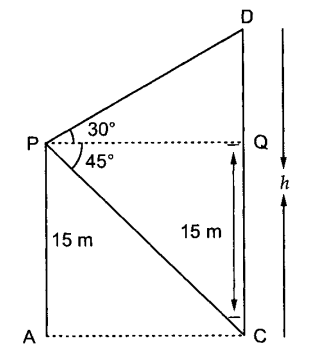
Let h metres be the height of the house CD.
We have
QD = CD- CQ = CD -A P = ( h - 15) metres.
In {tex}\triangle P Q C,{/tex} we have
tan 45o = {tex}\frac { Q C } { P Q } \Rightarrow 1 = \frac { 15 } { P Q } \Rightarrow P Q = 15{/tex} metres.
In {tex}\triangle P Q C,{/tex} we have
{tex}\tan 30 ^ { \circ } = \frac { Q D } { P Q }{/tex}
{tex}\Rightarrow \quad \frac { 1 } { \sqrt { 3 } } = \frac { h - 15 } { 15 } \Rightarrow h - 15 = \frac { 15 } { \sqrt { 3 } } \Rightarrow h - 15 = 5 \sqrt { 3 }{/tex}
{tex}\Rightarrow \quad h = 15 + 5 \times 1.732 = 23.66{/tex}metres.
Hence, the height of the opposite house is 23.66 metres.
Posted by Munazir Hussain Siddiqui 7 years, 2 months ago
- 1 answers
Neeraj Kumar 7 years, 2 months ago
Cos67-Sin23
As we know that Cos(90-A)=SinA
Cos67-Sin23=
Cos67-Cos(90-23)=
Cos67-Cos67=0
Posted by Kushagra Rajawat 7 years, 2 months ago
- 0 answers
Posted by Abhijeet Sharma 7 years, 2 months ago
- 0 answers
Posted by Pankaj Naik 6 years, 4 months ago
- 1 answers
Sia ? 6 years, 4 months ago
Let A → (0, -1), B → (2, 1) and C→ (0, 3) be the vertices of the triangle ABC. Let D, E and F be the mid-points of sides BC, CA and AB respectively. Then,
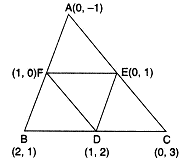
{tex}D \to \left( {\frac{{2 + 0}}{2},\frac{{1 + 3}}{2}} \right){/tex}
{tex} \Rightarrow D \to \left( {1,2} \right){/tex}
{tex}E \to \left\{ {\frac{{0 + 0}}{2},\frac{{3 + ( - 1)}}{2}} \right\}{/tex}
{tex}\Rightarrow E \to (0,1){/tex}
{tex}F \to \left\{ {\frac{{2 + 0}}{2},\frac{{1 + ( - 1)}}{2}} \right\}{/tex}
{tex}\Rightarrow F \to (1,0){/tex}
{tex}\therefore{/tex} Area of the triangle DEF
{tex}= \frac{1}{2}{/tex}[1(1 - 0) + 0(0 - 2) + 1(2 - 1)]
{tex}= \frac{1}{2}{/tex}[1 + 0 + 1]
= 1 square unit.
Again, area of the triangle ABC
{tex}= \frac{1}{2}{/tex}[0(1 - 3) + 2 {3 - (-1)} + 0(-1 -1)]
= 4 square units
{tex}\therefore{/tex} Ratio of the area of the triangle formed to the area of the given triangle = 1 : 4
Posted by Pankaj Naik 7 years, 2 months ago
- 1 answers
Amit Gupta 7 years, 2 months ago
Posted by Pankaj Naik 6 years, 4 months ago
- 1 answers
Sia ? 6 years, 4 months ago
Let (-1, 6) divides line segment joining the points (-3, 10) and(6, -8) in k:1.
Using Section formula, we get
{tex} - 1 = \frac{{( - 3) \times 1 + 6 \times k}}{{k + 1}}{/tex} {tex}4 \Rightarrow - k - 1 = ( - 3 + 6k){/tex}
⇒ −7k = −2 ⇒ k= {tex}\frac{2}{7}{/tex}
Therefore, the ratio is {tex}\frac{2}{7}:1{/tex} which is equivalent to 2:7.
Therefore, (-1, 6) divides line segment joining the points (-3, 10) and (6, -8) in 2:7.

myCBSEguide
Trusted by 1 Crore+ Students

Test Generator
Create papers online. It's FREE.

CUET Mock Tests
75,000+ questions to practice only on myCBSEguide app

Akash Modanwal 7 years, 2 months ago
0Thank You