
Ask questions which are clear, concise and easy to understand.
Ask QuestionPosted by Pankaj Kumar 7 years, 2 months ago
- 2 answers
Posted by Ankit Kumar 6 years, 6 months ago
- 1 answers
Sia ? 6 years, 6 months ago
We have,
6x = sec {tex}\theta{/tex}........(i)
and {tex}\frac { 6 } { x } = \tan \theta{/tex} ........(ii)
Adding (i) and (ii), we get
{tex}6 \left( x + \frac { 1 } { x } \right) = ( \sec \theta + \tan \theta ){/tex}.......(iii)
Subtracting (ii) from (i), we get
{tex}6 \left( x - \frac { 1 } { x } \right) = ( \sec \theta - \tan \theta ){/tex}........(iv)
Multiplying the corresponding sides of (iii) and (iv), we get
{tex}36 \left( x ^ { 2 } - \frac { 1 } { x ^ { 2 } } \right) = \left( \sec ^ { 2 } \theta - \tan ^ { 2 } \theta \right) = 1{/tex}
{tex}\Rightarrow 9 \left( x ^ { 2 } - \frac { 1 } { x ^ { 2 } } \right) = \frac { 1 } { 4 }{/tex}
Posted by Sid Thakur 7 years, 2 months ago
- 2 answers
Posted by Fawaz Ahmed 7 years, 2 months ago
- 2 answers
Posted by Devansh Kulshrestha 6 years, 6 months ago
- 1 answers
Sia ? 6 years, 6 months ago
LHS = {tex}\frac{\tan A}{\sec A-1}+\frac{\tan A}{\sec A+1}{/tex}
{tex}=\frac{\tan A(\sec A+1)+\tan A(\sec A-1)}{(\sec A-1)(\sec A+1)}{/tex}
{tex}=\frac{\tan A \cdot \sec A+\tan A+\tan A \sec A-\tan A}{\sec ^{2} A-1}{/tex}
{tex}=\frac{2 \tan A \sec A}{\tan ^{2} A}{/tex} [{tex}\because{/tex} {tex}(sec^2\theta - 1) = tan^2\theta {/tex}]
{tex}=\frac{2 \sec A}{\tan A}{/tex}
{tex}=\frac{2 \frac{1}{\cos A}}{\frac{\sin A}{\cos A}}{/tex}
{tex}=2 \times \frac{1}{\cos A} \times \frac{\cos A}{\sin A}{/tex}
{tex}=\frac{2}{\sin \mathrm{A}}{/tex}
{tex}= 2 cosec\ A{/tex} = RHS
Posted by Karan Khalia 7 years, 2 months ago
- 2 answers
Chiku Kumar 7 years, 2 months ago
Posted by Ashish Kumar 6 years, 6 months ago
- 1 answers
Sia ? 6 years, 6 months ago
Let, the two zeroes of the polynomial f(x) = 4x2 - 8kx - 9 be α and -α.
Comparing f(x) = 4x2 - 8kx - 9 with ax2+bx+c we get
a = 4; b = -8k and c = -9.
Sum of the zeroes = α + (-α) ={tex}-\frac ba=\;-\frac{-8k}4 {/tex}
0 = 2k
k = 0
Posted by Rishu Kumar 7 years, 2 months ago
- 0 answers
Posted by Aryan Dixena 6 years, 6 months ago
- 1 answers
Sia ? 6 years, 6 months ago
Given: A circle touches the side BC of a ΔABC at P and AB and AC produced at Q and R respectively.
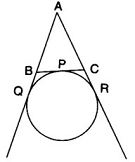
To Prove: AQ = {tex}\frac 12{/tex} perimeter of {tex}\triangle{/tex}ABC
Proof: {tex}\because{/tex}Length of the two tangents fron an external point to a circle are equal
{tex}\therefore{/tex} AQ = AR ........(1)
BQ = BP ........ (2)
CP = CR .........(3)
{tex}\therefore{/tex} Perimeter of {tex}\triangle{/tex}ABC = AB + BC + AC
= AB + (BP + CP) + AC
= (AB + BQ)+ (CR + AC) [Using (2) and (3)]
= AQ + AR
= AQ - AR
= AQ + AQ [from (1)]
= 2AQ
{tex}\Rightarrow{/tex} AQ = {tex}\frac 12{/tex} perimeter of {tex}\triangle{/tex}ABC
Posted by Reena Meena 7 years, 2 months ago
- 0 answers
Posted by Harshit Singh 7 years, 2 months ago
- 0 answers
Posted by Abhay Kumar 7 years, 2 months ago
- 1 answers
Posted by Farooq Multani 7 years, 2 months ago
- 1 answers
Ananya Sharma 7 years, 2 months ago
Posted by Akash Sonawane 6 years, 6 months ago
- 1 answers
Sia ? 6 years, 6 months ago
Given {tex}\triangle A B C{/tex} and {tex}\triangle PQR{/tex} in Which BC= a, CA = b, AB = c and QR = p, RP = q, PQ = r.
Also, {tex}\triangle A B C \sim \triangle P Q R{/tex}
To Prove {tex}\frac { a } { p } = \frac { b } { q } = \frac { c } { r }{/tex}
{tex}= \frac { a + b + c } { p + q + r }{/tex}
Proof Since {tex}\triangle ABC{/tex} and {tex}\triangle PQR{/tex} are similar, therefore their corresponding sides are proportional.
{tex}\therefore \quad \frac { a } { p } = \frac { b } { q } = \frac { c } { r } = k{/tex} (say) ...(i)
{tex}\Rightarrow \quad a = k p , b = k q{/tex} and {tex}c = k r{/tex}
{tex}\therefore \quad \frac { \text { perimeter of } \triangle A B C } { \text { perimeter of } \triangle P Q R }{/tex}
{tex}= \frac { a + b + c } { p + q + r }{/tex}
{tex}= \frac { k p + k q + k r } { p + q + r }{/tex}
{tex}= \frac { k ( p + q + r ) } { ( p + q + r ) } = k{/tex} ...(ii)
From (i) and (ii), we get
{tex}\frac { a } { p } = \frac { b } { q } = \frac { c } { r }{/tex}
{tex}= \frac { a + b + c } { p + q + r }{/tex}
{tex}= \frac { \text { perimeter of } \triangle A B C } { \text { perimeter of } \triangle P Q R }{/tex} [each equal to k].
Posted by Tanya Srivastava 7 years, 2 months ago
- 0 answers
Posted by Sakshi Rawal 7 years, 2 months ago
- 3 answers
Jitesh Kamboj 7 years, 2 months ago
Posted by Monu Suman 7 years, 2 months ago
- 0 answers
Posted by Harsha Vijay 7 years, 2 months ago
- 1 answers
Aastha Sekhri 7 years, 2 months ago
Posted by Sanrufi Khan 6 years, 6 months ago
- 1 answers
Sia ? 6 years, 6 months ago
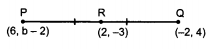
According to question
PR = RQ or R is mid-point of PQ
Using mid-point formula x {tex}= \frac { x _ { 1 } + x _ { 2 } } { 2 }{/tex} and y {tex}= \frac { y _ { 1 } + y _ { 2 } } { 2 }{/tex}
{tex}\frac { b - 2 + 4 } { 2 }{/tex} = - 3
{tex}\Rightarrow{/tex} b + 2 = - 6
{tex}\Rightarrow{/tex} b = - 8
Posted by Sanrufi Khan 7 years, 2 months ago
- 1 answers
Posted by Sanrufi Khan 6 years, 4 months ago
- 1 answers
Sia ? 6 years, 4 months ago
We will prove this by contradiction.
Let us suppose that (3+2 {tex}\sqrt { 5 }{/tex}) is rational.
It means that we have co-prime integers a and b such that
{tex}\frac { a } { b } = 3 + 2 \sqrt { 5 } \quad \frac { a } { b } - 3 = 2 \sqrt { 5 }{/tex}
{tex}\Rightarrow \frac{{a - 3b}}{b} = 2{\sqrt 5 \,{ \Rightarrow }}\frac{{a - 3b}}{{2b}} = \sqrt 5 {/tex} ....(1)
a and b are integers.
It means L.H.S of (1) is rational but we know that {tex}\sqrt { 5 }{/tex} is irrational. It is not possible. Therefore, our supposition is wrong. (3+2 {tex}\sqrt { 5 }{/tex}) cannot be rational.
Hence, (3+2 {tex}\sqrt { 5 }{/tex}) is irrational.
Posted by Ajay Dhanush 7 years, 2 months ago
- 0 answers
Posted by Archana Bandekar 7 years, 2 months ago
- 0 answers
Posted by Devendra Singh Marko 7 years, 2 months ago
- 4 answers
Posted by Sathiya Pynkodi 7 years, 2 months ago
- 1 answers
Posted by Khalid Raza 7 years, 2 months ago
- 1 answers
Posted by Tushar Gupta 7 years, 2 months ago
- 3 answers
Posted by Mohammad Anwar Bhat 7 years, 2 months ago
- 1 answers
Amit Gupta 7 years, 2 months ago
Posted by Tainya Kumari 7 years, 2 months ago
- 1 answers

myCBSEguide
Trusted by 1 Crore+ Students

Test Generator
Create papers online. It's FREE.

CUET Mock Tests
75,000+ questions to practice only on myCBSEguide app

Sweta Verma 7 years, 2 months ago
0Thank You