
Ask questions which are clear, concise and easy to understand.
Ask QuestionPosted by Shashi Kumar 7 years, 2 months ago
- 0 answers
Posted by Aakash Palliwar 6 years, 6 months ago
- 1 answers
Sia ? 6 years, 6 months ago
Given:
{tex}∆ABC\sim∆PQR{/tex}
and {tex}ar∆ABC=ar∆PQR{/tex}
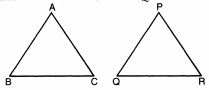
To prove: {tex}∆ABC\cong∆PQR{/tex}
Proof: {tex}∆ABC\sim∆PQR{/tex}
Also {tex}\operatorname { ar } ( \Delta A B C ) = \operatorname { ar } ( \Delta P Q R ){/tex} (given)
or, {tex}\frac { \operatorname { ar } ( \Delta A B C ) } { \operatorname { ar } ( \Delta P Q R ) } = 1{/tex}
Or {tex}\frac{AB^2}{PQ^2}=\frac{BC^2}{QR^2}=\frac{CA^2}{RP^2}=1{/tex}
Or {tex}\frac{AB}{PQ}=\frac{BC}{QR}=\frac{CA}{RP}=1{/tex}
Hence we get that
AB=PQ,BC=QR and CA=RP
Hence {tex}∆ABC\cong ∆PQR{/tex}
Posted by Harish Raghavendar 7 years, 2 months ago
- 3 answers
Posted by Preeti Roy 7 years, 2 months ago
- 1 answers
Harish Raghavendar 7 years, 2 months ago
Posted by Preeti Roy 7 years, 2 months ago
- 1 answers
Kartikeya Katariya 7 years, 2 months ago
Posted by Abhay Singh 7 years, 2 months ago
- 5 answers
Harish Raghavendar 7 years, 2 months ago
Posted by Soumy Malviya 6 years, 6 months ago
- 1 answers
Sia ? 6 years, 6 months ago
Let h is height of big building,here as per the diagram.
AE = CD = 8 m (Given)
BE = AB-AE = (h - 8) m
Let AC = DE = x
Also, {tex}\angle F B D = \angle B D E = 30 ^ { \circ }{/tex}
{tex}\angle F B C = \angle B C A = 45 ^ { \circ }{/tex}
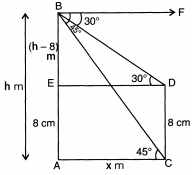
In {tex}\triangle {/tex}ACB, {tex}\angle A = 90 ^ { \circ }{/tex}
{tex}\tan 45 ^ { \circ } = \frac { A B } { A C }{/tex}
{tex}\Rightarrow {/tex} x = h, ...(i)
In {tex}\vartriangle {/tex}BDE, {tex}\angle E = 90 ^ { \circ }{/tex}
{tex}\tan 30 ^ { \circ } = \frac { B E } { E D }{/tex}
{tex}\Rightarrow \quad x = \sqrt { 3 } ( h - 8 ){/tex} .(ii)
From (i) and (ii), we get
{tex}h = \sqrt { 3 } h - 8 \sqrt { 3 }{/tex}
h(√3 - 1) = 8√3
h = {tex}\frac{8\sqrt3}{\sqrt3-1}=\frac{8\sqrt3}{\sqrt3-1}×\frac{\sqrt3+1}{\sqrt3+1}{/tex}
= {tex}\frac{1}{2}×(24+8√3)=\frac{1}{2}×(24+13.84)=18.92 m{/tex}
Hence height of the multistory building is 18.92 m and the distance between two buildings is 18.92 m.
Posted by Raj Modanwal 7 years, 2 months ago
- 2 answers
Vaibhav Parmar 7 years, 2 months ago
Posted by Raj Modanwal 7 years, 2 months ago
- 1 answers
Posted by Raj Modanwal 7 years, 2 months ago
- 0 answers
Posted by Shubham Tandi 6 years, 6 months ago
- 1 answers
Sia ? 6 years, 6 months ago
Given, tan θ + sec θ = {tex}l{/tex}........(1)
We know that, sec2 θ – tan2 θ = 1.......(2)
Now, sec θ + tan θ = {tex}l{/tex} [ from (1) ]
⇒ (sec θ + tan θ) {tex}\frac { ( \sec \theta - \tan \theta ) } { \sec \theta - \tan \theta } = 1{/tex}
⇒ {tex}\frac { \sec ^ { 2 } \theta - \tan ^ { 2 } \theta } { \sec \theta - \tan \theta } = l{/tex}
⇒ {tex}\frac { 1 } { \sec \theta - \tan \theta } = l{/tex} [ from equation (2) ]
or, sec θ – tan θ = {tex}\frac { 1 } { l }{/tex} ........(3)
Now, to get sec θ , eliminating tan θ from (1) and (3)
adding (1) and (3) we get :-
⇒ 2 sec θ = {tex}l + \frac { 1 } { l }{/tex}
⇒ 2 sec θ = {tex}\frac { l ^ { 2 } + 1 } { l }{/tex}
⇒ sec θ = {tex}\frac { l ^ { 2 } + 1 } { 2 l }{/tex}
Hence, proved.
Posted by Nadeem Kazi 5 years, 8 months ago
- 0 answers
Posted by Nadeem Kazi 7 years, 2 months ago
- 0 answers
Posted by Joyel Gupta 7 years, 2 months ago
- 1 answers
Kartikeya Katariya 7 years, 2 months ago
Posted by Nithin Sai 7 years, 2 months ago
- 1 answers
Kanika Jain 7 years, 2 months ago
Posted by Jigyasa Gambhir 6 years, 6 months ago
- 1 answers
Sia ? 6 years, 6 months ago
To prove :
{tex}3 \left( A B ^ { 2 } + B C ^ { 2 } + C A ^ { 2 } \right) = 4 \left( A D ^ { 2 } + B E ^ { 2 } + C F ^ { 2 } \right){/tex}
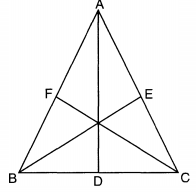
In triangle sum of squares of any two sides is equal to twice the square of half of the third side, together with twice the square of median bisecting it.
If AD is the median
{tex}A B ^ { 2 } + A C ^ { 2 } = 2 \left\{ A D ^ { 2 } + \frac { B C ^ { 2 } } { 4 } \right\}{/tex}
or, {tex}2 \left( A B ^ { 2 } + A C ^ { 2 } \right) = 4 A D ^ { 2 } + B C ^ { 2 }{/tex} ...(i)
Similarly by taking BE & CF as medians,
{tex}2 \left( A B ^ { 2 } + B C ^ { 2 } \right) = 4 B E ^ { 2 } + A C ^ { 2 }{/tex} ...(ii)
& {tex}2 \left( A C ^ { 2 } + B C ^ { 2 } \right) = 4 C F ^ { 2 } + A B ^ { 2 }{/tex} ...(iii)
By adding, (i), (ii) and (iii), we get
{tex}3 \left( A B ^ { 2 } + B C ^ { 2 } + A C ^ { 2 } \right) = 4 \left( A D ^ { 2 } + B E ^ { 2 } + C F ^ { 2 } \right){/tex}
Hence proved.
Posted by Deepak Choudhary 7 years, 2 months ago
- 1 answers
Posted by Vishy Singh 7 years, 2 months ago
- 1 answers
Aman Kasaundhan 7 years, 2 months ago
Posted by Ranjana Kawle 7 years, 2 months ago
- 1 answers
Posted by Prashant Chandila Prashant Chandila 7 years, 2 months ago
- 1 answers
Posted by Prashant Chandila Prashant Chandila 7 years, 2 months ago
- 2 answers
Deepak Choudhary 7 years, 2 months ago
Posted by Ayush Kumar 7 years, 2 months ago
- 0 answers
Posted by Rnock Denmark Denmark 6 years, 6 months ago
- 1 answers
Sia ? 6 years, 6 months ago
The required number is the HCF of (245 - 5) and (1029 - 5) i.e., 240 and 1024.
{tex}1024 = 240 \times 4 + 64{/tex}
{tex}240 = 64 \times 3 + 48{/tex}
{tex}64 = 48 \times 1 + 16{/tex}
{tex}48 = 16 \times 3 + 0{/tex}
{tex}\therefore H C F \text { is } 16{/tex}.
Posted by Srish Nambirajan 7 years, 2 months ago
- 1 answers
Kartikeya Katariya 7 years, 2 months ago
Posted by Priyanshu Yaduvanshi 7 years, 2 months ago
- 4 answers
Posted by Afjal Ansari 7 years, 2 months ago
- 1 answers
Posted by Srushti Kunkolienkar 7 years, 2 months ago
- 1 answers
A.K. Mahi ? 7 years, 2 months ago
Posted by Amal Kakkadath 7 years, 2 months ago
- 5 answers
Kartikeya Katariya 7 years, 2 months ago
A.K. Mahi ? 7 years, 2 months ago

myCBSEguide
Trusted by 1 Crore+ Students

Test Generator
Create papers online. It's FREE.

CUET Mock Tests
75,000+ questions to practice only on myCBSEguide app
