
Ask questions which are clear, concise and easy to understand.
Ask QuestionPosted by Hariom Tiwari 7 years, 2 months ago
- 1 answers
Posted by Saif Ansari 6 years, 6 months ago
- 1 answers
Sia ? 6 years, 6 months ago
Join OP, Suppose OP meets the circle at Q. Join AQ.
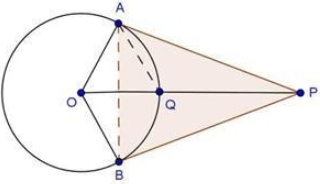
We have,
OP = diameter
{tex} \Rightarrow{/tex} OQ + PQ = diameter
{tex} \Rightarrow{/tex} PQ = diameter - radius
{tex} \Rightarrow{/tex} PQ = radius.
Therefore, OQ = PQ = radius.
Thus, OP is the hypotenuse of right triangle OAP and Q is the mid-point of OP.
Now,
In {tex} \triangle{/tex}OPA,
{tex} \sin \angle OPA = \frac{{OA}}{{OP}} = \frac{r}{{2r}}{/tex} [Give OP is the diameter of the circle]
{tex} \Rightarrow \sin \angle OPA = \frac{1}{2} = \sin 30^\circ{/tex}
{tex} \Rightarrow \angle OPA = 30^\circ{/tex}
Similarly, it can be proved that {tex} \angle OPB = 30^\circ {/tex}.
Now, {tex} \angle APB = \angle OPA + \angle OPB{/tex} {tex}= 30^\circ + 30^\circ = 60^\circ{/tex}
In {tex} \triangle{/tex}PAB,
PA = PB [Lengths of tangents drawn from an external point to a circle are equal]
{tex}\Rightarrow \angle PAB = \angle PBA{/tex} ....(i) [Equal sides have equal angles opposite to them]
{tex} \angle PAB + \angle PBA + \angle APB = 180^\circ {/tex} [Angle sum property]
{tex}\Rightarrow \angle PAB + \angle PAB = 180^\circ - 60^\circ = 120^\circ {/tex} [Using (i)]
{tex} \Rightarrow 2\angle PAB = 120^\circ{/tex}
{tex} \Rightarrow \angle PAB = 60^\circ{/tex} ....(ii)
From (i) and (ii)
{tex} \angle PAB = \angle PBA = \angle APB = 60^\circ {/tex}
{tex}{/tex} Therefore, {tex} \triangle{/tex}PAB is an equilateral triangle.
Posted by Bavika Raj 7 years, 2 months ago
- 1 answers
Posted by Animesh Dey 7 years, 2 months ago
- 1 answers
Roshan Pathak 5 years, 8 months ago
Posted by Yogita Lodaya 7 years, 2 months ago
- 0 answers
Posted by Abhi Singh 7 years, 2 months ago
- 2 answers
Avika Chaudhary 7 years, 2 months ago
Posted by Yash Patil 7 years, 2 months ago
- 1 answers
Sia ? 6 years, 6 months ago
Check the pattern here : <a href="https://mycbseguide.com/cbse-syllabus.html">https://mycbseguide.com/cbse-syllabus.html</a>
Posted by Yash Patil 7 years, 2 months ago
- 3 answers
Manoj Singh 7 years, 2 months ago
Posted by Tushar Gupta 7 years, 2 months ago
- 3 answers
Posted by Vaishnavi Khade 7 years, 2 months ago
- 2 answers
Posted by Vanshika Sharma 6 years, 6 months ago
- 1 answers
Sia ? 6 years, 6 months ago
Let a and b are numbers and HCF = x
Then LCM = 14x
Now sum of HCF and LCM
x+14x =600
15x = 600
x = 40
Hence HCF=40 and LCM=14{tex}\times{/tex}40
Given a=280 and b=?
We know that
a {tex}\times{/tex} b = HCF {tex}\times{/tex} LCM
So {tex}\mathrm b=\frac{40\times14\times40}{280}=2\times40=80{/tex}
Hence the other number = 80
Posted by Himanshu Singh 7 years, 2 months ago
- 0 answers
Posted by Aisha Jain 7 years, 2 months ago
- 3 answers
Preeti Roy 7 years, 2 months ago
Posted by Vishant Sahu 7 years, 2 months ago
- 1 answers
Apurv Gautam 7 years, 2 months ago
Posted by Madhav Verma 7 years, 2 months ago
- 1 answers
Posted by Shaikh Shaikh 6 years, 6 months ago
- 1 answers
Sia ? 6 years, 6 months ago
Let the point P(2, y) divide the line segment joining the points A(-2, 2) and B(3, 7) in the ratio {tex} k:1{/tex}
Then, the coordinates of P are
{tex}\left[ \frac { 3 k + ( - 2 ) \times 1 } { k + 1 } , \frac { 7 k + 2 \times 1 } { k + 1 } \right]{/tex}
{tex}= \left[ \frac { 3 k - 2 } { k + 1 } , \frac { 7 k + 2 } { k + 1 } \right]{/tex}
But the coordinates of P are given as {tex} (2, y){/tex}
{tex}\therefore \quad \frac { 3 k - 2 } { k + 1 } = 2{/tex}
{tex}\Rightarrow{/tex} {tex}3k - 2 = 2k + 2{/tex}
{tex}\Rightarrow{/tex} {tex}3k - 2k = 2 + 2{/tex}
{tex}\Rightarrow{/tex} {tex}k = 4{/tex}
{tex}\frac { 7 k + 2 } { k + 1 } = y{/tex}
Putting the values of k, we get
{tex}\frac { 7 \times 4 + 2 } { 4 + 1 } = y{/tex}
{tex}\frac { 30 } { 5 } = y{/tex}
{tex}6 = y{/tex}
i.e., {tex} y = 6{/tex}
Posted by Riya Garg 7 years, 2 months ago
- 2 answers
Posted by Deepak Shah 7 years, 2 months ago
- 0 answers
Posted by Rahul Maralingannavar 7 years, 2 months ago
- 3 answers
Posted by Rdx Trox 7 years, 2 months ago
- 2 answers
Aastha Sekhri 7 years, 2 months ago
Posted by Ankita Shrivastav 5 years, 8 months ago
- 1 answers
Aastha Sekhri 7 years, 2 months ago
Posted by Ram Verma 6 years, 6 months ago
- 1 answers
Sia ? 6 years, 6 months ago
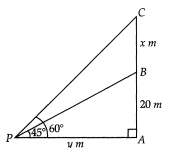
Let AP = y m and BC = xm.
{tex}\therefore {/tex} In {tex}\triangle B A P = \frac { B A } { P A } = \tan 45 ^ { \circ }{/tex}
{tex}\Rightarrow \quad \frac { 20 } { y } = 1{/tex}
{tex}\Rightarrow {/tex} y = 20
In {tex}\triangle {/tex}CAP {tex}\frac { C A } { P A } = \tan 60 ^ { \circ }{/tex}
{tex}\Rightarrow \quad \frac { 20 + x } { y } = \sqrt { 3 }{/tex}
{tex}\Rightarrow \quad 20 + x = y \sqrt { 3 }{/tex} (using y = 20)
{tex}\Rightarrow \quad 20 + x = 20 \sqrt { 3 }{/tex}
{tex}x = 20 \sqrt { 3 } - 20{/tex}
{tex}= 20 ( \sqrt { 3 } - 1 ){/tex}
{tex}= 20 \times ( 1 \cdot 73 - 1 ){/tex}
Hence, height of the tower = 14.64 m
Posted by Payal Patidar 7 years, 2 months ago
- 3 answers
Posted by Suman Devi 7 years, 2 months ago
- 0 answers
Posted by Amina Hashim T 7 years, 2 months ago
- 2 answers
Posted by Poonam Negi 6 years, 6 months ago
- 1 answers
Sia ? 6 years, 6 months ago
To prove the given result,we will use the following theorm.
The internal bisector of an angle of a triangle divides the opposite side internally in the ratio of the sides containing the angle
Since AD is the bisector of {tex}\angle{/tex}A of {tex}\Delta{/tex}ABC.
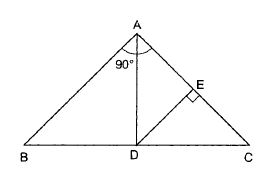
{tex}\therefore \quad \frac { A B } { A C } = \frac { B D } { D C }{/tex} [by above theorm]
{tex}\Rightarrow \quad \frac { A B } { A C } + 1 = \frac { B D } { D C } + 1{/tex}[Adding 1 on both sides]
{tex}\Rightarrow \quad \frac { A B + A C } { A C } = \frac { B D + D C } { D C }{/tex}
{tex}\Rightarrow \quad \frac { A B + A C } { A C } = \frac { B C } { D C }{/tex} ... (i)
In {tex}\Delta{/tex}'s CDE and CBA, we have
{tex}\angle{/tex}DCE = {tex}\angle{/tex}BCA = {tex}\angle{/tex}C [Common]
{tex}\angle{/tex}BAC = {tex}\angle{/tex}DEC [Each equal to 90°]
So, by AA-criterion of similarity, we have
{tex}\Delta{/tex}CDE ~ {tex}\Delta{/tex}CBA
{tex}\Rightarrow \quad \frac { C D } { C B } = \frac { D E } { B A }{/tex}
{tex}\Rightarrow \quad \frac { A B } { D E } = \frac { B C } { D C }{/tex} ...(ii)
From (i) and (ii), we obtain
{tex}\frac { A B + A C } { A C } = \frac { A B } { D E } \Rightarrow D E \times ( A B + A C ) = A B \times A C{/tex}
Posted by Jasmein Shaikh 7 years, 2 months ago
- 0 answers

myCBSEguide
Trusted by 1 Crore+ Students

Test Generator
Create papers online. It's FREE.

CUET Mock Tests
75,000+ questions to practice only on myCBSEguide app

Sia ? 6 years, 6 months ago
Check NCERT solutions here : https://mycbseguide.com/ncert-solutions.html
0Thank You