
Ask questions which are clear, concise and easy to understand.
Ask QuestionPosted by Aman Bhatt 7 years, 2 months ago
- 4 answers
Posted by Sanskriti Kumari 7 years, 2 months ago
- 3 answers
Sanskriti Kumari 7 years, 2 months ago
Posted by Isha Yadav 7 years, 2 months ago
- 5 answers
A.K. Mahi ? 7 years, 2 months ago
Posted by Noel Biju John 7 years, 2 months ago
- 2 answers
Posted by Ashish Rajput 7 years, 2 months ago
- 1 answers
Posted by Prarthana B S 7 years, 2 months ago
- 1 answers
Posted by Aman Tiwari 7 years, 2 months ago
- 2 answers
Posted by Jyoti Kumari 6 years, 6 months ago
- 1 answers
Sia ? 6 years, 6 months ago
{tex}\frac{1}{2a + b + 2x}{/tex} = {tex}\frac{1}{2a}{/tex} + {tex}\frac{1}{b}{/tex} + {tex}\frac{1}{2x}{/tex}
{tex}\Rightarrow{/tex} {tex}\frac{1}{2a + b + 2x}{/tex} - {tex}\frac{1}{2x}{/tex} = {tex}\frac{1}{2a}{/tex} + {tex}\frac{1}{b}{/tex}
{tex}\Rightarrow{/tex}{tex}\frac { 2 x - 2 a - b - 2 x } { ( 2 a + b + 2 x ) ( 2 x ) }{/tex} = {tex}\frac{b + 2a}{2a \times b}{/tex}
{tex}\Rightarrow{/tex} {tex}\frac { - ( 2 a + b ) } { ( 2 a + b + 2 x ) 2 x }{/tex} = {tex}\frac{b + 2a}{2ab}{/tex}
{tex}\Rightarrow{/tex}{tex}\frac { - 1 } { 4 a x + 2 b x + 4 x ^ { 2 } }{/tex} = {tex}\frac{1}{2ab}{/tex}
{tex}\Rightarrow{/tex} {tex}4x^2 + 2bx + 4ax = -2ab{/tex}
{tex}\Rightarrow{/tex} {tex}4x^2 + 2bx + 4ax + 2ab = 0{/tex}
{tex}\Rightarrow{/tex} {tex}2x(2x + b) + 2a(2x + b) = 0{/tex}
{tex}\Rightarrow{/tex} (2x + b)(2x + 2a) = 0
{tex}\Rightarrow{/tex} x = -{tex}\frac{b}{2}{/tex} or x = -a
Posted by Shantanu Pradhan 7 years, 2 months ago
- 0 answers
Posted by Darshana Bgga 7 years, 2 months ago
- 1 answers
Rupal ???? 7 years, 2 months ago
Posted by Yoyo Rithiksingh 7 years, 2 months ago
- 0 answers
Posted by Divyanshu Singh 7 years, 2 months ago
- 2 answers
Aditya Patil 7 years, 2 months ago
Posted by Sahil Tushir 7 years, 2 months ago
- 4 answers
Aastha Sekhri 7 years, 2 months ago
Posted by Dheeraj Kumar 7 years, 2 months ago
- 2 answers
Posted by Nandan Kumar 7 years, 2 months ago
- 0 answers
Posted by Pooja Yadav 7 years, 2 months ago
- 2 answers
Posted by Satyam Maharana 6 years, 6 months ago
- 2 answers
Sia ? 6 years, 6 months ago
We can write the given system of equations as
ax + by - a2 = 0........(1)
bx + ay - b2 = 0........(2)
From equation (1) & (2), we have
a1 = a, b1 = b, c1 = -a2
a2 = b, b2 = a, and c2 = -b2
Therefore, by cross-multiplication, we get
{tex}\Rightarrow \frac{x}{{b \times ( - {b^2}) - ( - {a^2}) \times a}}{/tex}{tex} = \frac{{ - y}}{{a \times ( - {b^2}) - ( - {a^2}) \times b}}{/tex}{tex}= \frac{1}{{a \times a - b \times b}}{/tex}
{tex}\Rightarrow \frac{x}{{ - {b^3} + {a^3}}} = \frac{{ - y}}{{ - a{b^2} + {a^2}b}} = \frac{1}{{{a^2} - {b^2}}}{/tex}
Now,
{tex}\frac{x}{{ - {b^3} + {a^3}}} = \frac{1}{{{a^2} - {b^2}}}{/tex}
{tex}\Rightarrow x = \frac{{{a^3} - {b^3}}}{{{a^2} - {b^2}}}{/tex}
{tex} = \frac{{(a - b)\left( {{a^2} + ab + {b^2}} \right)}}{{(a - b)(a + b)}}{/tex}
{tex} = \frac{{{a^2} + ab + {b^2}}}{{a + b}}{/tex}
also
{tex}\frac{{ - y}}{{ - a{b^2} + {a^2}b}} = \frac{1}{{{a^2} - {b^2}}}{/tex}
{tex}\Rightarrow - y = \frac{{{a^2}b - a{b^2}}}{{{a^2} - {b^2}}}{/tex}
{tex}\Rightarrow y = \frac{{a{b^2} - {a^2}b}}{{{a^2} - {b^2}}}{/tex}
{tex} = \frac{{ab(b - a)}}{{(a - b)(a + b)}}{/tex}
{tex} = \frac{{ - ab(a - b)}}{{(a - b)(a + b)}}{/tex}
{tex} = \frac{{ - ab}}{{a + b}}{/tex}
Therefore, {tex}x = \frac{{{a^2} + ab + {b^2}}}{{a + b}},\;y = \frac{{ - ab}}{{a + b}}{/tex} is the solution of the given system of the equations.
Posted by Rohit T 7 years, 2 months ago
- 1 answers
Saif Ansari 7 years, 2 months ago
Posted by Nitin Kumar 7 years, 2 months ago
- 1 answers
Posted by Rhythm Jain 7 years, 2 months ago
- 2 answers
Divyanshu Kumar 7 years, 2 months ago
Posted by Prateek Gupta 7 years, 2 months ago
- 2 answers
Posted by Shourya Jaat 7 years, 2 months ago
- 2 answers
Panchal Manthan 7 years, 2 months ago
Posted by Abhinav Dangi 6 years, 6 months ago
- 1 answers
Sia ? 6 years, 6 months ago
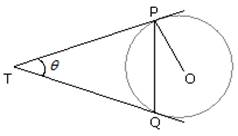
Given A circle with centre O and an external point T and two tangents TP and TQ to the circle, where P, Q are the points of contact.
To Prove: {tex}\angle{/tex}PTQ = 2{tex}\angle{/tex}OPQ
Proof: Let {tex}\angle{/tex}PTQ = {tex}\theta{/tex}
Since TP, TQ are tangents drawn from point T to the circle.
TP = TQ
{tex}\therefore{/tex} TPQ is an isoscles triangle
{tex}\therefore{/tex} {tex}\angle{/tex}TPQ = {tex}\angle{/tex}TQP = {tex}\frac12{/tex} (180o - {tex}\theta{/tex}) = 90o - {tex}\fracθ2{/tex}
Since, TP is a tangent to the circle at point of contact P
{tex}\therefore{/tex} {tex}\angle{/tex}OPT = 90o
{tex}\therefore{/tex} {tex}\angle{/tex}OPQ = {tex}\angle{/tex}OPT - {tex}\angle{/tex}TPQ = 90o - (90o - {tex}\frac12{/tex} {tex}\theta{/tex}) = {tex}\fracθ2{/tex}= {tex}\frac12{/tex}{tex}\angle{/tex}PTQ
Thus, {tex}\angle{/tex}PTQ = 2{tex}\angle{/tex}OPQ
Posted by Chaitanya Kashyap 7 years, 2 months ago
- 1 answers
Sia ? 6 years, 6 months ago
Check Sample Papers here : <a href="https://mycbseguide.com/cbse-sample-papers.html">https://mycbseguide.com/cbse-sample-papers.html</a>
Posted by Sonakshi Motte 7 years, 2 months ago
- 1 answers
Posted by Ritik Ranjan 7 years, 2 months ago
- 6 answers
Anushka Biswas 7 years, 2 months ago
Aastha Sekhri 7 years, 2 months ago
Yogita Ingle 7 years, 2 months ago
A Rational Number of the form p/q or a number which can be expressed in the form of p/q , where p and q are integers and q ≠ zero, is called a Rational - Number.
Example : 2 / 3 , -5 / 7, -10 / -3 are Rational Number.
Posted by Mintu Choudhary 6 years, 6 months ago
- 1 answers
Sia ? 6 years, 6 months ago
(-5, 7), (-1, 3)
Required distance
{tex}= \sqrt {([- 1 - {{(-5)}^2]} + {{(3- 7)}^2}}{/tex}
{tex}= \sqrt {16 + 16} = \sqrt {32}{/tex}
{tex}= 4\sqrt 2{/tex}
Posted by Amarjot Singh 7 years, 2 months ago
- 2 answers
Yogita Ingle 7 years, 2 months ago
The factors of 196 are: 1, 2, 4, 7, 14, 28, 49, 98, 196
The factors of 398220 are: 1, 2, 3, 4, 5, 6, 10, 12, 15, 20, 30, 60, 6637, 13274, 19911, 26548, 33185, 39822, 66370, 79644, 99555, 132740, 199110, 398220
Then the highest common factor is 4.

myCBSEguide
Trusted by 1 Crore+ Students

Test Generator
Create papers online. It's FREE.

CUET Mock Tests
75,000+ questions to practice only on myCBSEguide app
