
Ask questions which are clear, concise and easy to understand.
Ask QuestionPosted by Khushi Pandey 7 years, 1 month ago
- 2 answers
Posted by Deepak Kumar 7 years, 1 month ago
- 4 answers
Disha Rathore 7 years, 1 month ago
Uma Suhag 7 years, 1 month ago
Posted by Aradhya Veema 7 years, 1 month ago
- 4 answers
Posted by Sahil Singh 7 years, 1 month ago
- 2 answers
Keshab Sadotra 7 years, 1 month ago
Posted by Sahil Singh 7 years, 1 month ago
- 3 answers
A.K. Mahi ? 7 years, 1 month ago
Posted by Rishabh Singh 7 years, 1 month ago
- 7 answers
Pragati ... 7 years, 1 month ago
Deepak Kumar 7 years, 1 month ago
Naina Gupta 7 years, 1 month ago
A.K. Mahi ? 7 years, 1 month ago
Swarnajit Sahoo 7 years, 1 month ago
Posted by Lalit Singh 7 years, 1 month ago
- 4 answers
A.K. Mahi ? 7 years, 1 month ago
Posted by Yashvardhan Mishra 7 years, 1 month ago
- 5 answers
Posted by Ayush Tomar 5 years, 8 months ago
- 3 answers
Posted by Nikhil Puniya 7 years, 1 month ago
- 1 answers
Posted by Umar Tauseef 7 years, 1 month ago
- 1 answers
Posted by Sandeep Singh 7 years, 1 month ago
- 1 answers
Posted by Aryan Rana 6 years, 6 months ago
- 1 answers
Sia ? 6 years, 6 months ago
L.H.S
= (1 + cotA + tanA) (sinA - cosA)
= sinA - cosA + cotA sinA - cotA cosA + sinA tanA - tanA cosA
{tex}= \sin A - \cos A + \frac{{\cos A}}{{\sin A}} \times \sin A - \cot A\cos A + \sin A\;\tan A - \frac{{\sin A}}{{\cos A}} \times \cos A{/tex}
= sinA - cosA + cosA - cotA cosA + sinA tanA - sinA
= sinA tanA - cotA cosA........(1)
Now taking ;
{tex}\quad \frac{{\sec A}}{{\cos e{c^2}A}} - \frac{{\cos ecA}}{{{{\sec }^2}A}}{/tex}
{tex} = \frac{{\frac{1}{{\cos A}}}}{{\frac{1}{{{{\sin }^2}A}}}} - \frac{{\frac{1}{{\sin A}}}}{{\frac{1}{{{{\cos }^2}A}}}}{/tex}
{tex} = \frac{{{{\sin }^2}A}}{{\cos A}} - \frac{{{{\cos }^2}A}}{{\sin A}}{/tex}
{tex} = \sin A \times \frac{{\sin A}}{{\cos A}} - \cos A \times \frac{{\cos A}}{{\sin A}}{/tex}
{tex} = \sin A \times \tan A - \cos A \times \cot A{/tex}.......(2)
From (1) & (2),
(1 + cotA + tanA) (sinA - cosA) = {tex}\frac { \sec A } { cosec ^ { 2 } A } - \frac { cosec A } { \sec ^ { 2 } A }{/tex} = sinA.tanA - cosA.cotA
Hence, Proved.
Posted by Aditya Yadav 7 years, 1 month ago
- 0 answers
Posted by Akash Mudgal 7 years, 1 month ago
- 4 answers
A.K. Mahi ? 7 years, 1 month ago
Posted by Nitin Prajapati 7 years, 1 month ago
- 0 answers
Posted by Divyansh Gupta 6 years, 6 months ago
- 1 answers
Sia ? 6 years, 6 months ago
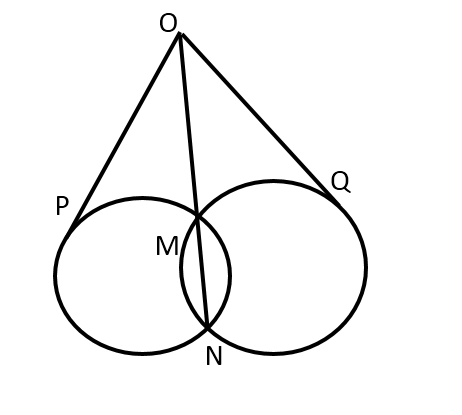
Let the two circles intersect at points M and N. MN is the chord.
Suppose O is a point on the common chord and OP and OQ be the tangents drawn from A to circle.
OP is the tangent and OMN is a secant.
According to the theorem which says that if PT is a tangent
to the circle from an external point P and a secant to the circle
through P intersects the circle at points A and B, then
{tex}\mathrm{PT}^{2}=\mathrm{PA} \times \mathrm{PB}{/tex}
Therefore, {tex}\mathrm{OP}^{2}=\mathrm{OM} \times \mathrm{ON}{/tex} ...... (1)
Similarly, OQ is the tangent and OMN is a secant for that also.
Therefore, {tex}\mathrm{OQ}^{2}=\mathrm{OM} \times \mathrm{ON}{/tex} ...... (2)
Comparing (1) and (2)
OP2 = OQ2 {tex}\Rightarrow{/tex}OP = OQ
Hence, the length of the 2 tangents is equal.
Posted by Anand Singh 7 years, 1 month ago
- 6 answers
Shivansh Upadhyay 7 years, 1 month ago
Danger Lion 7 years, 1 month ago
Posted by Anmol Sharma 6 years, 6 months ago
- 1 answers
Sia ? 6 years, 6 months ago
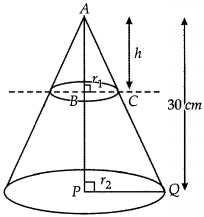
According to the question, The height of a cone is 30 cm. From its topside a small cone is cut by a plane parallel to its base.
Let the radii of smaller cone and original cone be r1 and r2 respectively and the height of smaller cone be h.
{tex}\triangle A B C \sim \triangle A P Q{/tex}
{tex}\Rightarrow \quad \frac { h } { 30 } \sim \frac { r _ { 1 } } { r _ { 2 } }{/tex} ...(1)
Volume smaller cone {tex}= \frac { 1 } { 27 } \times{/tex} Volume of original cone
{tex}\Rightarrow \quad \frac { 1 } { 3 } \pi r _ { 1 } ^ { 2 } \times h = \frac { 1 } { 27 } \times \frac { 1 } { 3 } \pi r _ { 2 } ^ { 2 } \times 30{/tex}
{tex}\Rightarrow \quad \left( \frac { r _ { 1 } } { r _ { 2 } } \right) ^ { 2 } \times \frac { h } { 30 } = \frac { 1 } { 27 }{/tex}
{tex}\Rightarrow \quad \left( \frac { h } { 30 } \right) ^ { 2 } \times \frac { h } { 30 } = \frac { 1 } { 27 }{/tex}
{tex}\left( \mathrm { Using } \frac { h } { 30 } = \frac { r _ { 1 } } { r _ { 2 } } \text { From } ( \mathrm { i } ) \right){/tex}
{tex}\Rightarrow \quad \left( \frac { h } { 30 } \right) ^ { 3 } = \frac { 1 } { 27 }{/tex}
{tex}\Rightarrow \quad h ^ { 3 } = \frac { 30 \times 30 \times 30 } { 27 }{/tex}
h = 10 cm
Hence, required height = (30 - 10) = 20 cm
Posted by Sushant Rao 7 years, 1 month ago
- 1 answers
Posted by Aditya Chauhan 7 years, 1 month ago
- 2 answers
Kajal Lanjhiyana 7 years, 1 month ago
Posted by Rahul Sharma 5 years, 8 months ago
- 1 answers
Sia ? 6 years, 6 months ago
n3 - n = n (n2 - 1) = n (n - 1) (n + 1)
Whenever a number is divided by 3, the remainder obtained is either 0 or 1 or 2.
∴ n = 3p or 3p + 1 or 3p + 2, where p is some integer.
If n = 3p, then n is divisible by 3.
If n = 3p + 1, then n – 1 = 3p + 1 –1 = 3p is divisible by 3.
If n = 3p + 2, then n + 1 = 3p + 2 + 1 = 3p + 3 = 3(p + 1) is divisible by 3.
So, we can say that one of the numbers among n, n – 1 and n + 1 is always divisible by 3.
⇒ n (n – 1) (n + 1) is divisible by 3.
Similarly, whenever a number is divided by 2, the remainder obtained is 0 or 1.
∴ n = 2q or 2q + 1, where q is some integer.
If n = 2q, then n is divisible by 2.
If n = 2q + 1, then n – 1 = 2q + 1 – 1 = 2q is divisible by 2 and n + 1 = 2q + 1 + 1 = 2q + 2 = 2 (q + 1) is divisible by 2.
So, we can say that one of the numbers among n, n – 1 and n + 1 is always divisible by 2.
⇒ n (n – 1) (n + 1) is divisible by 2.
Since, n (n – 1) (n + 1) is divisible by 2 and 3.
∴ n (n-1) (n+1) = n3 - n is divisible by 6.( If a number is divisible by both 2 and 3 , then it is divisible by 6)
Posted by Vividh Singh 7 years, 1 month ago
- 1 answers
Khushi Singh 7 years, 1 month ago
Posted by Jay Singh 6 years, 6 months ago
- 1 answers
Sia ? 6 years, 6 months ago
According to question we are given that,A thief, after committing a theft runs at a uniform speed of 50 m/minute. After 2 minutes, a policeman runs to catch him. He goes 60 m in first minute and increases his speed by 5 m/minute every succeeding minute.
Let the time taken by police to catch the thief be n minutes.
Since, the thief ran 2 minutes before the police started running.
Time taken by thief before he was caught = (n + 2) mins
Distance travelled by the thief in (n + 2) mins = 50(n + 2) m
Given that speed of the police increased by 5 m/min.
Speed of police in the 1st min = 60 m/min
Speed of police in the 2nd min = 65 m/min
Speed of police in the 3rd min = 70 m/min
Now, this forms an A.P. with a = 60 and d = 5
{tex}\therefore{/tex} Total distance travelled by the police in n minutes
{tex}= \frac { n } { 2 } [ 2 \times 60 + ( n - 1 ) \times 5 ]{/tex}
{tex}= \frac { n } { 2 } [ 120 + 5 n - 5 ]{/tex}
{tex}= \frac { n } { 2 } [ 115 + 5 n ]{/tex}
{tex}= \frac { 5 n } { 2 } [ 23 + n ]{/tex}
After the thief was caught by the police,
Distance travelled by the thief = Distance travelled by the police
{tex}\Rightarrow 50 ( n + 2 ) = \frac { 5 n } { 2 } [ 23 + n ]{/tex}}
{tex}\Rightarrow 10 ( n + 2 ) = \frac { n } { 2 } [ 23 + n ]{/tex}
{tex}\Rightarrow{/tex}20n + 40 = 23 + n2
{tex}\Rightarrow{/tex}n2 + 8n - 5n - 40 = 0
{tex}\Rightarrow{/tex}n(n + 8) - 5(n + 8) = 0
{tex}\Rightarrow{/tex}(n + 8)(n - 5) = 0
{tex}\Rightarrow{/tex}n + 8 = 0 or n - 5 = 0
{tex}\Rightarrow{/tex}n = -8 or n = 5
Thus,time is always postive, n=5
Thus, the time taken by police to catch the thief is 5 minutes.
Posted by Yugal Kharwal 7 years, 1 month ago
- 1 answers
Posted by Shafi Shaikh 7 years, 1 month ago
- 1 answers
Posted by Sarthak Rastogi 7 years, 1 month ago
- 0 answers

myCBSEguide
Trusted by 1 Crore+ Students

Test Generator
Create papers online. It's FREE.

CUET Mock Tests
75,000+ questions to practice only on myCBSEguide app

Pragati ... 7 years, 1 month ago
0Thank You