
Ask questions which are clear, concise and easy to understand.
Ask QuestionPosted by Zohan Khan 7 years, 1 month ago
- 2 answers
Posted by Aman Patel 7 years, 1 month ago
- 1 answers
Posted by Shoaib Akhtar 7 years, 1 month ago
- 7 answers
Posted by Sabu Foji 7 years, 1 month ago
- 1 answers
Posted by Bharath Veera Matta 7 years, 1 month ago
- 1 answers
Sankalp Awasthi 7 years, 1 month ago
Posted by Ashisb . 5 years, 8 months ago
- 1 answers
Posted by Jitu Rawat 7 years, 1 month ago
- 0 answers
Posted by Sharlin Thomas 6 years, 6 months ago
- 1 answers
Sia ? 6 years, 6 months ago
Let the coordinates of the third vertex be (x, y). Then by centroid formula, coordinates of centroid of given triangle are,
{tex}\left( \frac { x - 3 + 0 } { 3 } , \frac { y + 1 - 2 } { 3 } \right) = \left( \frac { x - 3 } { 2 } , \frac { y - 1 } { 3 } \right){/tex}
We have centorid is at origin (0, 0)
{tex}\therefore \frac { x - 3 } { 3 } = 0 \quad \text { and } \frac { y - 1 } { 3 } = 0{/tex}
{tex}\Rightarrow{/tex}x - 3 = 0 {tex}\Rightarrow{/tex}y - 1 = 0
{tex}\Rightarrow{/tex}x = 3{tex}\Rightarrow{/tex}y = 1
Hence, the coordinates of the third vertex are (3, 1).
Posted by Manisha Goel 7 years, 1 month ago
- 0 answers
Posted by Pradeep Kumar 7 years, 1 month ago
- 3 answers
Posted by Kanhaiya Chaudhary 7 years, 1 month ago
- 0 answers
Posted by Pranjal Soni 7 years, 1 month ago
- 0 answers
Posted by Srushti Kunkolienkar 7 years, 1 month ago
- 4 answers
Posted by Shivangi Agrawal 7 years, 1 month ago
- 1 answers
Sia ? 6 years, 6 months ago
Get NCERT solutions here : <a href="https://mycbseguide.com/ncert-solutions.html">https://mycbseguide.com/ncert-solutions.html</a>
Posted by Deepak Kumar 7 years, 1 month ago
- 2 answers
Posted by Atif Khan 7 years, 1 month ago
- 1 answers
Posted by Sweety Bharti 7 years, 1 month ago
- 0 answers
Posted by Sweety Bharti 7 years, 1 month ago
- 0 answers
Posted by Yogeshwar Verma 7 years, 1 month ago
- 0 answers
Posted by Muskan Khan 7 years, 1 month ago
- 0 answers
Posted by Vinay Bhardwaj 7 years, 1 month ago
- 1 answers
Posted by Puja Kaushal 7 years, 1 month ago
- 0 answers
Posted by Charit Gupta 7 years, 1 month ago
- 2 answers
Posted by Bicky Raj 7 years, 1 month ago
- 4 answers
Posted by Swagatika Das 7 years, 1 month ago
- 0 answers
Posted by Pushpinder Kaur 7 years, 1 month ago
- 0 answers
Posted by Aaryan Pundir 7 years, 1 month ago
- 6 answers
Posted by Chiching Misao 6 years, 6 months ago
- 1 answers
Sia ? 6 years, 6 months ago
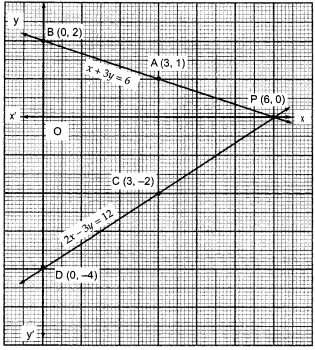
Graph of the equation {tex}x + 3y = 6{/tex}:
We have, {tex}x + 3y = 6{/tex} {tex} \Rightarrow {/tex} {tex}x = 6 - 3y{/tex}
When y = 1, we have x = 6 - 3 =3
When y = 2, we have x = 6 - 6 = 0
Thus, we have the following table:
| x | 3 | 0 |
| y | 1 | 2 |
Plotting the points {tex}A(3,1)\ and\ B(0,2){/tex} and drawing a line joining them, we get the graph of the equation x + 3y = 6 as shown in Fig.
Graph of the equation {tex}2x - 3y = 12{/tex} :
We have, {tex} 2 x - 3 y = 12 \Rightarrow y = \frac { 2 x - 12 } { 3 }{/tex}
When x=3, we have {tex}y = \frac { 2 \times 3 - 12 } { 3 } = - 2{/tex}
When x=0, we have {tex}y = \frac { 0 - 12 } { 3 } = - 4{/tex}
| x | 3 | 0 |
| y | -2 | -4 |
Plotting the points {tex}C(3,-2)\ and\ D(0, - 4){/tex} on the same graph paper and drawing a line joining them, we obtain the graph of the equation {tex}2x - 3y = 12{/tex} as shown in Fig.
Clearly, two lines intersect at P(6, 0).
Hence, {tex}x = 6, y = 0{/tex} is the solution of the given system of equations.
Putting x = 6, y = 0 in {tex}a = 4x + 3y{/tex}, we get
a = (4 {tex}\times{/tex} 6) + (3 {tex}\times{/tex} 0) = 24

myCBSEguide
Trusted by 1 Crore+ Students

Test Generator
Create papers online. It's FREE.

CUET Mock Tests
75,000+ questions to practice only on myCBSEguide app
