
Ask questions which are clear, concise and easy to understand.
Ask QuestionPosted by Amit Gupta 7 years, 1 month ago
- 3 answers
Amira Roy❤❤ 7 years, 1 month ago
Posted by Rahul Kumar 7 years, 1 month ago
- 1 answers
Sia ? 6 years, 6 months ago
Check NCERT solutions here : https://mycbseguide.com/ncert-solutions.html
Posted by Yuvraj Singh 7 years, 1 month ago
- 2 answers
Posted by Prince Raj 7 years, 1 month ago
- 1 answers
Posted by Piyush Tyagi 7 years, 1 month ago
- 4 answers
Posted by Rupam Mandal 7 years, 1 month ago
- 3 answers
Posted by Ayush Gupta 7 years, 1 month ago
- 0 answers
Posted by Gunjan Bhojwani 7 years, 1 month ago
- 5 answers
Posted by Radha Mishra 6 years, 4 months ago
- 1 answers
Sia ? 6 years, 4 months ago
We have,
{tex}\mathrm { LHS } = \frac { \tan \theta + \sec \theta - 1 } { \tan \theta - \sec \theta + 1 }{/tex}
{tex}\Rightarrow \quad \mathrm { LHS } = \frac { ( \tan \theta + \sec \theta ) - 1 } { ( \tan \theta - \sec \theta ) + 1 }{/tex}
{tex}\Rightarrow \quad \mathrm { LHS } = \frac { ( \sec \theta + \tan \theta ) - \left( \sec ^ { 2 } \theta - \tan ^ { 2 } \theta \right) } { \tan \theta - \sec \theta + 1 }{/tex} [{tex}\because{/tex} sec2{tex}\theta{/tex} - tan2{tex}\theta{/tex} = 1]
{tex}\Rightarrow \quad \mathrm { LHS } = \frac { ( \sec \theta + \tan \theta ) - ( \sec \theta + \tan \theta ) ( \sec \theta - \tan \theta ) } { \tan \theta - \sec \theta + 1 }{/tex}
{tex}\Rightarrow \quad \text { LHS } = \frac { ( \sec \theta + \tan \theta ) [ 1 - ( \sec \theta - \tan \theta ) ] } { \tan \theta - \sec \theta + 1 }{/tex}
{tex}\Rightarrow \quad \mathrm { LHS } = \frac { ( \sec \theta + \tan \theta ) ( 1 - \sec \theta + \tan \theta ) } { ( \tan \theta - \sec \theta + 1 ) }{/tex}
{tex}\Rightarrow \quad \mathrm { LHS } = \frac { ( \sec \theta + \tan \theta ) ( \tan \theta - \sec \theta + 1 ) } { ( \tan \theta - \sec \theta + 1 ) }{/tex}
{tex}\Rightarrow \quad L H S = \sec \theta + \tan \theta = \frac { 1 } { \cos \theta } + \frac { \sin \theta } { \cos \theta } = \frac { 1 + \sin \theta } { \cos \theta }{/tex} = RHS
Posted by Tapan Kumar Kumar 7 years, 1 month ago
- 0 answers
Posted by Lorial Brail 7 years, 1 month ago
- 0 answers
Posted by Namratha Sunkavalli 7 years, 1 month ago
- 1 answers
Posted by Akash Mudgal 7 years, 1 month ago
- 2 answers
Lorial Brail 7 years, 1 month ago
Posted by Lovepreet Kaur 7 years, 1 month ago
- 2 answers
Aashu Kumar 7 years, 1 month ago
Angle Anu? 7 years, 1 month ago
Posted by Kamandalam Nikitha 7 years, 1 month ago
- 1 answers
Yogita Ingle 7 years, 1 month ago
x2 + 8x + 15 = 0
x2 + 5x + 3x + 15 = 0
x(x + 5) + 3(x + 5) = 0
(x+ 5) (x + 3) = 0
x + 5 = 0, x+ 3 = 0
x = -5 or x = -3
Posted by Kamandalam Nikitha 7 years, 1 month ago
- 1 answers
Posted by ????? ??? 7 years, 1 month ago
- 1 answers
Posted by Naina Gupta 7 years, 1 month ago
- 2 answers
Naina Gupta 7 years, 1 month ago
Posted by Vidyanshu Singh 6 years, 6 months ago
- 1 answers
Sia ? 6 years, 6 months ago
The volume of a cuboid is given by the formula V = lwh,
and the surface area of a cuboid is given by the formula
SA = 2lh + 2wh + 2lw where l = length, w = width, and h = height.
Posted by Abhishek Kumar 7 years, 1 month ago
- 1 answers
A.K. Mahi ? 7 years, 1 month ago
Posted by Dev Mishra 7 years, 1 month ago
- 3 answers
Posted by Shrey Rastogi 6 years, 6 months ago
- 1 answers
Sia ? 6 years, 6 months ago
Let AB be the mountain of height h kilometres. Let C be a point at a distance of x km. from the base of the mountain such that the angle of elevation of the top at C is 30o. Let D be a point at a distance of 10 km from C such that the angle of elevation at D is of 15o.
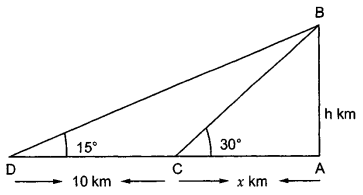
In {tex}\triangle C A B,{/tex} we have
{tex}\tan 30 ^ { \circ } = \frac { A B } { A C }{/tex}
{tex}\Rightarrow \quad \frac { 1 } { \sqrt { 3 } } = \frac { h } { x }{/tex}
{tex}\Rightarrow \quad x = \sqrt { 3 } h{/tex} ...(i)
In {tex}\triangle D A B,{/tex} we have
{tex}\tan 15 ^ { \circ } = \frac { A B } { A D }{/tex}
{tex}\Rightarrow \quad 0.27 = \frac { h } { x + 10 }{/tex}
{tex}\Rightarrow{/tex} (0.27) (x +1) = h ...(ii)
Substituting x = {tex}\sqrt { 3 }{/tex}h obtained from equation (i) in equation (ii), we get
{tex}0.27 ( \sqrt { 3 } h + 10 ) = h{/tex}
{tex}\Rightarrow \quad 0.27 \times 10 = h - 0.27 \times \sqrt { 3 } h{/tex}
{tex}\Rightarrow \quad h ( 1 - 0.27 \times \sqrt { 3 } ) = 2.7{/tex}
{tex}\Rightarrow{/tex} h (1 - 0.46) = 2.7
{tex}\Rightarrow \quad h = \frac { 2.7 } { 0.54 } = 5{/tex}
Hence, the height of the mountain is 5 km.

myCBSEguide
Trusted by 1 Crore+ Students

Test Generator
Create papers online. It's FREE.

CUET Mock Tests
75,000+ questions to practice only on myCBSEguide app

Abhi H 7 years, 1 month ago
0Thank You