
Ask questions which are clear, concise and easy to understand.
Ask QuestionPosted by Priyansh Goyal 7 years, 1 month ago
- 1 answers
Posted by Ammu Ammu 7 years, 1 month ago
- 0 answers
Posted by Jyothi Jain 7 years, 1 month ago
- 1 answers
Posted by Jayhan Kusuma 7 years, 1 month ago
- 3 answers
Trisha Bhardwaj 7 years, 1 month ago
Posted by Devendra Bairwa 7 years, 1 month ago
- 0 answers
Posted by Amaan Ahmed 7 years, 1 month ago
- 0 answers
Posted by Humayun Hassan 7 years, 1 month ago
- 3 answers
Payal Jena 7 years, 1 month ago
Avika Chaudhary 7 years, 1 month ago
Posted by Ak Baadshah 7 years, 1 month ago
- 3 answers
Ayush Maurya 7 years, 1 month ago
Posted by Abhay Randhawa 7 years, 1 month ago
- 3 answers
Rajeev Kumar Choudhary 7 years, 1 month ago
Posted by Rashid ¥€$ 7 years, 1 month ago
- 0 answers
Posted by Soumya Ranjan Samantaray 7 years, 1 month ago
- 0 answers
Posted by Simran Kaur 7 years, 1 month ago
- 1 answers
Praanshu Joshi 7 years, 1 month ago
Posted by Anjali Kumari??? 7 years, 1 month ago
- 1 answers
Posted by Neeraj Kumar Soni 7 years, 1 month ago
- 1 answers
Posted by Radhika :) Mishra:} 7 years, 1 month ago
- 4 answers
Chesta Pawan Manchanda 7 years, 1 month ago
Posted by Suroop Shah 7 years, 1 month ago
- 2 answers
Praanshu Joshi 7 years, 1 month ago
Posted by Deepshikha Shukla 7 years, 1 month ago
- 1 answers
Posted by Rashid ¥€$ 7 years, 1 month ago
- 2 answers
Posted by Neha Prajapati 7 years, 1 month ago
- 4 answers
Neha Prajapati 7 years, 1 month ago
Chesta Pawan Manchanda 7 years, 1 month ago
Apurv Gautam 7 years, 1 month ago
Posted by Khushi Garg 7 years, 1 month ago
- 0 answers
Posted by Lorial Brail 7 years, 1 month ago
- 1 answers
Subjeet Sahow 7 years, 1 month ago
Posted by Deepanshu Kumar 5 years, 8 months ago
- 0 answers
Posted by Abhishek Singh 7 years, 1 month ago
- 1 answers
Posted by Kashif Khan 7 years, 1 month ago
- 4 answers
Posted by Umesh Sharma 7 years, 1 month ago
- 1 answers
Sia ? 6 years, 6 months ago
Let a and d be the first term and common difference respectively of the given A.P. Then
an = a + (n - 1)d
{tex}\frac { 1 } { n } ={/tex} mth term
{tex}\Rightarrow \frac { 1 } { n } {/tex}= a + ( m - 1 ) d ...(i)
{tex}\frac { 1 } { m }{/tex}= nth term
{tex}\Rightarrow \frac { 1 } { m } {/tex}= a + ( n - 1 ) d ...(ii)
On subtracting equation (ii) from equation (i), we get
{tex}\frac { 1 } { n } - \frac { 1 } { m } = {/tex} [a+ (m-1) d] -[ a+ (n -1)d]
= a + md - d - a - nd + d
{tex}= ( m - n ) d{/tex}
{tex} \Rightarrow \frac { m - n } { m n } = ( m - n ) d {/tex}
{tex}\Rightarrow d = \frac { 1 } { m n }{/tex}
Putting d = {tex}\frac { 1 } { m n }{/tex} in equation (i), we get
{tex}\frac { 1 } { n } = a + \frac { ( m - 1 ) } { m n } {/tex}
{tex}\Rightarrow \frac { 1 } { n } = a + \frac { 1 } { n } - \frac { 1 } { m n } {/tex}
{tex}\Rightarrow a = \frac { 1 } { m n }{/tex}
{tex}\therefore{/tex} (mn)th term = a + (mn - 1) d
= {tex}\frac { 1 } { m n } + ( m n - 1 ) \frac { 1 } { m n } {/tex}{tex}\left[ \because a = \frac { 1 } { m n } = d \right]{/tex}
= {tex}\frac { 1 } { m n } + \frac { mn } { m n } - \frac { 1 } { m n }{/tex}
= 1
Posted by Abhi H 6 years, 6 months ago
- 1 answers
Sia ? 6 years, 6 months ago
Given: ABCD is a quadrilateral circumscribing a circle whose centre is O.
To prove:
- {tex}\angle{/tex}AOB + {tex}\angle{/tex}COD = 180o
- {tex}\angle{/tex}BOC + {tex}\angle{/tex}AOD = 180o
Construction: Join OP, OQ, OR and OS.
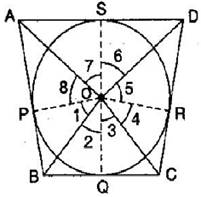
Proof: Since tangents from an external point to a circle are equal.
{tex}\therefore{/tex} AP = AS,
BP = BQ ........ (i)
CQ = CR
DR = DS
In {tex}\triangle{/tex}OBP and {tex}\triangle{/tex}OBQ,
OP = OQ [Radii of the same circle]
OB = OB [Common]
BP = BQ [From eq. (i)]
{tex}\therefore{/tex} {tex}\triangle{/tex}OPB {tex}\cong{/tex} {tex}\triangle{/tex}OBQ [By SSS congruence criterion]
{tex}\therefore{/tex} {tex}\angle{/tex}1 = {tex}\angle{/tex}2 [By C.P.C.T.]
Similarly, {tex}\angle{/tex}3 = {tex}\angle{/tex}4, {tex}\angle{/tex}5 = {tex}\angle{/tex}6, {tex}\angle{/tex}7 = {tex}\angle{/tex}8
Since, the sum of all the angles round a point is equal to 360o.
{tex}\therefore{/tex} {tex}\angle{/tex}1 + {tex}\angle{/tex}2 + {tex}\angle{/tex}3 + {tex}\angle{/tex}4+ {tex}\angle{/tex}5 + {tex}\angle{/tex}6 + {tex}\angle{/tex}7 + {tex}\angle{/tex}8 = 360o
{tex}\Rightarrow{/tex} {tex}\angle{/tex}1 + {tex}\angle{/tex}1 + {tex}\angle{/tex}4 + {tex}\angle{/tex}4+ {tex}\angle{/tex}5 + {tex}\angle{/tex}5 + {tex}\angle{/tex}8 + {tex}\angle{/tex}8 = 360o
{tex}\Rightarrow{/tex} 2 ({tex}\angle{/tex}1 + {tex}\angle{/tex}4 + {tex}\angle{/tex}5 + {tex}\angle{/tex}8) = 360o
{tex}\Rightarrow{/tex} {tex}\angle{/tex}1 + {tex}\angle{/tex}4 + {tex}\angle{/tex}5 + {tex}\angle{/tex}8 = 180o
{tex}\Rightarrow{/tex} ({tex}\angle{/tex}1 + {tex}\angle{/tex}5) + ({tex}\angle{/tex}4 + {tex}\angle{/tex}8) = 180o
{tex}\Rightarrow{/tex} {tex}\angle{/tex}AOB + {tex}\angle{/tex}COD = 180o
Similarly we can prove that
{tex}\angle{/tex}BOC + {tex}\angle{/tex}AOD = 180o

myCBSEguide
Trusted by 1 Crore+ Students

Test Generator
Create papers online. It's FREE.

CUET Mock Tests
75,000+ questions to practice only on myCBSEguide app

Sia ? 6 years, 6 months ago
Check NCERT solutions here : <a href="https://mycbseguide.com/ncert-solutions.html">https://mycbseguide.com/ncert-solutions.html</a>
0Thank You