
Ask questions which are clear, concise and easy to understand.
Ask QuestionPosted by Anujith Sm 7 years, 1 month ago
- 1 answers
Posted by Shrutie Singh 7 years, 1 month ago
- 2 answers
Posted by Yashdeep Yadav 7 years, 1 month ago
- 1 answers
Ankita Mohanty 7 years, 1 month ago
Posted by Ashish Bhardwaj 7 years, 1 month ago
- 1 answers
Posted by Ayush Kamal Kaushik 7 years, 1 month ago
- 1 answers
Posted by Piyush Daria 7 years, 1 month ago
- 2 answers
Posted by Ishika Chaudhary 7 years, 1 month ago
- 1 answers
Posted by Rishi Ojha Ojha 6 years, 6 months ago
- 1 answers
Sia ? 6 years, 6 months ago
Let APB be the tangent and take O as centre of the circle.
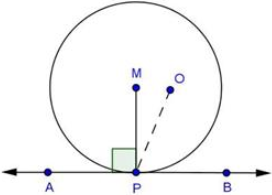
Let us suppose that MP{tex}\bot{/tex}AB does not pass through the centre.
Then,
{tex}\angle OPA = 90^\circ{/tex} [{tex}\because{/tex} Tangent is perpendicular to the radius of circle]
But {tex}\angle MPA = 90^\circ{/tex} [Given]
{tex}\therefore \angle OPA = \angle MPA{/tex}
This is only possible when point O and point M coincide with each other.
Hence, the perpendicular at the point of contact to the tangent to a circle passes through the centre of the circle.
Posted by Shrwan Singh 7 years, 1 month ago
- 2 answers
Posted by Hajira Tabassun 7 years, 1 month ago
- 1 answers
Hemant Kumar 7 years, 1 month ago
Posted by Noumi Thakur 7 years, 1 month ago
- 0 answers
Posted by Shweta Sharma 7 years, 1 month ago
- 3 answers
Posted by Parasappa Jaggal 7 years, 1 month ago
- 1 answers
Yogita Ingle 7 years, 1 month ago
90 = 2 x 3 x 3 x 5 = 2 x 32 x 5
144 = 2 x 2 x 2 x 2 x 3 x 3 = 24 x 32
HCF (90, 144) = 2 x 32 = 18
Posted by Abhishek Raikwar 6 years, 6 months ago
- 1 answers
Sia ? 6 years, 6 months ago
Total surface area of toy = C.S.A of hemisphere + C.S.A. of a cone
{tex} = 2\pi {r^2} + \pi rl{/tex}
Here, r = 7cm, h = 24 cm
{tex}\therefore l = \sqrt {{r^2} + {h^2}} = \sqrt {{7^2} + {{24}^2}} = 25cm{/tex}
T.S.A. of toy {tex} = 2 \times \frac{{22}}{7} \times 7 \times 7 + \frac{{22}}{7} \times 7 \times 25{/tex}
= 308 + 550 = 858 cm2
Posted by Khusi Gupta 7 years, 1 month ago
- 1 answers
Posted by Anirudh Mishra 7 years, 1 month ago
- 1 answers
Shashwat Majge 7 years, 1 month ago
[Divide cos15 as cos[45-30]]
Posted by Kushal Bains 7 years, 1 month ago
- 1 answers
Abhijit Kshatri 7 years, 1 month ago
Posted by Disha Rathore 7 years, 1 month ago
- 2 answers
Posted by Samriddhi Pal 7 years, 1 month ago
- 1 answers
Sia ? 6 years, 6 months ago
Check NCERT solutions here : https://mycbseguide.com/ncert-solutions.html
Posted by Pradeep Kumar 6 years, 6 months ago
- 1 answers
Sia ? 6 years, 6 months ago

Let a line AB have two mid-points, say, C and D. Then
AB = AC + CB = 2AC . . . . (i) . . . [As C is the mid-point of AB]
and AB = AD + DB = 2AD . . . . (ii) [As D is the mid-point of AB]
From equation (i) and (ii)
AC = AD and CB = DB
But this will possible only when D lies on point C. So every line segment has one and only one mid-point.
Posted by Viksita Bhardwaj 7 years, 1 month ago
- 2 answers
Kunal J 7 years, 1 month ago
Posted by Purvi Kyal 6 years, 6 months ago
- 1 answers
Sia ? 6 years, 6 months ago
Given Height of the bucket (h) = 15 cm
r = 14 cm
R = ?
Now,
Volume of the bucket {tex}= \pi \times \frac { 1 } { 3 } \times \left( r ^ { 2 } + R ^ { 2 } + r R \right) \times h{/tex}
{tex}\Rightarrow 5390 = \frac { 22 } { 7 } \times \frac { 1 } { 3 } \times \left( 14 ^ { 2 } + R ^ { 2 } + 14 R \right) \times 15{/tex}
{tex}\Rightarrow 5390 = \frac { 110 } { 7 } \times \left( 196 + \mathrm { R } ^ { 2 } + 14 \mathrm { R } \right){/tex}
{tex}\Rightarrow \frac { 539 \times 7 } { 11 } = 196 + R ^ { 2 } + 14 R{/tex}
{tex}\Rightarrow{/tex} 343 = 196 + R2 + 14R
{tex}\Rightarrow{/tex} R2 + 14R = 147
{tex}\Rightarrow{/tex} R2 + 14R = 147 = 0
{tex}\Rightarrow{/tex} R2+ 21R - 7R -147 =0
{tex}\Rightarrow{/tex} R(R + 21) -7(R + 21) = 0
{tex}\Rightarrow{/tex} (R - 7)(R + 21) = 0
{tex}\Rightarrow{/tex} R = -21 or R = 7
{tex}\Rightarrow{/tex} R = 7 cm. ({tex}\because{/tex} R cannot be negative)
Posted by Saurav Kumar 7 years, 1 month ago
- 2 answers
Posted by Prakriti Ghosh 7 years, 1 month ago
- 1 answers
Posted by Naman Sen 6 years, 6 months ago
- 1 answers
Sia ? 6 years, 6 months ago
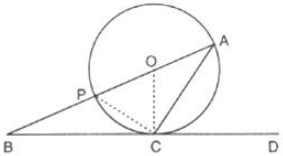
{tex}\angle OCD = 90^\circ{/tex} (tangent and radii are {tex}\bot {/tex} to one another at the point of contact)
In {tex}\triangle{/tex}OCA,
OC = OA (radii of circle)
Hence, {tex}\angle OCA = \angle OAC{/tex} (angles opposite to equal sides are equal)
Also, {tex}\angle OCD = \angle OCA + \angle ACD{/tex}
{tex}90^\circ = \angle OAC + \angle ACD{/tex} {tex}\left( {\because \angle OCA = \angle OAC} \right){/tex}
{tex}90^\circ = \angle BAC + \angle ACD{/tex}
Hence, {tex}\angle BAC + \angle ACD = 90^\circ{/tex}
Hence proved.
Posted by Saurav Raj Roy 7 years, 1 month ago
- 1 answers
Sia ? 6 years, 6 months ago
Check syllabus here : <a href="https://mycbseguide.com/cbse-syllabus.html">https://mycbseguide.com/cbse-syllabus.html</a>
Posted by Raman Baghel 7 years, 1 month ago
- 1 answers
Chesta Pawan Manchanda 7 years, 1 month ago

myCBSEguide
Trusted by 1 Crore+ Students

Test Generator
Create papers online. It's FREE.

CUET Mock Tests
75,000+ questions to practice only on myCBSEguide app

Deepanshi ☺☺ 7 years, 1 month ago
2Thank You