
Ask questions which are clear, concise and easy to understand.
Ask QuestionPosted by Vaishnavi Deshak 6 years, 4 months ago
- 1 answers
Sia ? 6 years, 4 months ago

P is midpoint of QR
or, {tex}\frac { a } { 3 } = \frac { - 5 + ( - 1 ) } { 2 }{/tex}
or, {tex}\frac { a } { 3 } = \frac { - 6 } { 2 }{/tex}
or, a = -9
Posted by Riddhi .... 7 years, 1 month ago
- 4 answers
Posted by Rajesh Tisso Rajesh Tisso 7 years, 1 month ago
- 3 answers
Posted by Asma Sonu Shaik 7 years, 1 month ago
- 1 answers
Posted by Ankit Raj 7 years, 1 month ago
- 2 answers
Posted by Knight Rider 6 years, 4 months ago
- 1 answers
Sia ? 6 years, 4 months ago
Given:- In {tex}\Delta{/tex}ABC, CA = CB and AP {tex}\times{/tex} BQ = AC2
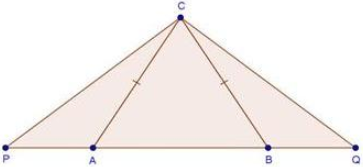
To prove:- {tex}\Delta{/tex}APC ~ {tex}\Delta{/tex}BCQ
Proof:- AP {tex}\times{/tex} BQ = AC2 [Given]
{tex}\Rightarrow AP \times BQ = AC \times AC{/tex}
{tex} \Rightarrow AP \times BQ = AC \times BC{/tex} [AC = BC given]
{tex}\Rightarrow \frac{{AP}}{{BC}} = \frac{{AC}}{{BQ}}{/tex} ....(i)
Since, CA = CB [Given]
Therefore, {tex}\angle CAB = \angle CBA{/tex} ...(ii) [Opposite angles to equal sides]
Now, {tex}\angle CAB + \angle CAP = 180^\circ {/tex} ...(iii) [Linear pair of angles]
And, {tex}\angle CBA + \angle CBQ = 180^\circ {/tex} ...(iv) [Linear pair of angles]
Therefore, Comparing equation (ii)(iii) and (iv),we get,
{tex}\angle CAP = \angle CBQ{/tex} ...(v)
In {tex}\Delta{/tex}APC and {tex}\Delta{/tex}BCQ
{tex}\angle CAP = \angle CBQ{/tex} [From (v)]
{tex}\frac{{AP}}{{BC}} = \frac{{AC}}{{BQ}}{/tex} [From (i)]
Therefore,by SAS criteria of similar triangles,we have,
Then, {tex}\Delta{/tex}APC ~ {tex}\Delta{/tex}BCQ
Posted by Raj Soni 7 years, 1 month ago
- 2 answers
Rajan Pathak 7 years, 1 month ago
Dhruvrajsinh Vala 7 years, 1 month ago
Posted by Mukhtiar Singh 7 years, 1 month ago
- 0 answers
Posted by Aditi Jha 5 years, 8 months ago
- 1 answers
Sia ? 6 years, 4 months ago
Check marking scheme here : https://mycbseguide.com/cbse-syllabus.html
Posted by Aditya Saini 7 years, 1 month ago
- 0 answers
Posted by Rahul Shukla 7 years, 1 month ago
- 2 answers
Soumya Sukhani 7 years, 1 month ago
Posted by Vikas Nayak 7 years, 1 month ago
- 0 answers
Posted by Lohith Lohith 7 years, 1 month ago
- 1 answers
Ayush Verma 7 years, 1 month ago
Posted by Rajan Pathak 7 years, 1 month ago
- 5 answers
Aisha Jain 7 years, 1 month ago
Disha Rathore 7 years, 1 month ago
Mona Sharma ? 7 years, 1 month ago
Vandana Maurya 7 years, 1 month ago
Posted by Rajan Pathak 7 years, 1 month ago
- 0 answers
Posted by Jagadeesh Meesala 7 years, 1 month ago
- 1 answers
Ajay Dhruw 7 years, 1 month ago
Posted by Sahil Bansal 7 years, 1 month ago
- 1 answers
Sia ? 6 years, 6 months ago
Check NCERT solutions here : <a href="https://mycbseguide.com/ncert-solutions.html">https://mycbseguide.com/ncert-solutions.html</a>
Posted by Nandeesh Kanavi 5 years, 8 months ago
- 0 answers
Posted by Jitendra Bairwa 7 years, 1 month ago
- 2 answers
Posted by Lucky Rawat 7 years, 1 month ago
- 1 answers
Posted by Murli Patidar 7 years, 1 month ago
- 0 answers
Posted by Aniket Jaiswal 7 years, 1 month ago
- 6 answers
Posted by Animesh Yadav 6 years, 6 months ago
- 1 answers
Sia ? 6 years, 6 months ago
Let the radius of the circle be r.
Now,
Circumference = Diameter + 45
{tex}\Rightarrow 2 \pi r = 2 r + 45{/tex}
{tex}\Rightarrow 2 \pi r - 2 r = 45{/tex}
{tex}\Rightarrow 2 r \left( \frac { 22 } { 7 } - 1 \right) = 45{/tex}
{tex}\Rightarrow 2 r \left( \frac { 15 } { 7 } \right) = 45{/tex}
{tex}\Rightarrow r = \frac { 45 \times 7 } { 30 }{/tex}
= 10.5 cm
Therefore, circumference = Diameter + 45 = 2(10.5) + 45 = 66 cm
Hence, the circumference of the circle is 66 cm.
Posted by Atulya Dwivedi 7 years, 1 month ago
- 0 answers
Posted by Chanchal Keshariya 6 years, 6 months ago
- 1 answers
Sia ? 6 years, 6 months ago
Since {tex}(x + 1){/tex} is a factor of {tex}2x^3 + ax^2 + 2bx + 1{/tex}
{tex}\Rightarrow{/tex} {tex}x = -1{/tex} is a zero of {tex}2x^3 + ax^2 + 2bx + 1{/tex}
{tex}\Rightarrow{/tex} {tex}2(-1)^3 + a(-1)^2 + 2b(-1) + 1 = 0 {/tex}
{tex}\Rightarrow{/tex} {tex}a - 2b - 1 = 0{/tex}
{tex}\Rightarrow{/tex} a - 2b = 1 ...(i)
Given that {tex}2a - 3b = 4{/tex} ...(ii)
Multiplying equation (i) by 2, we get
{tex}2a - 4b = 2{/tex} ...(iii)
Subtracting equation (iii) from (ii), we get
b = 2
Substituting b = 2 in equation (i), we have
a - 2(2) = 1
{tex}\Rightarrow{/tex} a - 4 = 1
{tex}\Rightarrow{/tex} a = 5
Hence, a = 5 and b = 2.

myCBSEguide
Trusted by 1 Crore+ Students

Test Generator
Create papers online. It's FREE.

CUET Mock Tests
75,000+ questions to practice only on myCBSEguide app

Ranjita Haldar 5 years, 11 months ago
2Thank You