
Ask questions which are clear, concise and easy to understand.
Ask QuestionPosted by Rohit Sahani 7 years, 1 month ago
- 4 answers
Posted by Priyanka Bisht 7 years, 1 month ago
- 1 answers
Posted by Himanshu Chaudhary 7 years, 1 month ago
- 1 answers
Posted by Saswat Panigrahi 7 years, 1 month ago
- 1 answers
Saurabh Singh Harariya 7 years, 1 month ago
Posted by Apurv Gautam 7 years, 1 month ago
- 7 answers
Posted by Vikash Yadav 6 years, 6 months ago
- 1 answers
Sia ? 6 years, 6 months ago
Given {tex} \tan A = \frac{1}{2},\tan B = \frac{1}{3}{/tex}
and {tex}\tan (A + B) = \frac{{\tan A + \tan B}}{{1 - \tan A\tan B}}{/tex}
{tex}\Rightarrow \tan (A + B) = \frac{{\frac{1}{2} + \frac{1}{3}}}{{1 - \frac{1}{2} \times \frac{1}{3}}}{/tex}
{tex}\Rightarrow \tan (A + B) = \frac{{\frac{5}{6}}}{{\frac{5}{6}}}{/tex}
{tex}\Rightarrow \tan (A + B) = 1{/tex}
{tex}\Rightarrow \tan (A + B) = \tan 45^\circ {/tex}
{tex}\Rightarrow A + B = 45^\circ {/tex}
Posted by Harshita Kaur 6 years, 6 months ago
- 1 answers
Sia ? 6 years, 6 months ago
Given First term (a) = 8
and, nth term (an) = 33
{tex}\Rightarrow{/tex} a + (n - 1)d = 33
{tex}\Rightarrow{/tex} 8 + (n - 1)d = 33
{tex}\Rightarrow{/tex} (n - 1)d = 33 - 8
{tex}\Rightarrow{/tex} (n - 1)d = 25 .....(i)
and, Sum of first n terms = 123
{tex} \Rightarrow \frac{n}{2}\left[ {a + {a_n}} \right] = 123{/tex}
{tex}\Rightarrow \frac{n}{2}\left[ {8 + 33} \right] = 123{/tex}
{tex} \Rightarrow \frac{n}{2} \times 41 = 123{/tex}
{tex} \Rightarrow n = \frac{{123 \times 2}}{{41}}{/tex}
{tex}\Rightarrow{/tex} n = 6
Put value of n in equation (i)
(6 - 1)d = 25
{tex}\Rightarrow{/tex} 5d = 25
{tex}\Rightarrow d = \frac{{25}}{5} = 5{/tex}
Posted by Krati Joshi 7 years, 1 month ago
- 3 answers
Posted by Maitree Parmar 6 years, 4 months ago
- 1 answers
Sia ? 6 years, 4 months ago
Suppose man's 1 day's work be {tex}\frac 1x{/tex} and boy's 1 day's work be {tex}\frac 1y{/tex}
Suppose, {tex}\frac 1x{/tex}= u and {tex}\frac 1y{/tex}= v
By first condition,
{tex}\frac { 2 } { x } + \frac { 5 } { y } = \frac { 1 } { 4 } \Rightarrow 2 u + 5 v = \frac { 1 } { 4 }{/tex}...........(i)
By second condition,
{tex}\frac { 3 } { x } + \frac { 6 } { y } = \frac { 1 } { 3 } \Rightarrow 3 u + 6 v = \frac { 1 } { 3 }{/tex}.............(ii)
Multiplying (i) by 6 and (ii) by 5,
{tex}\Rightarrow 12 u + 30 v = \frac { 6 } { 4 }{/tex}..........(iii)
{tex}15 u + 30 v = \frac { 5 } { 3 }{/tex}...........(iv)
Subtracting (iii) and (iv),
{tex}\Rightarrow 3u ={/tex} {tex} \frac { 5 } { 3 } - \frac { 6 } { 4 }{/tex}
{tex}\Rightarrow 3 u = \frac { 20 - 18 } { 12 }{/tex}
{tex}\Rightarrow 3 u = \frac { 2 } { 12 }{/tex}
{tex}\Rightarrow 3 u = \frac { 1 } { 6 }{/tex}
{tex}\Rightarrow u = \frac { 1 } { 18 }{/tex}
Putting u = {tex}\frac{1}{18}{/tex} in (i),
{tex}\Rightarrow 2 \times \frac { 1 } { 18 } + 5 v = \frac { 1 } { 4 }{/tex}{tex}\Rightarrow \frac { 1 } { 9 } + 5 v = \frac { 1 } { 4 } \Rightarrow 5 v = \frac { 1 } { 4 } - \frac { 1 } { 9 }{/tex}
{tex}\Rightarrow 5 v = \frac { 5 } { 36 } \Rightarrow v = \frac { 1 } { 36 }{/tex}
Now, {tex}u ={/tex} {tex}\frac { 1 } { 18 } \Rightarrow x = \frac { 1 } { 4 } = 18{/tex}
and {tex}v ={/tex} {tex}\frac { 1 } { 36 } \Rightarrow y = \frac { 1 } { v } = 36{/tex}
{tex}\therefore{/tex}{tex} x = 18, y = 26{/tex}
The man will complete the given work in {tex}18\ days{/tex} and the boy will complete the given work in {tex}36 days{/tex} when they work alone.
Posted by Subham Tiwari 6 years, 6 months ago
- 1 answers
Posted by Rahul Rahul 7 years, 1 month ago
- 2 answers
Posted by N Mukesh Thakur 7 years, 1 month ago
- 3 answers
Posted by Abdul Wajid Malik 7 years, 1 month ago
- 4 answers
Deepanshi Mittal 7 years, 1 month ago
Posted by Biplab Sarkar 6 years, 6 months ago
- 1 answers
Sia ? 6 years, 6 months ago
Here a=10 and let d be the common difference. Then,
S14=1505 {tex}\Rightarrow{/tex} {tex}\frac{n}{2}{/tex}[2a+(n-1)d]=1505, where n=14 and a=10
{tex}\Rightarrow{/tex} {tex}\frac{{14}}{2}{/tex}{tex} \cdot {/tex}{tex}(20+13d)=1505 {/tex}
{tex}\Rightarrow{/tex} {tex}(20+13d)={/tex}{tex}\frac{{1505}}{7}{/tex}{tex}=215{/tex}
{tex}\Rightarrow{/tex} {tex}13d=195{/tex}
{tex}\Rightarrow{/tex}{tex}d=15.{/tex}
Thus, a=10 and d=15.
{tex}T_{25} = (a+24d)=(10+24\times15)=370.{/tex}
Hence, the 25th term is 370.
Posted by Vj Krishna 7 years, 1 month ago
- 1 answers
Akash Modanwal 7 years, 1 month ago
Posted by Aman Choudhary 7 years, 1 month ago
- 2 answers
Shubham Singh 7 years, 1 month ago
Posted by Vaibhav Baliyan 6 years, 6 months ago
- 1 answers
Sia ? 6 years, 6 months ago
Check formulae in the revision notes : <a href="https://mycbseguide.com/cbse-revision-notes.html">https://mycbseguide.com/cbse-revision-notes.html</a>
Posted by Soumitra Agrawal 7 years, 1 month ago
- 3 answers
Posted by Kaushal Grewal 6 years, 6 months ago
- 1 answers
Sia ? 6 years, 6 months ago
Let the number of rows be x and the number of students in each row be y.
Then, the total number of students = xy.
Case I When there are 4 more students in each row.
Then, number of students in each row = {tex}(y + 4){/tex}.
And, number of rows = {tex}(x - 2).{/tex}
Total number of students = {tex}(x - 2) (y + 4){/tex}
{tex}\therefore{/tex} {tex}(x - 2)(y + 4) = xy{/tex}
{tex}\Rightarrow{/tex} {tex}4x - 2y = 8{/tex}
{tex} \Rightarrow{/tex}{tex}2x - y = 4.{/tex} ...(i)
Case II When 4 students are removed from each row.
Then, number of students in each row = {tex}(y - 4).{/tex}
And, number of rows = {tex}(x + 4).{/tex}
Total number of students = {tex}(x + 4)(y - 4){/tex}
{tex}\therefore{/tex} {tex}(x + 4)(y - 4) = xy{/tex}{tex} \Rightarrow{/tex} {tex}4y - 4x = 16{/tex}
{tex}\Rightarrow{/tex}{tex}4(y - x) = 16{/tex} {tex}\Rightarrow{/tex}{tex}(y - x)= 4{/tex}. ...(ii)
Adding (i) and (ii), we get {tex}x = 8{/tex}
Putting {tex}x = 8{/tex} in (ii), we get
{tex}y - 8 = 4{/tex} {tex}\Rightarrow{/tex} {tex}y = 12.{/tex}
Thus, {tex}x = 8\ and\ y = 12{/tex}.
This shows that there are 8 rows and there are 12 students in each row.
Hence, the number of students in the class = {tex}xy = 8\times12 = 96{/tex}.
Posted by Sushant Singh 7 years, 1 month ago
- 2 answers
Posted by Kkk M 6 years, 4 months ago
- 1 answers
Sia ? 6 years, 4 months ago
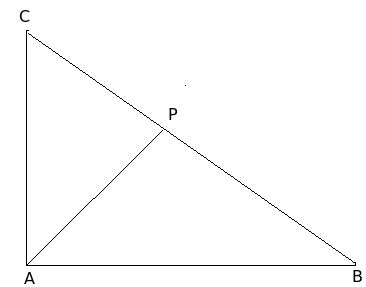
According to question it is given that in ∆ ABC,
AC2 = BC2 - AB2
{tex}\Rightarrow{/tex} AC2 + AB2 = BC2
{tex}\therefore \triangle{/tex}ABC is right angled at A (by using converse of Pythagoras theorem)
{tex}\therefore {/tex} {tex}\angle{/tex} A = 90°
Now, In {tex}\triangle{/tex}APC
{tex}\angle{/tex}PAC + {tex}\angle{/tex}C = 90° ........(i)
Similarly, {tex}\angle{/tex}B + {tex}\angle{/tex}C = 90° .........(ii)
from (i) and (ii), we get
{tex}\angle{/tex}B + {tex}\angle{/tex}C = {tex}\angle{/tex}PAC + {tex}\angle{/tex}C
{tex}\Rightarrow{/tex} {tex}\angle{/tex}B = {tex}\angle{/tex}PAC
In {tex}\triangle{/tex}BPA and {tex}\triangle{/tex}APC,
{tex}\angle{/tex}B = {tex}\angle{/tex}PAC (proved)
{tex}\angle{/tex}BPA = {tex}\angle{/tex}APC (each 90°)
{tex}\therefore \quad \triangle B P A \sim \triangle A P C{/tex}
{tex}\Rightarrow \quad \frac { \mathrm { PB } } { \mathrm { PA } } = \frac { \mathrm { PA } } { \mathrm { CP } }{/tex}
{tex}\Rightarrow \quad \mathrm { PB } \times \mathrm { CP }= PA^2{/tex}
Hence proved.
Posted by Khyati Jha 7 years, 1 month ago
- 0 answers
Posted by Atul Pal 7 years, 1 month ago
- 0 answers
Posted by Kanishka Sahu 5 years, 8 months ago
- 4 answers
Posted by Kartik Chauhan 7 years, 1 month ago
- 0 answers
Posted by Abdul Wajid Malik 7 years, 1 month ago
- 1 answers
Apurv Gautam 7 years, 1 month ago
Posted by Sher Singh 7 years, 1 month ago
- 1 answers

myCBSEguide
Trusted by 1 Crore+ Students

Test Generator
Create papers online. It's FREE.

CUET Mock Tests
75,000+ questions to practice only on myCBSEguide app

Nikhil Rai 7 years, 1 month ago
1Thank You