
Ask questions which are clear, concise and easy to understand.
Ask QuestionPosted by Deepika K 7 years, 1 month ago
- 0 answers
Posted by Nishant Ranjan 7 years, 1 month ago
- 2 answers
Nishant Ranjan 7 years, 1 month ago
Posted by Pratyush Prakash 7 years, 1 month ago
- 0 answers
Posted by Sushil Yadav 7 years, 1 month ago
- 2 answers
Mohit Kumar 7 years, 1 month ago
Posted by Daksh Kumar 6 years, 6 months ago
- 1 answers
Sia ? 6 years, 6 months ago
Any positive integer is of the form 2q or 2q + 1, for some integer q.
{tex}\therefore{/tex} When n = 2q
{tex}\style{font-family:Arial}{n^2\;-\;n\;=\;n(n\;-\;1)\;=\;2q(2q\;-\;1)=\;2m,}{/tex}
where m = q(2q - 1) ( m is any integer)
This is divisible by 2
When n = 2q + 1
{tex}\style{font-family:Arial}{\begin{array}{l}n^2\;-\;n\;=\;n(n\;-\;1)\;=\;(2q\;+\;1)(2q+1-1)\\=2q(2q+1)\end{array}}{/tex}
= 2m, when m = q(2q + 1) ( m is any integer)
which is divisible by 2.
Hence, n2 - n is divisible by 2 for every positive integer n.
Posted by Vivek Vivu 6 years, 6 months ago
- 1 answers
Sia ? 6 years, 6 months ago
Let the ratio be K: 1
Coordinate of P are {tex}\left( {\frac{{3K + 2}}{{K + 1}},\frac{{7K - 2}}{{K + 1}}} \right){/tex}
P lies on the line 2x + y - 4 = 0
{tex} \Rightarrow 2\left( {\frac{{3K + 2}}{{K + 1}}} \right) + \frac{{7K - 2}}{{K + 1}} - \frac{4}{1} = 0{/tex}
{tex} \Rightarrow {/tex} 6K + 4 + 7K - 2 - 4K - 4 = 0
{tex} \Rightarrow {/tex} 9K - 2 = 0
{tex} \Rightarrow K = \frac{2}{9}{/tex} or 2 : 9
Posted by Deepakahirwar Deepakahirwar 7 years, 1 month ago
- 1 answers
Posted by Fatima Alarakha 7 years, 1 month ago
- 2 answers
Posted by Vaibhav Shukla 7 years, 1 month ago
- 1 answers
Posted by Debobroto Das 6 years, 6 months ago
- 1 answers
Sia ? 6 years, 6 months ago
Here,G is the centroid of a triangle ABC.
Let A(b, c), B(0, 0) and C(a, 0) be the coordinates of {tex}\Delta{/tex}ABC then coordinates of centroid are {tex}G\left[ {\frac{{a + b+0}}{3},\frac{c+0+0}{3}} \right]{/tex}
To prove:-
(AB)2 + (BC)2 + (CA)2 = 3(GA2 + GB2 + GC2)
Consider : L.H.S.
=(AB)2 +( BC)2 + (CA)2
= b2 + c2 + a2 + (a - b)2 + c2
= b2 + c2 + a2 + a2 + b2 - 2ab + c2
= 2a2 + 2b2 + 2c2 - 2ab
Consider : R.H.S.
=3(GA2 + GB2 + GC2)
{tex}=3\left[ {{{\left( {\frac{{a + b}}{3} - b} \right)}^2} + {{\left( {c - \frac{c}{3}} \right)}^2} + {{\left( {\frac{{a + b}}{3}} \right)}^2}} \right.{/tex}{tex}\left. { + {{\left( {\frac{c}{3}} \right)}^2} + \left( {\frac{{a + b}}{3} - a} \right) + {{\left( {\frac{c}{3}} \right)}^2}} \right]{/tex}
{tex} = 3{\left[ {{{\left( {\frac{{a - 2b}}{3}} \right)}^2} + {{\left( {\frac{{2c}}{3}} \right)}^2} + \left( {\frac{{a + b}}{3}} \right)} \right.^2}{/tex} {tex}\left. { + {{\left( {\frac{c}{3}} \right)}^2} + {{\left( {\frac{{b - 2a}}{3}} \right)}^2} + {{\left( {\frac{c}{3}} \right)}^2}} \right]{/tex}
{tex} = 3\left[ {\frac{{{a^2} + 4{b^2} - 4ab}}{9} + \frac{{4{c^2}}}{9} + \frac{{{a^2} + {b^2} + 2ab}}{9}} \right.{/tex} {tex}\left. { + {{\frac{c}{9}}^2} + \frac{{{b^2} + 4{a^2} - 4ab}}{9} + {{\frac{c}{9}}^2}} \right]{/tex}
{tex}= 3 \left[ {\frac{{{a^2} + 4{b^2} - 4ab + 4{c^2} + {a^2} + {b^2} + 2ab + {c^2} + {b^2} + 4{a^2} - 4ab + {c^2}}}{9}} \right]{/tex}
{tex} = 3\left[ {\frac{{6{a^2} + 6{b^2} + 6{c^2} - 6ab}}{9}} \right]{/tex}
{tex} = 3 \times 3\left[ {\frac{{2{a^2} + 2{b^2} + 2{c^2} - 2ab}}{9}} \right]{/tex}
= 2a2 + 2b2 + 2c2 - 2ab
L.H.S. = R.H.S.
Therefore, (AB)2 + (BC)2 + (CA)2 = 3(GA2 + GB2 + GC2)
Posted by Rajan Mishra 7 years, 1 month ago
- 2 answers
Sahil Sultania 7 years, 1 month ago
Posted by Abhishek Dwivedi 7 years, 1 month ago
- 2 answers
Rajan Mishra 7 years, 1 month ago
Posted by Ajad Maurya 6 years, 6 months ago
- 1 answers
Sia ? 6 years, 6 months ago
Let the first term and the common difference of the AP be a and d respectively.
According to the question,
Third term + seventh term = 6
{tex} \Rightarrow {/tex} [a + (3 - 1)d] + [a + (7 - 1)d] = 6 = a + (n - 1)d
{tex} \Rightarrow {/tex} (a + 2d) + (a + 6d) = 6 {tex} \Rightarrow {/tex} 2a + 8d = 6
{tex} \Rightarrow {/tex} a + 4d = 3 ..... (1)
Dividing throughout by 2 &
(third term) (seventh term) = 8
{tex} \Rightarrow {/tex} (a + 2d) (a + 6d) = 8
{tex} \Rightarrow {/tex} (a + 4d - 2d) (a + 4d + 2d) = 8
{tex} \Rightarrow {/tex} (3 - 2d) (3 + 2d) = 8
{tex} \Rightarrow {/tex} 9 - 4d2 = 8
{tex} \Rightarrow 4{d^2} = 1 \Rightarrow {d^2} = \frac{1}{4} \Rightarrow d + \pm \frac{1}{2}{/tex}
Case I, when {tex}d = \frac{1}{2}{/tex}
Then from (1), {tex}a + 4\left( {\frac{1}{2}} \right) = 3{/tex}
{tex} \Rightarrow {/tex} a + 2 = 3 {tex} \Rightarrow {/tex} a = 3 - 2 {tex} \Rightarrow {/tex} a = 1
{tex}\therefore {/tex} Sum of first sixteen terms of the AP = S16
{tex} = \frac{{16}}{2}[2a + (16 - 1)d]{/tex} {tex}\because {S_n} = \frac{n}{2}[2a + (n - 1)d]{/tex}
= 8[2a + 15d]
{tex} = 8[2(1) + 15(\frac{1}{2})]{/tex}
{tex} = 8[12 + \frac{{15}}{2}]{/tex}
{tex} = 8[\frac{{19}}{2}]{/tex}
{tex} = 4 \times 19 = 76{/tex}
Case II. When {tex}d = - \frac{1}{2}{/tex}
Then from (1),
{tex}a + 4\left( { - \frac{1}{2}} \right) = 3{/tex}
{tex} \Rightarrow {/tex} a - 2 = 3 {tex} \Rightarrow {/tex} a = 3 + 2 {tex} \Rightarrow {/tex} a = 5
{tex}\therefore {/tex} Sum of first sixteen terms of the AP = S16
{tex} = \frac{{16}}{2}[2a + (16 - 1)d]{/tex} {tex}\because {S_n} = \frac{n}{2}[2a + (n - 1)d]{/tex}
{tex} = 8[2a + 15d] = 8\left[ {2(5) + 15\left( { - \frac{1}{2}} \right)} \right] = 8\left[ {10 - \frac{{15}}{2}} \right] = 8\left[ {\frac{5}{2}} \right] = 20{/tex}
Posted by Mikey Agarwal 7 years, 1 month ago
- 0 answers
Posted by Pooja Gupta 5 years, 8 months ago
- 4 answers
Posted by Divyansh Pandey 7 years, 1 month ago
- 2 answers
Posted by Parth Ambekar 7 years, 1 month ago
- 0 answers
Posted by Dhanush Bonkuri 7 years, 1 month ago
- 6 answers
Yogita Ingle 7 years, 1 month ago
(xy + yz) - (xy - yz) = xy + yz - xy + yz = yz + yz = 2yz
Posted by John Stone 6 years, 6 months ago
- 1 answers
Sia ? 6 years, 6 months ago
Given: A circle with centre O. A tangent CD at C.
Diameter AB is produced to D.
BC and AC chords are joined, ∠BAC = 30°
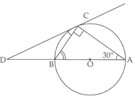
To prove: BC = BD
Proof: DC is tangent at C and, CB is chord at C.
Therefore, ∠DCB = ∠BAC [∠s in alternate segment of a circle]
⇒ ∠DCB = 30° …(i) [∵ ∠BAC = 30° (Given)]
AOB is diameter. [Given]
Therefore, ∠BCA = 90° [Angle in s semi circle]
Therefore, ∠ABC = 180° - 90° - 30° = 60°
In ΔBDC,
Exterior ∠B = ∠D + ∠BCD
⇒ 60° = ∠D + 30°
⇒ ∠D = 30° …(ii)
Therefore, ∠DCB = ∠D = 30° [From (i), (ii)]
⇒ BD = BC [∵ Sides opposite to equal angles are equal in a triangle]
Hence, proved.
Posted by Supriya Tiwari 7 years, 1 month ago
- 2 answers
Posted by Priyanshi Kumari 6 years, 6 months ago
- 1 answers
Sia ? 6 years, 6 months ago
Given,
{tex}\frac { 1 } { ( a + b + x ) } = \frac { 1 } { a } + \frac { 1 } { b } + \frac { 1 } { x }{/tex}
{tex}\Rightarrow \quad \frac { 1 } { ( a + b + x ) } - \frac { 1 } { x } = \frac { 1 } { a } + \frac { 1 } { b } \Rightarrow \frac { x - ( a + b + x ) } { x ( a + b + x ) } = \frac { b + a } { a b }{/tex}
{tex}\Rightarrow \quad \frac { - ( a + b ) } { x ( a + b + x ) } = \frac { ( a + b ) } { a b }{/tex}
On dividing both sides by (a+b)
{tex}\Rightarrow \quad \frac { - 1 } { x ( a + b + x ) } = \frac { 1 } { a b }{/tex}
Now cross multiply
{tex}\Rightarrow{/tex} x(a + b + x) = -ab
{tex}\Rightarrow{/tex} x2 + ax + bx + ab = 0
{tex}\Rightarrow{/tex} x(x +a) + b(x +a) = 0
{tex}\Rightarrow{/tex} (x + a) (x + b) = 0
{tex}\Rightarrow{/tex} x + a = 0 or x + b = 0
{tex}\Rightarrow{/tex} x = -a or x = -b.
Therefore, -a and -b are the roots of the equation.
Posted by Mumaiz Peer 5 years, 8 months ago
- 4 answers
Posted by Mumaiz Peer 7 years, 1 month ago
- 1 answers
Posted by Khushi Saini 7 years, 1 month ago
- 5 answers
Arohi . 7 years, 1 month ago
Manya Tomar 7 years, 1 month ago

myCBSEguide
Trusted by 1 Crore+ Students

Test Generator
Create papers online. It's FREE.

CUET Mock Tests
75,000+ questions to practice only on myCBSEguide app
