
Ask questions which are clear, concise and easy to understand.
Ask QuestionPosted by Bhavesh Kumar 7 years, 1 month ago
- 1 answers
Posted by Vaishnavi ???? 7 years, 1 month ago
- 0 answers
Posted by Pritam Singh 7 years, 1 month ago
- 2 answers
Posted by Aastha Chandrakar 7 years, 1 month ago
- 1 answers
Sreehitha M 7 years, 1 month ago
Posted by Karunya Ray 7 years, 1 month ago
- 7 answers
Posted by Parth Pathak 7 years, 1 month ago
- 1 answers
Posted by Abhishek Tiwari 7 years, 1 month ago
- 2 answers
Ajay Papnai 7 years, 1 month ago
Posted by Prince Katariya 7 years, 1 month ago
- 1 answers
Purvanshi Yadav 7 years, 1 month ago
Posted by Amarnath Shukla 7 years, 1 month ago
- 2 answers
Posted by Deepak Kumar 6 years, 6 months ago
- 1 answers
Sia ? 6 years, 6 months ago
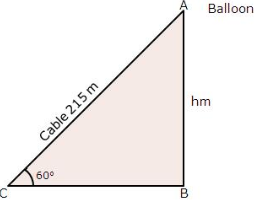
Let height of balloon from ground = h m
Length of cable {tex}= 215 m{/tex}
In {tex}\Delta ABC{/tex}
{tex}\sin {60^o} = \frac{{AB}}{{AC}}{/tex}
{tex} \Rightarrow \frac{{\sqrt 3 }}{2} = \frac{h}{{215}}{/tex}
{tex} \Rightarrow h = \frac{{215\sqrt 3 }}{2}{/tex}
{tex} \Rightarrow h = \frac{{215 \times 1.73}}{2} = 185.9{/tex}
Posted by Firoz Ahmed 7 years, 1 month ago
- 2 answers
Posted by Preeti Roy 7 years, 1 month ago
- 1 answers
Posted by Laxmi Diwan 7 years, 1 month ago
- 1 answers
Posted by Raushan Patel 7 years, 1 month ago
- 5 answers
Sakshi Shobha 7 years, 1 month ago
Posted by Sujal Gupta 7 years, 1 month ago
- 3 answers
Posted by Rounak Rai 5 years, 8 months ago
- 0 answers
Posted by Astha Banerjee 7 years, 1 month ago
- 2 answers
Sinchana Sheshadri 7 years, 1 month ago
Posted by Gautam Renu 7 years, 1 month ago
- 3 answers
Posted by Sudhanshu Gupta 7 years, 1 month ago
- 2 answers
Posted by Aishwarya Kashyap 5 years, 8 months ago
- 1 answers
Posted by Harshitha Harshitha 7 years, 1 month ago
- 2 answers
Posted by Garima Demla 7 years, 1 month ago
- 1 answers
Posted by Shivansh Srivastava 6 years, 6 months ago
- 1 answers
Sia ? 6 years, 6 months ago
The given quadratic polynomial is:
f(x) = x3 + 3px2 + 3qx + r
we have to show that the zeroes of given polynomial are in the form of AP.
Let, a - d, a, a + d be the zeroes of the polynomial, then
The sum of zeroes = {tex}\frac{{ - b}}{a}{/tex}
a + a - d + a + d = -3p
3a = - 3p
a = - p
Since, a is the zero of the polynomial f(x),
Therefore, f(a) = 0
f(a) = a3 + 3pa2 + 3qa + r = 0
{tex}\Rightarrow{/tex} a3 + 3pa2 + 3qa + r = 0
{tex}\Rightarrow{/tex} (-p)3 + 3p(-p)2 + 3q(-p) + r = 0
{tex}\Rightarrow{/tex} -p3 + 3p3 - 3pq + r = 0
{tex}\Rightarrow{/tex} 2p3 - 3pq + r = 0
Which is the required condition.
Posted by Yasir Khan 7 years, 1 month ago
- 4 answers
Posted by Astha Jaiswal 7 years, 1 month ago
- 4 answers

myCBSEguide
Trusted by 1 Crore+ Students

Test Generator
Create papers online. It's FREE.

CUET Mock Tests
75,000+ questions to practice only on myCBSEguide app

Raj Malhotra 7 years, 1 month ago
0Thank You