
Ask questions which are clear, concise and easy to understand.
Ask QuestionPosted by Nikhil Kumar 7 years, 1 month ago
- 0 answers
Posted by Jitendra Choudhary 7 years, 1 month ago
- 3 answers
Posted by Ankit Kumar 7 years, 1 month ago
- 0 answers
Posted by Garima Demla 7 years, 1 month ago
- 4 answers
Garima Demla 7 years, 1 month ago
Posted by Guru Patel 7 years, 1 month ago
- 1 answers
Yogita Ingle 7 years, 1 month ago
let √5 be rational
then it must in the form of p/q [q is not equal to 0][p and q are co-prime]
√5=p/q
⇒ √5 × q = p
squaring on both sides
⇒ 5× q× q = p× p ------> 1
p×p is divisible by 5
p is divisible by 5
p = 5c [c is a positive integer] [squaring on both sides ]
p× p = 25× c× c --------- > 2
sub p× p in 1
5× q× q = 25× c× c
q× q = 5× c× c
⇒ q is divisble by 5
thus q and p have a common factor 5
there is a contradiction
as our assumsion p &q are co prime but it has a common factor
so √5 is an irrational
Posted by Deepak Mishra 7 years, 1 month ago
- 1 answers
Posted by Uday Sharma 7 years, 1 month ago
- 1 answers
Abhinav Verma 7 years, 1 month ago
Posted by Vivek Singh 7 years, 1 month ago
- 1 answers
Posted by Laxmi Diwan 7 years, 1 month ago
- 1 answers
Posted by Mitali Sabale 7 years, 1 month ago
- 1 answers
Posted by Tejaswini Sridharan 7 years, 1 month ago
- 0 answers
Posted by Satwik Megeri 6 years, 4 months ago
- 1 answers
Sia ? 6 years, 4 months ago
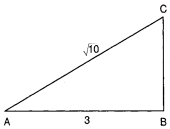
We have,
{tex}cosec \;A = \frac { \text { Hypotenuse } } { \text { Perpendicular } } = \frac { \sqrt { 10 } } { 1 }{/tex}
So, we draw a right triangle ABC, right-angled at B such that
Perpendicular = BC = 1 unit and, Hypotenuse{tex}= A C = \sqrt { 10 }{/tex}.
By Pythagoras theorem, we have
{tex}A C ^ { 2 } = A B ^ { 2 } + B C ^ { 2 }{/tex}
{tex}\Rightarrow \quad ( \sqrt { 10 } ) ^ { 2 } = A B ^ { 2 } + 1 ^ { 2 }{/tex}
{tex}\Rightarrow \quad A B ^ { 2 } = 10 - 1 = 9{/tex}
{tex}\Rightarrow \quad A B = \sqrt { 9 } = 3{/tex}
When we consider the trigonometric ratios of {tex}\angle A{/tex}, we have
Base = AB = 3 units, Perpendicular = BC = 1 units and, Hypotenuse{tex}= A C = \sqrt { 10 }{/tex} units
{tex}\therefore \quad \sin A = \frac { \text { Perpendicular } } { \text { Hypotenuse } } = \frac { 1 } { \sqrt { 10 } } , \cos A = \frac { \text { Base } } { \text { Hypotenuse } } = \frac { 3 } { \sqrt { 10 } }{/tex}
{tex}\tan A = \frac { \text { Perpendicular } } { \text { Base } } = \frac { 1 } { 3 } , \quad \sec A = \frac { \text { Hypotenuse } } { \text { Base } } = \frac { \sqrt { 10 } } { 3 }{/tex}.
and, {tex}\cot A = \frac { \text { Base } } { \text { Perpendicular } } = \frac { 3 } { 1 } = 3{/tex}
Posted by Samridhi Yadav 7 years, 1 month ago
- 0 answers
Posted by Soumajit Karak 7 years, 1 month ago
- 2 answers
Posted by Poonam Jyoti 6 years, 6 months ago
- 1 answers
Sia ? 6 years, 6 months ago
Let {tex} \alpha{/tex} and {tex} \frac { 1 } { \alpha }{/tex} be the zeros of (a2 + 9)x2 + 13x + 6a.
Then, we have
{tex} \alpha \times \frac { 1 } { \alpha } = \frac { 6 a } { a ^ { 2 } + 9 }{/tex}
⇒ 1 = {tex} \frac { 6 a } { a ^ { 2 } + 9 }{/tex}
⇒ a2 + 9 = 6a
⇒ a2 - 6a + 9 = 0
⇒ a2 - 3a - 3a + 9 = 0
⇒ a(a - 3) - 3(a - 3) = 0
⇒ (a - 3) (a - 3) = 0
⇒ (a - 3)2 = 0
⇒ a - 3 = 0
⇒ a = 3
So, the value of a in given polynomial is 3.
Posted by Krish Rawat 7 years, 1 month ago
- 2 answers
Posted by Aditya Dwivedi 7 years, 1 month ago
- 1 answers
Posted by Harsh Bardhan 7 years, 1 month ago
- 0 answers
Posted by Akash Mishra 7 years, 1 month ago
- 1 answers
Posted by Abhishek Kumar 7 years, 1 month ago
- 3 answers
Guru Patel 7 years, 1 month ago
Posted by Shreya Gupta 7 years, 1 month ago
- 2 answers
Vinutha Lohithesh 7 years, 1 month ago
Vinutha Lohithesh 7 years, 1 month ago
Posted by Rizwan Alam 7 years, 1 month ago
- 2 answers
Posted by Garima Demla 7 years, 1 month ago
- 3 answers
Garima Demla 7 years, 1 month ago
Posted by Purvanshi Yadav 7 years, 1 month ago
- 2 answers
Omprakash Bishnoi 7 years, 1 month ago
Pragati ... 7 years, 1 month ago
Posted by Ritesh Nirman 7 years, 1 month ago
- 1 answers
Posted by Priyanshu Sinha 6 years, 6 months ago
- 1 answers
Sia ? 6 years, 6 months ago
Let AB = x, BC = x
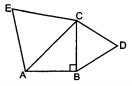
Area of an equilateral triangle of side a = {tex}\frac { \sqrt { 3 } } { 4 }{/tex}a2
Area of {tex}\triangle{/tex}BCD = {tex}\frac { \sqrt { 3 } } { 4 }{/tex}x2 ..(i)
Now side AC = {tex}\sqrt { x ^ { 2 } + x ^ { 2 } } = \sqrt { 2 x ^ { 2 } } = x \sqrt { 2 }{/tex} (by pythagoras theorem)
Area of {tex}\triangle{/tex}ACE = {tex}\frac { \sqrt { 3 } } { 4 } ( \sqrt { 2 } x ) ^ { 2 }{/tex} = 2
{tex}\frac { \sqrt { 3 } } { 4 }{/tex}x2 = 2. Area of BCD [from (i)]
{tex}\therefore{/tex} ar{tex}\triangle{/tex}BCD = {tex}\frac{1}{2}{/tex}area of {tex}\triangle{/tex}ACE.
Posted by Chetan Lodha 7 years, 1 month ago
- 2 answers
Posted by Prajwal Oberoi 7 years, 1 month ago
- 4 answers
Äãßhù @@Sswäg 7 years, 1 month ago

myCBSEguide
Trusted by 1 Crore+ Students

Test Generator
Create papers online. It's FREE.

CUET Mock Tests
75,000+ questions to practice only on myCBSEguide app
