
Ask questions which are clear, concise and easy to understand.
Ask QuestionPosted by Raushan Raj 7 years, 1 month ago
- 1 answers
Posted by Saket Parihar 7 years, 1 month ago
- 1 answers
Posted by Aniket Patil 7 years, 1 month ago
- 0 answers
Posted by Muskan Soni 7 years, 1 month ago
- 1 answers
Mr. Singh 7 years, 1 month ago
Posted by Abdul Wajid Malik 7 years, 1 month ago
- 5 answers
Zohran Jamil 7 years, 1 month ago
Posted by Akash Parashar 7 years, 1 month ago
- 5 answers
Mr. Singh 7 years, 1 month ago
Nidhi 23 7 years, 1 month ago
Posted by Om Chauhan 7 years, 1 month ago
- 0 answers
Posted by Hemant Kumer 7 years, 1 month ago
- 1 answers
Posted by Mahesh Kumar Yadav 6 years, 6 months ago
- 1 answers
Sia ? 6 years, 6 months ago
We have,
{tex}2\left(\frac{\cos58^\circ}{\sin32^\circ}\right)-\sqrt3\left(\frac{\cos38^\circ cosec52^\circ}{\tan15^\circ\tan60^\circ\tan75^\circ}\right){/tex}
{tex}=2\left\{\frac{\cos\left(90^\circ-32^\circ\right)}{\sin32^\circ}\right\}-\sqrt3\left\{\frac{\cos38^\circ cosec\left(90^\circ-38^\circ\right)}{\tan15^\circ\tan60^\circ\tan\left(90^\circ-15^\circ\right)}\right\}{/tex}
{tex}= 2 \left( \frac { \sin 32 ^ { \circ } } { \sin 32 ^ { \circ } } \right) - \sqrt { 3 } \left\{ \frac { \cos 38 ^ { \circ } \sec 38 ^ { \circ } } { \tan 15 ^ { \circ } \times \sqrt { 3 } \times \cot 15 ^ { \circ } } \right\}{/tex} {tex}\left[\because\;\cos\left(90-\theta\right)=\sin\theta\;,\;\cos ec\left(90-\theta\right)=sec\theta,\;\tan\left(90-\theta\right)=cot\theta\;\right]{/tex}
{tex}= 2 - \sqrt { 3 } \left\{ \frac { \cos 38 ^ { \circ } \times \frac { 1 } { \cos 38 ^ { \circ } } } { \tan 15 ^ { \circ } \times \sqrt { 3 } \times \frac { 1 } { \tan 15 ^ { \circ } } } \right\} = 2 - \frac { \sqrt { 3 } } { \sqrt { 3 } } = 2 - 1 = 1{/tex} {tex}\left[sec\theta=\frac1{\cos\theta},\;cot\theta=\frac1{\tan\theta}\right]{/tex}
therefore, {tex}2\left(\frac{\cos58^\circ}{\sin32^\circ}\right)-\sqrt3\left(\frac{\cos38^\circ cosec52^\circ}{\tan15^\circ\tan60^\circ\tan75^\circ}\right)=1{/tex}
Posted by Aditya Ujjwal 5 years, 8 months ago
- 2 answers
Sarita S 7 years, 1 month ago
Abhishek Varma 7 years, 1 month ago
Posted by Saachi Kakkar 7 years, 1 month ago
- 5 answers
Posted by Satyanarayan Tamboli 7 years, 1 month ago
- 2 answers
Posted by Partha Sengupta 7 years, 1 month ago
- 1 answers
Posted by Nitin Jangra 7 years, 1 month ago
- 6 answers
Posted by Nitin Jangra 7 years, 1 month ago
- 4 answers
Posted by Nimisha Sharma 7 years, 1 month ago
- 0 answers
Posted by Susmita Kumari 6 years, 6 months ago
- 1 answers
Sia ? 6 years, 6 months ago
We have to draw a line segment of length 7 cm.Then,we have to find a point P on it, which divides it in the ratio 3 : 5.
Steps of construction:
- Draw a line segment {tex}AB=7{/tex} cm.
- Draw a ray AX, making an acute {tex}\angle BAX{/tex} with AB.
- Mark {tex}3+5=8{/tex} points, i.e, {tex}A_1, A_2, A_3, A_4 ...A_8{/tex} on AX, such that {tex}AA_1 = A_1A_2 = A_2A_3 = A_3A_4 ... = A_7A_8{/tex}
- Join A{tex}_8{/tex}B
- From A3, draw {tex}A_3P || A_8B{/tex} which intersects AB at point P [ by making an angle at A3 equal to {tex}\angle AA_8B{/tex}
Then, P is the point on AB which divides it in the ratio 3:5. So, {tex}AP : PB = 3:5{/tex}
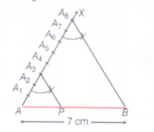
Justification: In {tex}\triangle ABA_8{/tex}, we have {tex}A_3P || A_8B{/tex}
{tex}\therefore \frac{AP}{PB}=\frac{AA_3}{A_3A_8}{/tex} [ by basic proportionality theorem]
By construction, {tex}\frac{AA_3}{A_3A_8}=\frac{3}{5}{/tex}
Hence, {tex}\frac{AP}{PB}=\frac{3}{5}{/tex}
Posted by Mr. Singh 7 years, 1 month ago
- 1 answers
Kanha Bhai 7 years, 1 month ago
Posted by Garima Demla 7 years, 1 month ago
- 3 answers
Posted by Rahul Kumar 7 years, 1 month ago
- 1 answers
Posted by Ayushi Goel 7 years, 1 month ago
- 0 answers
Posted by Rdx Trox 7 years, 1 month ago
- 4 answers
Golu Mis 7 years, 1 month ago
Posted by Ashin K 6 years, 6 months ago
- 1 answers
Sia ? 6 years, 6 months ago
According to the question, {tex}\triangle ABC {/tex} is an equilateral triangle.
In {tex}\triangle{/tex}ABD, using Pythagoras theorem,
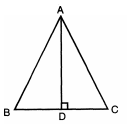
{tex}\Rightarrow{/tex} AB2 = AD2 + BD2
{tex}\Rightarrow{/tex} BC2 = AD2 + BD2, (as AB = BC = CA)
{tex}\Rightarrow{/tex} (2 BD)2 = AD2 + BD2, (perpendicular is the median in an equilateral triangle)
{tex}\Rightarrow{/tex} 4BD2 - BD2 = AD2
{tex}\therefore{/tex} 3BD2 = AD2
Posted by Haider Malik 7 years, 1 month ago
- 1 answers
Posted by Saif Ansari 7 years, 1 month ago
- 3 answers
Zeenat Siddiqui?? 7 years, 1 month ago
Komal Jha 7 years, 1 month ago
Posted by Niraj Singh 7 years, 1 month ago
- 1 answers
Kannu Kranti Yadav 7 years, 1 month ago
Posted by Divyanshi Singh 7 years, 1 month ago
- 2 answers
Mr. Singh 7 years, 1 month ago

myCBSEguide
Trusted by 1 Crore+ Students

Test Generator
Create papers online. It's FREE.

CUET Mock Tests
75,000+ questions to practice only on myCBSEguide app

Shivam Anand 7 years, 1 month ago
1Thank You