
Ask questions which are clear, concise and easy to understand.
Ask QuestionPosted by Alphonsa Nixon 6 years, 6 months ago
- 1 answers
Sia ? 6 years, 6 months ago
{tex}sec\ \theta+ tan\ \theta = p{/tex} ...(i)
Also {tex}sec^2 \theta - tan^2 \theta = 1{/tex}
{tex}\Rightarrow{/tex} (sec {tex}\theta{/tex} - tan {tex}\theta{/tex}) (sec {tex}\theta{/tex} + tan {tex}\theta{/tex}) = 1
{tex}\Rightarrow{/tex} p(sec {tex}\theta{/tex} - tan {tex}\theta{/tex}) = 1
[using equation (i)]
{tex}\Rightarrow{/tex} sec {tex}\theta{/tex} - tan {tex}\theta{/tex} {tex}=\frac{1}{p}{/tex} ...(ii)
(ii) - (i) we get
{tex}-2 tan{/tex} {tex}\theta{/tex} {tex}=\frac{1-p^{2}}{p}{/tex}
{tex}\Rightarrow{/tex}- tan {tex}\theta{/tex} {tex}=\frac{1-p^{2}}{2 p}{/tex}
{tex}\Rightarrow{/tex}- cot {tex}\theta{/tex} {tex}=\frac{2 p}{1-p^{2}}{/tex}
cot {tex}\theta{/tex} {tex}=\left(\frac{2 p}{1-p^{2}}\right)^{2}{/tex}
{tex}=\frac{-4 p^{2}}{\left(1-p^{2}\right)^{2}}{/tex}
{tex}\Rightarrow{/tex} {tex}cosec^2{/tex} {tex}\theta{/tex} - 1 {tex}=\frac{-4 p^{2}}{\left(1-p^{2}\right)^{2}}{/tex}
{tex}\Rightarrow{/tex} {tex}cosec^2{/tex} {tex}\theta{/tex} {tex}=\frac{-4 p^{2}}{\left(1-p^{2}\right)^{2}}+1=\frac{-4 p^{2}+\left(1-p^{2}\right)^{2}}{\left(1-p^{2}\right)^{2}}{/tex}
{tex}cosec^2{/tex} {tex}\theta{/tex} {tex}=\frac{-4 p^{2}+1+p^{4}-2 p^{2}}{\left(1-p^{2}\right)^{2}}{/tex}
{tex}=\frac{\left(1+p^{2}\right)^{2}}{\left(1-p^{2}\right)^{2}}{/tex}
{tex}\Rightarrow{/tex} {tex}cosec\ \theta{/tex} {tex}=\frac{1+p^{2}}{1-p^{2}}{/tex}
Posted by Aradhana Singh 6 years, 11 months ago
- 4 answers
Aradhana Singh 6 years, 11 months ago
Posted by Dev Shah 6 years, 11 months ago
- 1 answers
Aradhana Singh 6 years, 11 months ago
Posted by Dheeraj Tushir 6 years, 11 months ago
- 4 answers
Raunak _ Pandey ?? 6 years, 11 months ago
Shreyas S 6 years, 11 months ago
Posted by Shruti Raj 6 years, 11 months ago
- 2 answers
Gogul Krishnan 6 years, 11 months ago
Mayank Gorana 6 years, 11 months ago
Posted by Prakash Thakur 6 years, 6 months ago
- 1 answers
Sia ? 6 years, 6 months ago
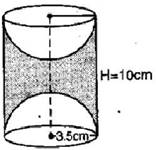
TSA of the article = 2{tex}\pi{/tex}rh + 2(2{tex}\pi{/tex}r2)
= 2{tex}\pi{/tex} (7)(20) + 2[2{tex}\pi{/tex} (7)2]
= 280{tex}\pi{/tex} + 98{tex}\pi{/tex}
= 378{tex}\pi{/tex}
= 378{tex}\times{/tex} {tex}\frac {22}7{/tex}
= 1188 cm 2
Posted by Vaishnavi Sappa 6 years, 11 months ago
- 1 answers
Posted by Ayush Kumar 6 years, 11 months ago
- 2 answers
Posted by J.R.Priya Dharshini 6 years, 11 months ago
- 6 answers
J.R.Priya Dharshini 6 years, 11 months ago
Posted by Dream Girl 6 years, 6 months ago
- 1 answers
Sia ? 6 years, 6 months ago
Since {tex}(5x+2), (4x-1)\ and\ (x+2){/tex} are in AP, we have
{tex}(4x-1)-(5x+2)=(x+2)-(4x-1){/tex}
{tex}\Rightarrow{/tex} {tex}4x-1-5x-2=x+2-4x+1{/tex}
{tex}\Rightarrow{/tex} {tex}-x-3=-3x+3{/tex}
{tex}\Rightarrow{/tex} 2x = 6
{tex}\Rightarrow{/tex} x = 3.
Posted by Vansh Gautam 6 years, 6 months ago
- 1 answers
Sia ? 6 years, 6 months ago
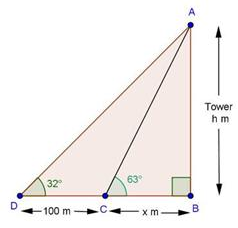
Let height of tower = h m
Let distance {tex}BC = x \ m{/tex}
In {tex}\Delta ABC{/tex}
{tex}\tan {63^o} = \frac{{AB}}{{BC}}{/tex}
{tex} \Rightarrow 1.9626 = \frac{h}{x}{/tex}
{tex} \Rightarrow x = \frac{h}{{1.9626}}{/tex}
{tex} \Rightarrow x = 0.5095h{/tex} ...(i)
In {tex}\Delta ABD{/tex}
{tex}tan32^\circ= \frac{h}{{100 + x}}{/tex}
{tex}\Rightarrow 0.6248= \frac{h}{{100 + x}}{/tex}
{tex} \Rightarrow h = 62.48 + 0.6248x{/tex}
{tex} \Rightarrow h = 62.48 + 0.6248 \times 0.5059h{/tex}
{tex} \Rightarrow 0.6817h = 62.48{/tex}
{tex} \Rightarrow h = \frac{{62.48}}{{0.6817}} = 91.65m{/tex}
Put value of h in Eq(i) , we get
{tex}x = 0.5095 \times 91.65 = 46.69m{/tex}
{tex}\therefore{/tex} Height of tower = 91.65 m
Distance of first position from tower {tex}= 100 + x{/tex}
{tex}= 100 + 46.69 \\ = 146.69 m{/tex}
Posted by Karann Deep 6 years, 11 months ago
- 6 answers
Shivani Jangid 6 years, 11 months ago
Posted by Neelam Sahu 6 years, 11 months ago
- 1 answers
Yogita Ingle 6 years, 11 months ago
The radius of circle = 8cm
diameter = 8 × 2 = 16cm
The diameter of circle = diagonal of square = 16cm
area of square = (diagonal)²/2 = 16²/2 = 256/2 = 128cm²
Posted by Sham_Bhavi Xyz 6 years, 11 months ago
- 4 answers
Yogita Ingle 6 years, 11 months ago
Sum of zeros = –5 + 4 = – 1,
Product of zeros = – 5 × 4 = – 20
Required polynomial = x2 + x – 20
</div>Sapna Jain 6 years, 11 months ago
Posted by Rupal ???? 6 years, 6 months ago
- 1 answers
Sia ? 6 years, 6 months ago
Given, acos{tex} \theta{/tex} - b sin{tex} \theta{/tex} = c
Squaring on both sides
(a cos{tex} \theta{/tex} - b sin{tex} \theta{/tex})2 = c2
By Adding (a sin{tex} \theta{/tex} + b cos{tex} \theta{/tex})2 on both sides, we get
(a cos{tex} \theta{/tex} - b sin{tex} \theta{/tex})2 + (a sin{tex} \theta{/tex} + b cos{tex} \theta{/tex})2 =c2 + (a sin{tex} \theta{/tex} + b cos{tex} \theta{/tex})2
(a2cos2{tex} \theta{/tex} + b2sin2{tex} \theta{/tex} - 2ab sin{tex} \theta{/tex} cos{tex} \theta{/tex}) + (a2sin2{tex} \theta{/tex} + b2cos2{tex} \theta{/tex} + 2ab sin{tex} \theta{/tex} cos{tex} \theta{/tex}) =c2 + (a sin{tex} \theta{/tex} + b cos{tex} \theta{/tex})2
a2(cos2{tex} \theta{/tex} + sin2{tex} \theta{/tex}) + b2(sin2{tex} \theta{/tex} + cos2{tex} \theta{/tex})=c2 + (a sin{tex} \theta{/tex} + b cos{tex} \theta{/tex})2
a2 + b2 = c2 + (a sin{tex} \theta{/tex} + b cos{tex} \theta{/tex})2
{tex} \Rightarrow{/tex} (a sin{tex} \theta{/tex} + b cos{tex} \theta{/tex})2 = a2 + b2 - c2
{tex} \Rightarrow{/tex} a sin{tex} \theta{/tex} + b cos{tex} \theta{/tex} = {tex} \pm \sqrt { a ^ { 2 } + b ^ { 2 } - c ^ { 2 } }{/tex}
Posted by Muskan Ojha 6 years, 11 months ago
- 5 answers
Posted by Harshit Jain 6 years, 11 months ago
- 6 answers
Posted by Kumkum Saini 6 years, 11 months ago
- 1 answers
Shivani Jangid 6 years, 11 months ago
Posted by Lakshay Dalla 6 years, 11 months ago
- 1 answers
Harshika Saxena 6 years, 11 months ago
Posted by Subodh Saini 6 years, 11 months ago
- 7 answers
Posted by Chinmay Sadhwani 5 years, 8 months ago
- 7 answers
Rishabh Jain 6 years, 11 months ago
Posted by Utu Pandey 6 years, 11 months ago
- 1 answers
Posted by Uttam Tiwari 6 years, 11 months ago
- 3 answers
Shivam The Galaxy 6 years, 11 months ago
Posted by Karthika Ramesh 5 years, 8 months ago
- 1 answers
Shivani Jangid 6 years, 11 months ago
Posted by Hardik Sethi 6 years, 11 months ago
- 2 answers
Posted by Muskan Ojha 6 years, 11 months ago
- 2 answers
Muskan Ojha 6 years, 11 months ago

myCBSEguide
Trusted by 1 Crore+ Students

Test Generator
Create papers online. It's FREE.

CUET Mock Tests
75,000+ questions to practice only on myCBSEguide app

Sia ? 6 years, 6 months ago
Area of minor sector = {tex}\frac { \theta } { 360 } \times \pi r ^ { 2 }{/tex}
{tex}= \frac { 90 } { 360 } \times 3.14 \times 10 \times 10 = 78.5 \mathrm { cm } ^ { 2 }{/tex}
Area of {tex}\triangle O A B = \frac { O A \times O B } { 2 }{/tex}
{tex}= \frac { 10 \times 10 } { 2 } = 50 \mathrm { cm } ^ { 2 }{/tex}
{tex}\therefore {/tex} Area of the minor segment
= Area of minor sector - Area of {tex}\triangle O A B{/tex}
{tex}= 78.5 \mathrm { cm } ^ { 2 } - 50 \mathrm { cm } ^ { 2 } = 28.5 \mathrm { cm } ^ { 2 }{/tex}
{tex}= 3.14 \times 10 \times 10 - 78.5{/tex}
{tex}= 314 - 78.5 = 235.5 \mathrm { cm } ^ { 2 }{/tex}
Alternative method
Area of major sector = {tex}\frac { 360 - \theta } { 360 } \times \pi r ^ { 2 }{/tex}
{tex}= \frac { 360 - 90 } { 360 } \times 3.14 \times ( 10 ) ^ { 2 } = 235.5 \mathrm { cm } ^ { 2 }{/tex}
0Thank You