
Ask questions which are clear, concise and easy to understand.
Ask QuestionPosted by Suyog Bhandari 6 years, 11 months ago
- 3 answers
Posted by Abhishek Meena 6 years, 11 months ago
- 5 answers
Yaar 6 years, 11 months ago
Hello Hello 6 years, 11 months ago
Posted by Nishit Sharna 6 years, 11 months ago
- 1 answers
Posted by N Mukesh Thakur 6 years, 11 months ago
- 1 answers
Posted by Aryan Oberoy 6 years, 11 months ago
- 1 answers
Posted by Dubari Baruah 6 years, 6 months ago
- 1 answers
Posted by Sneha Mishra 6 years, 11 months ago
- 2 answers
Divya Keshav 6 years, 11 months ago
Maithili Bompilwar 6 years, 11 months ago
Posted by Vaibhav Saini 6 years, 11 months ago
- 0 answers
Posted by Teesha Sharma 6 years, 11 months ago
- 1 answers
Posted by Aryan Pradhan 6 years, 6 months ago
- 1 answers
Sia ? 6 years, 6 months ago
Let a1 and a2 be the first terms and d1 and d2 be the common difference of the two APs respectively.
Let Sn and S'n be the sums of the first n terms of the two APs and Tn and T'n be their nth terms respectively.
Then, {tex}\frac { S _ { n } } { S _ { n } ^ { \prime } } = \frac { 7 n + 1 } { 4 n + 27 } \Rightarrow \frac { \frac { n } { 2 } \left[ 2 a _ { 1 } + ( n - 1 ) d _ { 1 } \right] } { \frac { n } { 2 } \left[ 2 a _ { 2 } + ( n - 1 ) d _ { 2 } \right] } = \frac { 7 n + 1 } { 4 n + 27 }{/tex}
{tex}\Rightarrow \frac { 2 a _ { 1 } + ( n - 1 ) d _ { 1 } } { 2 a _ { 2 } + ( n - 1 ) d _ { 2 } } = \frac { 7 n + 1 } { 4 n + 27 }{/tex} ........(i)
To find the ratio of mth terms, we replace n by (2m -1) in the above expression.
Replacing n by (2 {tex}\times{/tex} 9 -1), i.e., 17 on both sides in (i), we get
{tex}\frac { 2 a _ { 1 } + ( 17 - 1 ) d _ { 1 } } { 2 a _ { 2 } + ( 17 - 1 ) d _ { 2 } } = \frac { 7 \times 17 + 1 } { 4 \times 17 + 27 } \Rightarrow \frac { 2 a _ { 1 } + 16 d _ { 1 } } { 2 a _ { 2 } + 16 d _ { 2 } } = \frac { 120 } { 95 }{/tex}
{tex}\Rightarrow \frac { a _ { 1 } + 8 d _ { 1 } } { a _ { 2 } + 8 d _ { 2 } } = \frac { 24 } { 19 }{/tex}
{tex}\Rightarrow \frac { a _ { 1 } + ( 9 - 1 ) d _ { 1 } } { a _ { 2 } + ( 9 - 1 ) d _ { 2 } } = \frac { 24 } { 19 }{/tex}
{tex}\Rightarrow \frac { a _ { 1 } + ( 9 - 1 ) d _ { 1 } } { a _ { 2 } + ( 9 - 1 ) d _ { 2 } } = \frac { 24 } { 19 }{/tex}
{tex}\Rightarrow \frac { T _ { 9 } } { T _ { 9 } ^ { \prime } } = \frac { 24 } { 19 }{/tex}
{tex}\therefore{/tex} required ratio = 24:19.
Posted by Ansh Nanesha 6 years, 11 months ago
- 6 answers
Abhishek Sahu 6 years, 11 months ago
@Kumu...#Vk... ?? 6 years, 11 months ago
Riya ? 6 years, 11 months ago
Rishabh Jain 6 years, 11 months ago
Posted by Deepak Deepak 6 years, 11 months ago
- 2 answers
Posted by Aarushi Yadav 6 years, 11 months ago
- 3 answers
Ram Kushwah 6 years, 11 months ago
Let the two odd positive no. be x = 2k + 1 and y = 2p + 1
Hence, x2 + y2 = (2k + 1)2 +(2p + 1)2
= 4k2 + 4k + 1 + 4p2 + 4p + 1
= 4k2 + 4p2 + 4k + 4p + 2
= 4 (k2 + p2 + k + p) + 2
clearly, notice that the sum of square is even the no. is not divisible by 4
hence, if x and y are odd positive integer, then x2 + y2 is even but not divisible by four
Posted by Aman Singh Yadav 6 years, 11 months ago
- 2 answers
Ram Kushwah 6 years, 11 months ago
Roots of px2-5x+p=0 are equal
if (-5)2=4p(p)
4p2=25
p2=25/4
p=5/2
Posted by Ayush Sharma 6 years, 11 months ago
- 2 answers
Yashomani Maurya 6 years, 11 months ago
Riya ? 6 years, 11 months ago
Posted by Ashish Dubey 6 years, 11 months ago
- 2 answers
Ram Kushwah 6 years, 11 months ago
by pythagoras theorem
base2 + heigh2=hypo2
divide by hypo2
base2/hypo2 + height2/hypo2=hypo2/hypo2
sin2x+cos2x=1
Posted by Kavita Khushwaha 6 years, 11 months ago
- 2 answers
Posted by Chetan Sharma 6 years, 11 months ago
- 1 answers
Ram Kushwah 6 years, 11 months ago
IF NEW TRIANGLE IS PQR THEN SIDES ARE
6*3/5,8*3/5,9*3/5
OR 3.6 cm,4.8 cm and 5.4 cm so make the new triangle with these sides
Posted by Rishabh Jain 6 years, 6 months ago
- 1 answers
Sia ? 6 years, 6 months ago
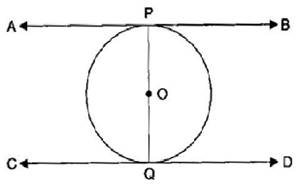
Given: PQ is a diameter of a circle with centre O.
The lines AB and CD are the tangents at P and Q respectively.
To Prove: AB {tex}\parallel{/tex} CD
Proof: Since AB is a tangent to the circle at P and OP is the radius through the point of contact.
{tex}\therefore{/tex} {tex}\angle{/tex}OPA = 90o ........ (i)
[The tangent at any point of a circle is {tex}\perp{/tex} to the radius through the point of contact]
{tex}\because{/tex} CD is a tangent to the circle at Q and OQ is the radius through the point of contact.
{tex}\therefore{/tex} {tex}\angle{/tex}OQD = 90o ........ (ii)
[The tangent at any point of a circle is {tex}\perp{/tex} to the radius through the point of contact]
From eq. (i) and (ii), {tex}\angle{/tex}OPA = {tex}\angle{/tex}OQD
But these form a pair of equal alternate angles also,
{tex}\therefore{/tex} AB {tex}\parallel{/tex} CD
Posted by Nikhil Raj 6 years, 11 months ago
- 3 answers
Posted by Sourabh Bhardwaj 6 years, 11 months ago
- 3 answers
Rishabh Jain 6 years, 11 months ago
Posted by Pramod Kumar 6 years, 6 months ago
- 1 answers
Sia ? 6 years, 6 months ago
Let n be a given positive odd integer.
On dividing n by 6, let m be the quotient and r be the remainder.
Then, by Euclid's division lemma, we have
{tex}n = 6m + r{/tex}, where {tex}0 \leq r < 6{/tex}
{tex}\Rightarrow{/tex} {tex}n = 6m + r{/tex}, where {tex}r = 0, 1, 2, 3, 4, 5{/tex}
{tex}\Rightarrow{/tex} {tex}n = 6m\ or\ (6m + 1){/tex} {tex}or\ (6m + 2)\ or\ (6m + 3)\ or\ (6m + 4)\ or\ (6m + 5).{/tex}
But, {tex}n = 6m, (6m + 2), (6m + 4){/tex} give even values of n.
Thus, when n is odd, it is of the form {tex}(6m + 1)\ or\ (6m + 3)\ or\ (6m + 5){/tex} for some integer m.
Posted by Aditya Gupta 6 years, 11 months ago
- 1 answers
Posted by Ranbir Yaday Yadav 6 years, 11 months ago
- 1 answers
Posted by Gundeep Singh 6 years, 11 months ago
- 2 answers
Puja Sahoo 6 years, 11 months ago
Posted by Harshita Sharma 6 years, 11 months ago
- 4 answers
Harshita Sharma 6 years, 11 months ago
Posted by Dayal Shankar Verma 6 years, 11 months ago
- 1 answers
Hariesh Lokesh 6 years, 11 months ago

myCBSEguide
Trusted by 1 Crore+ Students

Test Generator
Create papers online. It's FREE.

CUET Mock Tests
75,000+ questions to practice only on myCBSEguide app

Suyog Bhandari 6 years, 11 months ago
0Thank You