
Ask questions which are clear, concise and easy to understand.
Ask QuestionPosted by Aman Kumar 7 years, 2 months ago
- 3 answers
Posted by Pawan Sharma 7 years, 2 months ago
- 4 answers
Anushka Jugran ? 7 years, 2 months ago
Posted by Neeraj Maran 7 years, 2 months ago
- 2 answers
Krishnav Maheshwari 7 years, 2 months ago
Posted by Ankush Kamboj 7 years, 2 months ago
- 1 answers
Krishnav Maheshwari 5 years, 11 months ago
Posted by Nisha Devi 7 years, 2 months ago
- 0 answers
Posted by Vishakha Singh? 7 years, 2 months ago
- 1 answers
Vishakha Singh? 7 years, 2 months ago
Posted by ?Garima Sharma? 7 years, 2 months ago
- 5 answers
Naveen Tiwari 7 years, 2 months ago
Posted by ?Garima Sharma? 7 years, 2 months ago
- 2 answers
Puja Sahoo? 7 years, 2 months ago
Posted by Roshan Kumar 7 years, 2 months ago
- 1 answers
Posted by Ishant Mathur 7 years, 2 months ago
- 0 answers
Posted by Ishmeet Kaur 5 years, 11 months ago
- 1 answers
Sia ? 6 years, 9 months ago
Let the point on y-axis be P(0, y) and AP: PB = K: 1
Therefore {tex}\frac { 5 - k } { k + 1 } = 0{/tex} gives k = 5
Hence required ratio is 5: 1
{tex}y = \frac { - 4 ( 5 ) - 6 } { 6 } = \frac { - 13 } { 3 }{/tex}
Hence point on y-axis is {tex}\left( 0 , \frac { - 13 } { 3 } \right){/tex}.
Posted by Mohan Kumar 7 years, 2 months ago
- 3 answers
Posted by Baldev Sharma 7 years, 2 months ago
- 4 answers
. . 7 years, 2 months ago
Posted by Jatin Verma 7 years, 2 months ago
- 1 answers
Posted by Isha Saini 7 years, 2 months ago
- 2 answers
Yogita Ingle 7 years, 2 months ago
Surface area = 4 πr2
2464 = 4 × 22/7 × r2
2464 = 88/7 × r2
r2 = 2464 × 7/88
r2 = 28 × 7
r2 = 7× 4 × 7
r = 7 × 2
r = 14 cm
New radius = 2r = 2 × 14 = 28 cm
New surface area = 4 × 22/7 × 28 × 28 = 9856 cm2
Posted by Aryaa Aryaa 7 years, 2 months ago
- 0 answers
Posted by Lakshay Chauhan 7 years, 2 months ago
- 4 answers
Shubhendra Singh ? 7 years, 2 months ago
Posted by Pooja Rao 7 years, 2 months ago
- 4 answers
Chetna Pandey 7 years, 2 months ago
Posted by Manjot Panag 7 years, 2 months ago
- 4 answers
Posted by Ashish Singh 6 years, 8 months ago
- 1 answers
Sia ? 6 years, 8 months ago
In right {tex}\triangle {/tex}AMB,
tan B = {tex}\frac { 3 } { 4 }{/tex}
{tex}\Rightarrow{/tex} {tex}\frac { A M } { B M } = \frac { 3 } { 4 }{/tex}
{tex}\Rightarrow{/tex} 4AM = 3BM {tex}\Rightarrow{/tex}BM = {tex}\frac { 4 } { 3 }{/tex}AM ...(i)
In right {tex}\triangle{/tex}AMC,
tan C = {tex}\frac { \mathrm { AM } } { \mathrm { MC } }{/tex}
{tex}\Rightarrow \frac { 5 } { 12 } = \frac { \mathrm { AM } } { \mathrm { MC } }{/tex}
{tex}\Rightarrow{/tex} MC = {tex}\frac { 12 } { 5 }{/tex} AM ...(ii)
Now, BM + MC = BC
{tex}\frac { 4 } { 3 }{/tex}AM + {tex}\frac { 12 } { 5 }{/tex}AM = 56
AM {tex}\left( \frac { 4 } { 3 } + \frac { 12 } { 5 } \right){/tex} = 56
AM {tex}\left( \frac { 20 + 36 } { 15 } \right){/tex} = 56
{tex}\Rightarrow{/tex} AM = {tex}\frac { 56 \times 15 } { 56 }{/tex}
= 15 cm
Posted by Shagun Sharma 7 years, 2 months ago
- 2 answers
Ram Kushwah 7 years, 2 months ago
Asinx=Bcosx
sinx/cosx=B/A
tanx =B/A
sec2x-1=tan2x=B/A
Posted by Mohd Sameer 6 years, 9 months ago
- 1 answers
Sia ? 6 years, 9 months ago
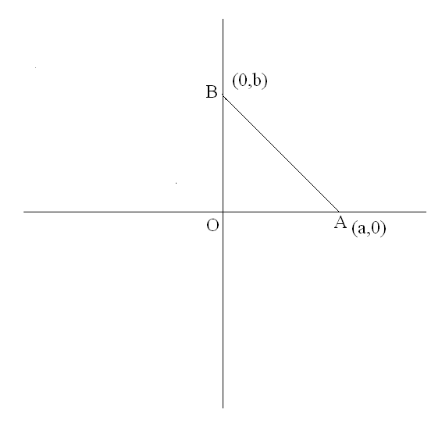
The coordinate of A (a,0), B (0,b) and O (0, 0)
Area of Triangle AOB {tex} = \frac{1}{2} \times base \times height{/tex}
{tex} = \frac{1}{2} \times a \times b = \frac{1}{2}ab\,sq.\,units{/tex}
Posted by Zain Zalm 7 years, 2 months ago
- 1 answers
Posted by Vishu Joshi 7 years, 2 months ago
- 1 answers
Chitransh Pratap Singh 7 years, 2 months ago

myCBSEguide
Trusted by 1 Crore+ Students

Test Generator
Create papers online. It's FREE.

CUET Mock Tests
75,000+ questions to practice only on myCBSEguide app

Sia ? 6 years, 9 months ago
Let us suppose that the ten's digit of required number be x and its unit digit be y respectively.
Therefore, required number = 10x + y
According to the given conditions
10x + y = 4(x + y) + 3
{tex} \Rightarrow{/tex} 10x + y = 4x + 4y + 3
or, 10x +y - 4x - 4y = 3
{tex} \Rightarrow{/tex} 6x - 3y = 3
{tex} \Rightarrow{/tex} 2x - y = 1...........(i)
and
10x + y + 18 = 10y + x
{tex}\Rightarrow{/tex}10x + y - 10y - x = - 18
{tex} \Rightarrow{/tex}9x - 9y = -18
{tex} \Rightarrow{/tex}9(x - y) = -18
{tex} \Rightarrow ( x - y ) = \frac { - 18 } { 9 }{/tex}
{tex} \Rightarrow{/tex}x - y = - 2 .........(ii)
Subtracting equation (ii) from equation (i), we get
x - y - ( 2x - y) = - 2 - 1
x - y - 2x +y = - 3
- x = -3
{tex} \therefore{/tex}x = 3
Put the value of x = 3 in equation (i), we get
2{tex} \times{/tex}3 - y = 1
{tex} \Rightarrow{/tex}y = 6 - 1 = 5
{tex} \therefore{/tex} x = 3, y = 5
Required number = 10x + y
= 10 {tex} \times{/tex}3 + 5
= 30 + 5
= 35
Therefore the required number is 35.
0Thank You