
Ask questions which are clear, concise and easy to understand.
Ask QuestionPosted by Ravpreet Randhawa 7 years, 2 months ago
- 2 answers
Posted by Alvina Advin 6 years, 9 months ago
- 1 answers
Sia ? 6 years, 9 months ago
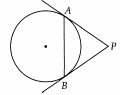
In Triangle APB
Since PA = PB (Tangents from same external point are euqal)
{tex}\therefore {/tex} {tex}\angle P A B = \angle P B A{/tex}
(Opposite angles to equal sides are equal)
Posted by Nitin Kumar 7 years, 2 months ago
- 1 answers
Yogita Ingle 7 years, 2 months ago
Given diameter of the copper rod = 1 cm
So, radius(r) of the copper rod = 1/2 cm
Let R is the radius of the cross section(circular) of the wire.
Now, according to the question,
πR2 ×(18×100) = π(1/2)2 ×8
⇒ R2 ×(18×100) = (1/2)2 ×8
⇒ R2 ×(18×100) = 8/4
⇒ R2 ×(18×100) = 2
⇒R2 = 2/(18×100)
⇒ R2 = 1/(9×100)
⇒ R = √{1/(9×100)}
⇒ R = 1/(3×10)
⇒ R = 1/30
Now, thickness of the wire = 2r = 2 × 1/30 = 2/30 = 1/15 = 0.067 cm
Posted by Aditya Kumar 7 years, 2 months ago
- 1 answers
Nishant Mahipal 7 years, 2 months ago
Posted by Paras Nagpal 6 years, 8 months ago
- 1 answers
Sia ? 6 years, 8 months ago
We have to find the greatest number that divides 445, 572 and 699 and leaves remainders of 4, 5 and 6 respectively. This means when the number divides 445, 572 and 699 leaves remainders 4, 5 and 6 is that
445 - 4 = 441, 572 - 5 = 567 and 699 - 6 = 693 are completely divisible by the required number.For the highest number which divides the above numbers can be calculated by HCF .
Therefore, the required number is the H.C.F. of 441, 567 and 693 Respectively.
First, consider 441 and 567.
By applying Euclid’s division lemma, we get
567 = 441 {tex}\times{/tex} 1 + 126
441 = 126 {tex}\times{/tex} 3 + 63
126 = 63 {tex}\times{/tex} 2 + 0.
Therefore, H.C.F. of 441 and 567 = 63
Now, consider 63 and 693
again we have to apply Euclid’s division lemma, we get
693 = 63 {tex}\times{/tex} 11 + 0.
Therefore, H.C.F. of 441, 567 and 693 is 63
Hence, the required number is 63. 63 is the highest number which divides 445,572 and 699 will leave 4,5 and 6 as remainder respectively.
Posted by Akshita Khandelwal 7 years, 2 months ago
- 1 answers
Posted by Mona Sharma ? 7 years, 2 months ago
- 2 answers
Posted by Aj Raghav 7 years, 2 months ago
- 5 answers
Posted by Sakshi Patel 7 years, 2 months ago
- 3 answers
Posted by Mohit Kumar 7 years, 2 months ago
- 2 answers
D.J Alok 7 years, 2 months ago
Posted by Pihu Saini 7 years, 2 months ago
- 2 answers
Gaurav Seth 7 years, 2 months ago
Given that two different dice are tossed.
Total number of outcomes = 62
= 36.
(1) Let A be the event of getting a doublet.
n(A) = {1,1},{2,2},{3,3},{4,4},{5,5},{6,6}
= 6.
Required probability P(A) = 6/36
= 1/6.
(ii) Let B be the event of getting a sum of 10 of the numbers of two dice.
n(B) = {6,4},{4,6},{5,5}
= 3.
Required probability P(B) = n(B)/n(S)
= 3/36
= 1/12
Posted by Arpita Bajpai 7 years, 2 months ago
- 2 answers
Disha Kumari 7 years, 2 months ago
Posted by Ayush Meshram 7 years, 2 months ago
- 1 answers
Disha Kumari 7 years, 2 months ago
Posted by Vikash Khare 7 years, 2 months ago
- 0 answers
Posted by Ramakant??? 8306360538 7 years, 2 months ago
- 2 answers
Gaurav Seth 7 years, 2 months ago
Second term (a2) = 8
fifth term (a5) = 17
we know that general formula of a term in ap is a+(n-1)d
therefore, a2=a+d 8=a+d
a5=a+4d 17=a+4d
solving the two equations simultaneously....
we get....d=3
{tex}\therefore{/tex} a=5 (a= First term)
Posted by Shubham Vashite 7 years, 2 months ago
- 2 answers
Posted by Nikhil Patel 7 years, 2 months ago
- 3 answers
Posted by Deepta Sreenivasan 6 years, 8 months ago
- 1 answers
Sia ? 6 years, 8 months ago
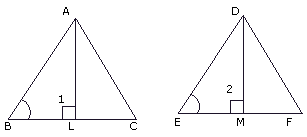
Given: Two triangles ABC and DEF such that {tex}\triangle {/tex}ABC {tex} \sim {/tex} {tex}\triangle {/tex}DEF
To prove: {tex}\frac{{ar\left( {\vartriangle ABC} \right)}}{{ar\left( {\vartriangle DEF} \right)}} = \frac{{A{B^2}}}{{D{E^2}}} = \frac{{B{C^2}}}{{E{F^2}}} = \frac{{A{C^2}}}{{D{F^2}}}{/tex}
Construction: Draw AL {tex} \bot {/tex} BC and DM {tex} \bot {/tex} EF
Proof:- Since similar triangles are equiangular and their corresponding sides are proportional
{tex}\therefore {/tex} {tex}\triangle {/tex} ABC {tex} \sim {/tex}{tex}\triangle {/tex}DEF
{tex}\Rightarrow {/tex} {tex}\angle{/tex} A = {tex}\angle{/tex} D, {tex}\angle{/tex} B = {tex}\angle{/tex} E, {tex}\angle{/tex} C ={tex}\angle{/tex}F
And {tex}\frac{{AB}}{{DE}} = \frac{{BC}}{{EF}} = \frac{{AC}}{{DF}}{/tex} .......(i)
In {tex}\triangle {/tex} ALB and {tex}\triangle {/tex} DMB,
{tex}\angle{/tex} 1= {tex}\angle{/tex} 2 and {tex}\angle{/tex} B= {tex}\angle{/tex} E
{tex}\Rightarrow {/tex} {tex}\triangle {/tex} ALB {tex} \sim {/tex} {tex}\triangle {/tex}DME [By AA similarity]
{tex}\Rightarrow {/tex}{tex}\frac{{AL}}{{DM}} = \frac{{AB}}{{DE}}{/tex} .....(ii)
From (i) and (ii), we get
{tex}\frac{{AB}}{{DE}} = \frac{{BC}}{{EF}} = \frac{{AC}}{{DF}} = \frac{{AL}}{{DM}}{/tex} ......(iii)
Now{tex}\frac{{area\left( {\vartriangle ABC} \right)}}{{area\left( {\vartriangle DEF} \right)}} = \frac{{\frac{1}{2}\left( {BC \times AL} \right)}}{{\frac{1}{2}\left( {BF \times DM} \right)}}{/tex}
{tex} \Rightarrow \frac{{area\left( {\vartriangle ABC} \right)}}{{area\left( {\vartriangle DEF} \right)}} = \frac{{BC}}{{EF}} \times \frac{{AL}}{{DM}}{/tex}
{tex} \Rightarrow \frac{{area\left( {\vartriangle ABC} \right)}}{{area\left( {\vartriangle DEF} \right)}} = \frac{{BC}}{{EF}} \times \frac{{BC}}{{EF}} = \frac{{B{C^2}}}{{E{F^2}}}{/tex}
Hence, {tex}\frac{{area\left( {\vartriangle ABC} \right)}}{{area\left( {\vartriangle DEF} \right)}} = \frac{{A{B^2}}}{{D{E^2}}} \times \frac{{B{C^2}}}{{E{F^2}}} = \frac{{A{C^2}}}{{D{F^2}}}{/tex}
Let the largest side of the largest triangle be x cm
Using above theorem,
{tex}\frac{{{x^2}}}{{{{27}^2}}} = \frac{{144}}{{81}} \Rightarrow \frac{x}{{27}} = \frac{{12}}{9}{/tex}
{tex}\Rightarrow {/tex} x = 36 cm
Posted by Rohit Bhagat Bgagat 7 years, 2 months ago
- 0 answers
Posted by Sanket Singh Rajpoot 7 years, 2 months ago
- 2 answers
Posted by Taanya Oberoi 7 years, 2 months ago
- 4 answers
Gaurav Seth 7 years, 2 months ago
Coordinates of the centroid G are
[ (x1+x2+x3) / 3, (y1+y2+y3 ) / 3]
Posted by Adithi Laxman 7 years, 2 months ago
- 0 answers
Posted by Jaskaran Kalsi 6 years, 8 months ago
- 1 answers
Sia ? 6 years, 8 months ago
Given, p = a2b3
and q = a3b
HCF(p,q) = a2b
LCM(p, q) = a3b3
{tex}\begin{array}{l}pq=a^2b^3\times a^3b=a^5b^4\;-----------(1)\\LCM(p,q)\times HCF(p,q)=a^3b^3\times a^2b=a^5b^4----(2)\\From\;equation\;(1)\;and\;(2)\;We\;get\\LCM(p,q)\times HCF(p,q)\;=\;pq\end{array}{/tex}
Posted by Nikhil Jais 7 years, 2 months ago
- 0 answers

myCBSEguide
Trusted by 1 Crore+ Students

Test Generator
Create papers online. It's FREE.

CUET Mock Tests
75,000+ questions to practice only on myCBSEguide app

Sia ? 6 years, 8 months ago
We have,
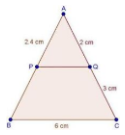
According to the question,we are given that,
{tex}P Q \| B C{/tex}
Therefore, by thales theorem,
We have,
{tex}\frac { A P } { P B } = \frac { A Q } { Q C }{/tex}
{tex}\frac { 2.4 } { P B } = \frac { 2 } { 3 }{/tex}
{tex}\Rightarrow P B = \frac { 3 \times 2.4 } { 2 }{/tex}
{tex}= \frac { 3 \times 24 } { 20 }{/tex}
{tex}= \frac { 3 \times 6 } { 5 }{/tex}
{tex}= \frac { 18 } { 5 }{/tex}
{tex}\Rightarrow{/tex} PB = 3.6 cm
Now, AB = AP + PB
= 2.4 + 3.6
= 6 cm
In {tex}\triangle {/tex}APQ and {tex}\triangle{/tex}ABC
{tex}\angle A = \angle A{/tex} [Common]
{tex}\angle A P Q = \angle A B C{/tex} [{tex}\because{/tex} PQ || BC {tex}\Rightarrow{/tex} Corresponding angles are equal]
{tex}\Rightarrow \triangle A P Q \sim \triangle A B C{/tex} [By AA criteria]
{tex}\Rightarrow \frac { A B } { A P } = \frac { B C } { P Q }{/tex} [Corresponding sides of similar triangles are proportional]
{tex}\Rightarrow \frac { 6 } { 2.4 } = \frac { 6 } { P Q }{/tex}
{tex}\Rightarrow P Q = \frac { 6 \times 2.4 } { 6 }{/tex}
{tex}\Rightarrow{/tex} PQ = 2.4 cm
Hence, AB = 6 cm and PQ = 2.4 cm
0Thank You