
Ask questions which are clear, concise and easy to understand.
Ask QuestionPosted by Sultan Mirza 6 years, 9 months ago
- 1 answers
Posted by Raj Yadav 6 years, 9 months ago
- 1 answers
Sia ? 6 years, 9 months ago
Diagonals of a parallelogram bisect each other.
So E is mid point of AC, So Coordinates of E are {tex}E(\frac{3-6}{2},\frac{-4+2}{2}){/tex} or {tex} E ( \frac{-3}{2},-1)....(1){/tex}
Again E is the mid point of BD so coordinates of E are:
{tex}E ( \frac{x-1}{2}, \frac{y-3}{2})....(2){/tex}
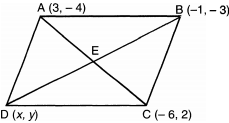
from (1) and (2 ) we get
{tex}\frac{x-1}{2}{/tex} = -{tex}\frac{3}{2}{/tex}
x - 1 = -3
x = -2
{tex}\frac{y-3}{2}{/tex} = -1
y - 3 = -2
y = 1
Hence the coordinates of fourth vertex D are (-2, 1)
Now area of {tex}\triangle{/tex}ABC,
{tex}= \frac { 1 } { 2 } \left[ x _ { 1 } \left( y _ { 2 } - y _ { 3 } \right) + x _ { 2 } \left( y _ { 3 } - y _ { 1 } \right) + x _ { 3 } \left( y _ { 1 } - y _ { 2 } \right) \right]{/tex}
{tex}= \frac { 1 } { 2 } [ 3 ( - 3 - 2 ) - 1 ( 2 + 4 ) - 6 ( - 4 + 3 ) ]{/tex}
{tex}= \frac { 1 } { 2 } [ - 15 - 6 + 6 ]{/tex}
{tex}= \frac { 1 } { 2 } \times ( - 15 ){/tex}
{tex}= - \frac { 15 } { 2 }{/tex}
{tex}= \frac { 15 } { 2 }{/tex} sq. units
Since, diagonal divides parallelogram into two equal parts
So, Area of parallelogram ABCD
= 2 {tex}\times{/tex} Area of {tex}\triangle{/tex} ABC
{tex}= 2 \times \frac { 15 } { 2 }{/tex}= 15 sq.units.
Posted by Shriya ?? 7 years, 2 months ago
- 2 answers
Sanjay Kaswan 7 years, 2 months ago
. . 7 years, 2 months ago
Posted by Aa Bisht 7 years, 2 months ago
- 3 answers
Gurjar Kabir (बैंसला) 7 years, 2 months ago
Posted by Shivansh Tripathi 7 years, 2 months ago
- 1 answers
Posted by Sunaina Thakur 7 years, 2 months ago
- 0 answers
Posted by Priti Chouhan 6 years, 9 months ago
- 1 answers
Sia ? 6 years, 9 months ago
{tex}mx(x - 7) +49 = 0{/tex} {tex}\Rightarrow{/tex} {tex}mx^2 - 7mx + 49 = 0{/tex}
Here a = m, b = -7m, c = 49
{tex}\Rightarrow{/tex} {tex}D = b^2 - 4ac{/tex}
For equal roots, D = 0
{tex}\Rightarrow{/tex} 0 = (-7m)2 - 4 {tex}\times{/tex} m {tex}\times{/tex} 49
{tex}\Rightarrow{/tex} {tex}0 = 49m^2 - 196m{/tex}
{tex}\Rightarrow{/tex} {tex}49m^2 - 196m = 0{/tex}
{tex}\Rightarrow{/tex} {tex}7m(7m - 28) = 0{/tex}
{tex}\Rightarrow{/tex} 7m = 0 or 7m - 28 = 0
{tex}\Rightarrow{/tex} m = 0 or m = {tex}\frac{28}{7}{/tex} = 4
but m {tex}\ne{/tex} 0 [{tex}\because{/tex}In quadratic a {tex}\ne{/tex} 0]
{tex}\therefore{/tex} m = 4
Posted by Aizah Khan 7 years, 2 months ago
- 1 answers
Posted by Navdeep Kaur 6 years, 9 months ago
- 1 answers
Sia ? 6 years, 9 months ago
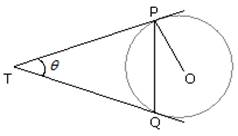
Given A circle with centre O and an external point T and two tangents TP and TQ to the circle, where P, Q are the points of contact.
To Prove: {tex}\angle{/tex}PTQ = 2{tex}\angle{/tex}OPQ
Proof: Let {tex}\angle{/tex}PTQ = {tex}\theta{/tex}
Since TP, TQ are tangents drawn from point T to the circle.
TP = TQ
{tex}\therefore{/tex} TPQ is an isoscles triangle
{tex}\therefore{/tex} {tex}\angle{/tex}TPQ = {tex}\angle{/tex}TQP = {tex}\frac12{/tex} (180o - {tex}\theta{/tex}) = 90o - {tex}\fracθ2{/tex}
Since, TP is a tangent to the circle at point of contact P
{tex}\therefore{/tex} {tex}\angle{/tex}OPT = 90o
{tex}\therefore{/tex} {tex}\angle{/tex}OPQ = {tex}\angle{/tex}OPT - {tex}\angle{/tex}TPQ = 90o - (90o - {tex}\frac12{/tex} {tex}\theta{/tex}) = {tex}\fracθ2{/tex}= {tex}\frac12{/tex}{tex}\angle{/tex}PTQ
Thus, {tex}\angle{/tex}PTQ = 2{tex}\angle{/tex}OPQ
Posted by Neeraj Shukla 7 years, 2 months ago
- 0 answers
Posted by Trish Batra 7 years, 2 months ago
- 0 answers
Posted by Vipin Sharma 7 years, 2 months ago
- 5 answers
Anushka Jugran ? 7 years, 2 months ago
Posted by Ansh Gautam 7 years, 2 months ago
- 1 answers
Posted by Durgesh Patal 7 years, 2 months ago
- 2 answers
Posted by Tanuj Saini 6 years, 9 months ago
- 1 answers
Sia ? 6 years, 9 months ago
Given,
tan A = n tan B
{tex} \Rightarrow{/tex} tanB = {tex}\frac{1}{n}{/tex}tan A
{tex}\Rightarrow{/tex} cotB = {tex}\frac { n } { \tan A }{/tex}..........(1)
Also given,
sin A = m sin B
{tex}\Rightarrow{/tex} sin B = {tex}\frac{1}{m}{/tex}sin A
{tex}\Rightarrow{/tex} cosec B = {tex}\frac { m } { \sin A }{/tex}.....(2)
We know that, cosec2B - cot2B = 1, hence from (1) & (2) :-
{tex} \quad \frac { m ^ { 2 } } { \sin ^ { 2 } A } - \frac { n ^ { 2 } } { \tan ^ { 2 } A } = 1{/tex}
{tex}\Rightarrow \quad \frac { m ^ { 2 } } { \sin ^ { 2 } A } - \frac { n ^ { 2 } \cos ^ { 2 } A } { \sin ^ { 2 } A } = 1{/tex}
{tex}\Rightarrow \quad \frac { m ^ { 2 } - n ^ { 2 } \cos ^ { 2 } A } { \sin ^ { 2 } A } = 1{/tex}
{tex}\Rightarrow{/tex} m2 - n2cos2A = sin2A
{tex}\Rightarrow{/tex} m2 - n2cos2A = 1 - cos2A
{tex}\Rightarrow{/tex} m2 - 1 = n2cos2A - cos2A
{tex}\Rightarrow{/tex} m2 - 1 = (n2 - 1) cos2A
{tex}\Rightarrow \quad \frac { m ^ { 2 } - 1 } { n ^ { 2 } - 1 } ={/tex} cos2A
Posted by Nilendra Yadav Yadav 7 years, 2 months ago
- 5 answers
Posted by Raman Deep 6 years, 9 months ago
- 1 answers
Sia ? 6 years, 9 months ago
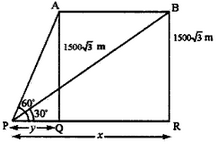
Height of jet plane {tex}= 1500 \sqrt { 3 } \mathrm { m }{/tex}
PQ = y and PR = x
where Q is right below A (1st position)
and R is right below B (2nd position)
Using {tex}\triangle PRB{/tex} ,{tex}\frac { x } { 1500 \cdot \sqrt { 3 } } = \cot 30 ^ { \circ }{/tex}
{tex}\Rightarrow \frac { x } { 1500 \cdot \sqrt { 3 } } = \cot 30 ^ { \circ }{/tex}
{tex}\Rightarrow \frac { x } { 1500 \sqrt { 3 } } = \sqrt { 3 }{/tex}
{tex}\Rightarrow x = 1500 \cdot \sqrt { 3 } \times \sqrt { 3 }{/tex}
{tex}\therefore{/tex} x = 4500 m ........(i)
Using {tex}\triangle PQA{/tex}, {tex}\frac { y } { 1500 \sqrt { 3 } } = \cot 60 ^ { \circ }{/tex}
{tex}\Rightarrow \frac { \mathrm { y } } { 1500 \sqrt { 3 } } = \frac { 1 } { \sqrt { 3 } }{/tex}
{tex}y = \frac { 1500 \sqrt { 3 } } { \sqrt { 3 } } = 1500 m{/tex}......(ii)
Subtracting (ii) from (i), we get x - y = 4500 - 1500 = 3000 m
Distance traveled in 15 seconds = 3000 m
Distance traveled in 1 second = {tex}\frac { 3000 } { 15 } = 200 \mathrm { m } / \mathrm { sec }{/tex}
Hence, speed of jet plane = {tex}\frac { 200 } { 1000 } \times 60 \times 60 \mathrm { km } / \mathrm { hr } = 720 \mathrm { km } / \mathrm { hr }{/tex}
Posted by Virendra Singh 7 years, 2 months ago
- 0 answers
Posted by Ramakant??? 8306360538 6 years, 9 months ago
- 1 answers
Sia ? 6 years, 9 months ago
Given numbers are 657 and 963 .
Here, 657 < 963
By using Euclid's Division algorithmm , we get
963 = (657 × 1) + 306
Here , remainder = 306 .
So, On taking 657 as new dividend and 306 as the new divisor and then apply Euclid's Division lemma, we get
657 = (306 × 2) + 45
Here, remainder = 45
So, On taking 306 as new dividend and 45 as the new divisor and then apply Euclid's Division lemma, we get
306 = (45 × 6) + 36
Here, remainder = 36
So, On taking 45 as new dividend and 36 as the new divisor and then apply Euclid's Division lemma, we get
45 = (36 × 1) + 9
Here, remainder = 9
So, On taking 36 as new dividend and 9 as the new divisor and then apply Euclid's Division lemma, we get
36 = (9 × 4) + 0
Here , remainder = 0 and last divisor is 9.
Hence, HCF of 657 and 963 = 9.
∴ 9 = 657x + 963(-15)
⇒ 9 = 657x - 14445
⇒ 657x = 9 + 14445
⇒ 657x = 14454
⇒x = 14454/657
⇒ x =22
Posted by Deepesh Maley 7 years, 2 months ago
- 4 answers
Komal Ranjha 7 years, 2 months ago
Posted by Ramakant??? 8306360538 7 years, 2 months ago
- 1 answers
. . 7 years, 2 months ago
Posted by Komal Jha 7 years, 2 months ago
- 2 answers
Posted by Khushi Singhal 7 years, 2 months ago
- 1 answers
Posted by Ankit Yadav 7 years, 2 months ago
- 1 answers
Rohit Labade 7 years, 2 months ago
Posted by Monu Kushwaha 7 years, 2 months ago
- 0 answers

myCBSEguide
Trusted by 1 Crore+ Students

Test Generator
Create papers online. It's FREE.

CUET Mock Tests
75,000+ questions to practice only on myCBSEguide app

Sia ? 6 years, 9 months ago
Let the first term and the common difference of the AP be a and d respectively.
3rd term = 12 ..... Given
{tex} \Rightarrow {/tex} a + (3 - 1)d = 12 {tex}\because {a_n} = a + (n - 1)d{/tex}
{tex} \Rightarrow {/tex} a + 2d = 12 ......... (1)
Last term = 106 ........ Given
{tex} \Rightarrow {/tex} So the term = 106 {tex}\because {/tex} The AP consists of 50 terms
{tex} \Rightarrow {/tex} a + (50 - 1)d = 106
{tex} \Rightarrow {/tex} a + 49d = 106 ........ (2)
Solving (1) and (2), we get
a = 8
d = 2
Therefore, 29th term of the AP
= 9 + (29 - 1)d {tex}\because {a_n} = a + (n - 1)d{/tex}
= 9 + 28d
= 8 + (28) (2)
= 8 + 56
= 64
0Thank You