
Ask questions which are clear, concise and easy to understand.
Ask QuestionPosted by Aashu Kumar 7 years, 2 months ago
- 0 answers
Posted by Kamal Choudhary 7 years, 2 months ago
- 3 answers
Mukesh Singh 7 years, 2 months ago
Anshika Pal???? 7 years, 2 months ago
Posted by ???????? ???? 7 years, 2 months ago
- 3 answers
Aashu Kumar 7 years, 2 months ago
Amit Singh 7 years, 2 months ago
Simran Kaur 7 years, 2 months ago
Posted by ???????? ???? 7 years, 2 months ago
- 0 answers
Posted by Kamal Choudhary 7 years, 2 months ago
- 1 answers
Posted by Divanshu Rawat 7 years, 2 months ago
- 2 answers
Divanshu Rawat 7 years, 2 months ago
Anshika Pal???? 7 years, 2 months ago
Posted by Anshika Pal???? 7 years, 2 months ago
- 2 answers
Divanshu Rawat 7 years, 2 months ago
Posted by Juhi Kumari 7 years, 2 months ago
- 2 answers
Yogita Ingle 7 years, 2 months ago
√3 = 1.732......
√5 = 2.236.....
The numbers which can be expressed in the form of p/q, where q ≠ 0 are called rational numbers. A terminating decimal and a non-terminating non-repeating decimal can be represented as a rational number.
Therefore, a rational number between √3 and √5 is 2.
So, three irrational numbers between √3 and √5 are: 1.79877985647984123564........ , 2.0100100010000100001110001.......... , 2.1212121212123121234.......
Posted by Santosh Lamani 7 years, 2 months ago
- 0 answers
Posted by Santosh Lamani 6 years, 8 months ago
- 1 answers
Sia ? 6 years, 8 months ago
Let h be the height of each cone. Then,
Sum of the volumes of two cones = Volume of the sphere
{tex}\Rightarrow{/tex}{tex}\frac { 1 } { 3 } \pi r _ { 1 } ^ { 2 } h + \frac { 1 } { 3 } \pi r _ { 2 } ^ { 2 } h = \frac { 4 } { 3 } \pi R ^ { 3 }{/tex}
{tex}\Rightarrow{/tex} {tex}\left( r _ { 1 } ^ { 2 } + r _ { 2 } ^ { 2 } \right) h = 4 R ^ { 3 }{/tex}
{tex}\Rightarrow{/tex} {tex}h = \frac { 4 R ^ { 3 } } { r _ { 1 } ^ { 2 } + r _ { 2 } ^ { 2 } }{/tex}
Posted by Anjali Singh 7 years, 2 months ago
- 0 answers
Posted by Kanishka Maurya 7 years, 2 months ago
- 1 answers
Posted by Geetanjali Ahirwar 6 years, 8 months ago
- 1 answers
Sia ? 6 years, 8 months ago
Let A be the first term and D be the common difference of the given A.P. Then,
a = Sum of p terms
{tex}\Rightarrow \quad a = \frac { p } { 2 } \{ 2 A + ( p - 1 ) D \}{/tex}
{tex}\Rightarrow \quad \frac { 2 a } { p } = \{ 2 A + ( p - 1 ) D \}{/tex}...(i)
b = Sum of q terms
{tex}\Rightarrow \quad b = \frac { q } { 2 } \{ 2 A + ( q - 1 ) D \}{/tex}
{tex}\Rightarrow \quad \frac { 2 b } { q } = \{ 2 A + ( q - 1 ) D \}{/tex}...(ii)
and, c = Sum of r terms
{tex}\Rightarrow \quad c = \frac { r } { 2 } \{ 2 A + ( r - 1 ) D \}{/tex}
{tex}\Rightarrow \quad \frac { 2 c } { r } = \{ 2 A + ( r - 1 ) D \}{/tex}...(iii)
Multiplying equation (i), (ii) and (iii) by (q - r), (r - p) and (p - q) respectively and adding, we get
{tex}\frac { 2 a } { p } ( q - r ) + \frac { 2 b } { q } ( r - p ) + \frac { 2 c } { r } ( p - q ){/tex}
= {2A + (p - 1)D} (q - r) + {2A + (q - 1)D} (r - p)+ {2A+(r - 1)D} (p-q)
= 2Aq - 2Ar + (p-1)(q -r) D + 2Ar - 2AP + (q - 1) (r -p)D + 2Ap - 2Aq + (r -1)(p-q)A
= 2Aq - 2Ar + 2Ar - 2AP+ 2Ap - 2Aq + (p-1)(q -r) D + (q - 1) (r -p)D + (r -1)(p-q)A
= 2A (q - r + r - p + p - q) + D {(p-1) (q - r) + (q - 1) (r - p) + (r - 1) (p-q)}
= 2A × 0 + D × 0
= 0
Posted by Tushar Srivastava 7 years, 2 months ago
- 0 answers
Posted by Shriya ?? 7 years, 2 months ago
- 3 answers
Naman Jain 7 years, 2 months ago
Posted by Sandhya Chaurasia 7 years, 2 months ago
- 1 answers
Posted by Khushi Pali 7 years, 2 months ago
- 6 answers
Shriya ?? 7 years, 2 months ago
Mamta Singh 7 years, 2 months ago
Posted by Aman Kumar Jha 7 years, 2 months ago
- 0 answers
Posted by Reet Brar 6 years, 9 months ago
- 1 answers
Sia ? 6 years, 9 months ago
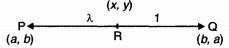
According to the question, R(x, y) is a point on the line segment joining the points P(a, b) and Q(b, a)
Let point R(x + y) divides the line joining P(a,b) and Q(b,a) in the ratio {tex}\lambda{/tex} : 1.
{tex}\therefore x = \frac { \lambda b + a } { \lambda + 1 }{/tex}
{tex}y = \frac { \lambda a + b } { \lambda + 1 }{/tex}
Adding, {tex}x+y=\frac { \lambda b + a + \lambda a + b } { \lambda + 1 }{/tex}
{tex}= \frac { \lambda ( a + b ) + 1 \times ( a + b ) } { \lambda + 1 }{/tex}
{tex}= \frac { ( \lambda + 1 ) \times ( a + b ) } { \lambda + 1 } = a + b{/tex}
{tex}\Rightarrow x+y=a+b{/tex}
Hence Proved.
Posted by Karan Bhaleria 7 years, 2 months ago
- 2 answers
Posted by Jaswinder Singh 7 years, 2 months ago
- 0 answers
Posted by Ujjwal Verma 7 years, 2 months ago
- 0 answers
Posted by Ashish Agarwal 7 years, 2 months ago
- 3 answers
Vaibhav Baliyan 7 years, 2 months ago
Chaitu Chowdary 7 years, 2 months ago

myCBSEguide
Trusted by 1 Crore+ Students

Test Generator
Create papers online. It's FREE.

CUET Mock Tests
75,000+ questions to practice only on myCBSEguide app

Kiran Yadav 7 years, 2 months ago
0Thank You