
Ask questions which are clear, concise and easy to understand.
Ask QuestionPosted by Rakesh Kumar 6 years, 9 months ago
- 1 answers
Posted by Abhishek Kumar 7 years, 2 months ago
- 1 answers
Posted by Nithin Reddy 7 years, 2 months ago
- 3 answers
Posted by Vaibhav Prajapati 7 years, 2 months ago
- 2 answers
Gaurav Seth 7 years, 2 months ago
(Draw diagram based on gives conditions. mark E , D,C points down and A,B points up.)
Tan 60 = AD/ED
= 1500/ED
ED = 1500
Tan 30 = BC/EC
1/ = 1500√3/EC
DE = EC - ED
4500-1500
= 3000
PLANE TRAVELS 3000 m in 15 sec.
speed = Dstance/Time
= 3000/15
200 m/s.
Jet plane speed = 200m/s.
Ravi Yadav 7 years, 2 months ago
Posted by Bijay Sahu 7 years, 2 months ago
- 0 answers
Posted by Archit Anand 7 years, 2 months ago
- 2 answers
Samridhi Yadav 7 years, 2 months ago
Posted by Priya Sahu 7 years, 2 months ago
- 2 answers
Posted by Vidhi Lalwani? 7 years, 2 months ago
- 3 answers
Vidhi Lalwani? 7 years, 2 months ago
Posted by Bhag Singh 6 years, 8 months ago
- 1 answers
Sia ? 6 years, 8 months ago

Given: XY and X'Y' at are two parallel tangents to the circle wth centre O and AB is the tangent at the point C,which intersects XY at A and X'Y' at B.
To prove: ∠AOB = 90º .
Construction: Join OC.
Proof:
In ΔOPA and ΔOCA
OP = OC (Radii )
AP = AC (Tangents from point A)
AO = AO (Common )
ΔOPA ≅ ΔOCA (By SSS criterion)
Therefore, ∠POA = ∠COA .... (1) (By C.P.C.T)
Similarly , ΔOQB ≅ ΔOCB
∠QOB = ∠COB .......(2)
POQ is a diameter of the circle.
Hence, it is a straight line.
Therefore, ∠POA + ∠COA + ∠COB + ∠QOB = 180°
From equations (1) and (2), it can be observed that
2∠COA + 2∠COB = 180°
∴ ∠COA + ∠COB = 90°
∴ ∠AOB = 90°
Hence proved.
Posted by Divya Yadav 7 years, 2 months ago
- 1 answers
?Aryan ? 7 years, 2 months ago
Posted by ?Aryan ? 7 years, 2 months ago
- 5 answers
???????? ???? 7 years, 2 months ago
Posted by Pushpa Jha 7 years, 2 months ago
- 5 answers
Pushpa Jha 7 years, 2 months ago
Posted by Thrupthi N 6 years, 9 months ago
- 1 answers
Sia ? 6 years, 9 months ago
The given equations are
{tex}\frac { a x } { b } - \frac { b y } { a } - ( a + b ) = 0{/tex}
{tex}ax - by - 2ab = 0{/tex}
By cross multiplication, we have
{tex}\frac { x } { \left( - \frac { b } { a } \right) \times ( - 2 a b ) - ( - b ) \times ( - ( a + b ) ) } ={/tex}{tex}\frac { y } { - ( a + b ) \times a - ( - 2 a b ) \times \frac { a } { b } }{/tex}{tex}= \frac { 1 } { \frac { \mathrm { a } } { \mathrm { b } } \times ( - \mathrm { b } ) - \mathrm { a } \times \left( - \frac { \mathrm { b } } { \mathrm { a } } \right) } {/tex}
{tex}\Rightarrow \frac { x } { 2 b ^ { 2 } - b ( a + b ) } = \frac { y } { - a ( a + b ) + 2 a ^ { 2 } } = \frac { 1 } { - a + b }{/tex}
or, {tex}\frac { x } { 2 b ^ { 2 } - a b - b ^ { 2 } } = \frac { y } { - a ^ { 2 } - a b + 2 a ^ { 2 } } = \frac { 1 } { - a + b }{/tex}
{tex}\Rightarrow \frac { x } { b ^ { 2 } - a b } = \frac { y } { a ^ { 2 } - a b } = \frac { 1 } { - ( a - b ) }{/tex}
{tex}\Rightarrow \frac { x } { - b ( a - b ) } = \frac { y } { a ( a - b ) } = \frac { 1 } { - ( a - b ) }{/tex}
{tex}\therefore \frac { x } { - b ( a - b ) } = \frac { 1 } { - ( a - b ) }{/tex} and {tex}\frac { y } { a ( a - b ) } = \frac { 1 } { - ( a - b ) }{/tex}
{tex}\therefore x = \frac { - b ( a - b ) } { - ( a - b ) } \text { and } y = \frac { a ( a - b ) } { - ( a - b ) }{/tex}
{tex} \Rightarrow{/tex} {tex}x = b,\ and\ y = -a{/tex}
{tex}\therefore{/tex} the solution is {tex}x = b, y = -a{/tex}
Posted by Riya Jain 6 years, 9 months ago
- 1 answers
Sia ? 6 years, 9 months ago
LHS = {tex}\frac{1}{sec x - tan x}{/tex} - {tex}\frac{1}{cos x}{/tex}
={tex}\frac{sec x + tan x}{(sec x - tan x)(sec x + tan x)}{/tex} - {tex}\frac{1}{cos x}{/tex}
= {tex}\frac{secx + tan x}{sec^2 x - tan^2 x}{/tex} - {tex}\frac{1}{cos x}{/tex}
{tex}=sec x + tan x - sec x{/tex}{tex}[\because sec^2\theta-tan^2\theta=1]{/tex}
= tan x
RHS = {tex}\frac{1}{cosx - 1}{/tex} - {tex}\frac{1}{sec x + tan x}{/tex}
={tex}\frac{1}{cos x}{/tex} - {tex}\frac{sec x - tan x}{(sec x + tan x)(sec x - tan x)}{/tex}
={tex}\frac{1}{cos x}{/tex} - {tex}\frac{sec x - tan x}{sec^2 x - tan^2 x}{/tex}
= sec x - {tex}\frac{sec x - tan x}{1}{/tex}
{tex}=sec x - sec x + tan x{/tex}
{tex}=tan x{/tex}
Hence, LHS = RHS
Posted by Varun Tiwari 7 years, 2 months ago
- 4 answers
Posted by Singanamala Viswa Nitish 6 years, 8 months ago
- 1 answers
Sia ? 6 years, 8 months ago
- deg p(x) = deg q(x)
{tex}p ( x ) = 2 x ^ { 2 } - 2 x + 14{/tex}
g(x) = 2
q(x) = x2 - x + 7
r(x) = 0
Clearly, p(x) = q(x) {tex} \times {/tex} g(x) + r(x) - deg q(x) = deg r(x)
{tex}p ( x ) = x ^ { 3 } + x ^ { 2 } + x + 1{/tex}
{tex}g ( x ) = x ^ { 2 } - 1{/tex}
q(x) = x + 1
r(x) = 2x + 2
Clearly, {tex}p ( x ) = q ( x ) \times g ( x ) + r ( x ){/tex} - deg r(x) = 0
{tex}p ( x ) = x ^ { 3 } + 2 x ^ { 2 } - x - 2{/tex}
{tex}g ( x ) = x ^ { 2 } - 1{/tex}
q(x) = x + 2
r(x) = 4
Clearly, {tex}p ( x ) = q ( x ) \times g ( x ) + r ( x ){/tex}
Posted by Rohit Rohit 7 years, 2 months ago
- 1 answers
Posted by Abishay Narain 7 years, 2 months ago
- 3 answers
Gaurav Seth 7 years, 2 months ago
Let the original number of students be x.
Total budget of the food = Rs 240
Original budget of each student =
If 4 students failed to go to the picnic, then
Number of student who went to the picnic = x– 4
New budget of each student =
New budget of each student – Original budget of each student = Rs 5

Posted by Venkanna Ganta 6 years, 9 months ago
- 1 answers
Sia ? 6 years, 9 months ago
Let the speed of the boat in still water be 'x' km/hr and speed of the stream be 'y' km/
Speed = Distance / Time
{tex}\therefore{/tex} {tex}\frac { 30 } { x - y } + \frac { 28 } { x + y } = 7{/tex}
and {tex}\frac { 21 } { x - y } + \frac { 21 } { x + y } = 5{/tex}
Let {tex}\frac { 1 } { x - y } \text { be } a \text { and } \frac { 1 } { x + y } \text { be } b{/tex}
30a + 28b = 7 ......(i)
21a + 21b = 5 ......(ii)
Multiplying (i) by 3 and (ii) by 4 and then subtracting.
{tex}90a+84b=21{/tex} ..............(iii)
{tex}84a+84b=20 {/tex} ..............(iv)
By solving (iii) and (iv)
{tex}90a-21=84a-20{/tex}
{tex}\Rightarrow{/tex}6a= 1
{tex}\Rightarrow{/tex} {tex}a = \frac { 1 } { 6 }{/tex}
Putting this value of ,a in eqn., (i),
{tex}30 \times \frac { 1 } { 6 } + 28 b = 7{/tex}
{tex}28 b = 7 - 30 \times \frac { 1 } { 6 } = 2{/tex}
{tex}\therefore{/tex}{tex}b = \frac { 1 } { 14 }{/tex}
x + y = 14 ...(iv)
Now, {tex}a = \frac { 1 } { x - y } = \frac { 1 } { 6 }{/tex}
{tex}\Rightarrow{/tex} x - y = 6
{tex}\Rightarrow{/tex}x = y + 6 .....(v)
Putting (iv) in (v)
y + 6 + y = 14
{tex}\Rightarrow{/tex} y = 4
Hence, speed of the boat in still water = 10 km/hr and speed of the stream = 4 km/hr.
Posted by Vidhi Lalwani? 7 years, 2 months ago
- 5 answers
Posted by Manorama Mishra 7 years, 2 months ago
- 1 answers
Gurjar Kabir (बैंसला) 7 years, 2 months ago
Posted by Isha Saini 7 years, 2 months ago
- 1 answers
Gaurav Seth 7 years, 2 months ago
Sphere: d=21cm hence r=21/2 cm.
vol. of sphere = 4/3 x 22/7 x 21/2 x 21/2 x 21/2
= 77 x 3 x 21 = 1617x3 = 4851cm3
Cube: side= 1cm
vol. of cube = a3 = 13 = 1cm3
No. of cubes formed from the sphere= volume of sphere / volume of cube
= 4851/1 = 4851
Hence the number of cubes that can be formed = 4851
Posted by Ankit Yadav 7 years, 2 months ago
- 2 answers
Puja Sahoo? 7 years, 2 months ago
Gaurav Seth 7 years, 2 months ago
Let us assume Jacob’s current age is x and his son’s current age is y.
Five years hence, Jacob’s age = x + 5 and his son’s age = y + 5
As per question;
x + 5 = 3(y + 5)
Or, x + 5 = 3y + 15
Or, x = 3y + 15 – 5 = 3y + 10
Five years ago, Jacob’s age = x – 5 and his son’s age = y – 5
As per question;
x – 5 = 7(y – 5)
Or, x – 5 = 7y – 35
Or, x = 7y – 35 + 5 = 7y – 30
Substituting the value of x from first equation in this equation, we get;
3y + 10 = 7y – 30
Or, 3y + 10 + 30 = 7y
Or, 7y – 3y = 40
Or, 4y = 40
Or, y = 10
Substituting the value of y in first equation, we get;
x = 3y + 10
Or, x = 3 x 10 + 10 = 40
Hence, Jacob’s age = 40 years and son’s age = 10 years
Posted by Sanu Ooo1 6 years, 8 months ago
- 1 answers
Sia ? 6 years, 8 months ago
Speed of motorboat in still water = 15 km/hr
Let Speed of the stream = x km/ hr
Then speed downstream = (15+x) km /hr
and speed upstream = (15-x) km /hr
According to the question
{tex}{30 \over 15+x} +{30 \over 15-x} = 4{1 \over 2}{/tex}
{tex}\implies 30 [{15 - x +15 +x \over (15+x) (15- x)}] = {9 \over 2}{/tex}
{tex}\implies {30 \times 30 \over 225 - x^2} = {9 \over 2}{/tex}
{tex}\implies {900 \over 225 - x^2} = {9 \over 2}{/tex}
{tex}\implies{/tex}- 9x2 + 2025 = 1800
{tex}\implies{/tex} - 9x2 = 1800 - 2025
{tex}\implies{/tex} 9x2 = 225
{tex}\implies{/tex} x2 = 25
{tex}\implies{/tex} {tex}x = \pm 5{/tex}
Speed of the motorboat cannot be negative. So, x = 5
Hence, speed of the stream = 5 km /hr.
Posted by Afeeful Islam 7 years, 2 months ago
- 4 answers
Posted by Neeraj Singh 6 years, 9 months ago
- 1 answers
Sia ? 6 years, 9 months ago
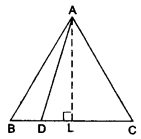
Given, {tex}\triangle ABC{/tex} in which {tex}AB = BC = CA{/tex} and D is a point on BC such that BD ={tex}\frac { 1 } { 3 }{/tex}BC.
Prove: 9AD2 = 7AB2.
Construction :Draw {tex}A L \perp B C{/tex}
Proof: In right triangles ALB and ALC, we have
{tex}AB = AC {/tex}(given)
{tex}AL = AL {/tex}(common)
{tex}\therefore \triangle A L B \cong \triangle A L C{/tex} [by RHS axiom]
So, {tex}BL = CL.{/tex}
Thus, BD ={tex}\frac { 1 } { 3 }{/tex}BC and BL ={tex}\frac { 1 } { 2 }{/tex}BC.
In {tex}\triangle ALB{/tex}, {tex}\angle A L B = 90 ^ { \circ }{/tex}
By using pythagoras theorem, we get
{tex}\therefore{/tex} AB2 = AL2 + BL2 ...(i)
In {tex}\triangle ALD{/tex}, {tex}\angle A L D = 90 ^ { \circ }{/tex}
By using pythagoras theorem, we get
{tex}\therefore{/tex} AD2 = AL2 + DL2
= AL2 + (BL - BD)2
= AL2 + BL2 + BD2 - {tex}2 B L \cdot B D{/tex}
= (AL2 + BL2) + BD2 - {tex}2 B L \cdot B D{/tex}
= AB2 + BD2 - {tex}2 B L \cdot B D{/tex} [using (i)]
{tex}= B C ^ { 2 } + \left( \frac { 1 } { 3 } B C \right) ^ { 2 } - 2 \left( \frac { 1 } { 2 } B C \right) \cdot \frac { 1 } { 3 } B C{/tex}
{tex}= B C ^ { 2 } + \frac { 1 } { 9 } B C ^ { 2 } - \frac { 1 } { 3 } B C ^ { 2 }{/tex}
{tex}= \frac { 7 } { 9 } B C ^ { 2 } = \frac { 7 } { 9 } A B ^ { 2 }{/tex} [{tex}\because{/tex} BC = AB]
Therefore, 9AD2 = 7AB2.
Posted by Sohail Akhtar 7 years, 2 months ago
- 1 answers
Posted by Swatej Singh 7 years, 2 months ago
- 0 answers
Posted by Sanjeev Sanju 6 years, 9 months ago
- 1 answers
Sia ? 6 years, 9 months ago
A copper rod of diameter 2 cm and length 10 cm is drawn into a wire of uniform thickness and length 10 m.We have to find the thickness of the wire.
We know that,
1 m = 1000 mm and 1 cm = 10 mm
Given Diameter of silver rod = 2 cm = 20 mm
{tex}\Rightarrow{/tex} Radius of silver rod (r1) = 1 cm = 10 mm
Length of the silver rod (h1) = 10 cm = 100 mm
Length of the wire (h2) = 10 m = 10000 mm
Let the radius of the wire be r2 cm.
As the wire is made from the rod
{tex}\Rightarrow{/tex}Volume of the rod = Volume of the wire
{tex}\Rightarrow \pi r _ { 1 } ^ { 2 } h _ { 1 } = \pi r _ { 2 } ^ { 2 } h _ { 2 }{/tex}
{tex}\Rightarrow \pi \times ( 10 ) ^ { 2 } \times 100 = \pi \times r _ { 2 } ^ { 2 } \times 10000{/tex}
{tex}\Rightarrow{/tex}10000 = {tex}r _ { 2 } ^ { 2 } \times{/tex}10000
{tex}\Rightarrow{/tex} r22 = 1
{tex}\Rightarrow{/tex} r2= 1 cm
Diameter of the wire (d{tex}_2{/tex}) = 2{tex}\times{/tex}1
= 2mm
Diameter of the wire (d2) = Thickness of the wire = 2mm
Posted by Thakurshubhankar Singh 7 years, 2 months ago
- 5 answers

myCBSEguide
Trusted by 1 Crore+ Students

Test Generator
Create papers online. It's FREE.

CUET Mock Tests
75,000+ questions to practice only on myCBSEguide app

Sia ? 6 years, 9 months ago
Let n = 4q + 1 (an odd integer)
{tex}\therefore \quad n ^ { 2 } - 1 = ( 4 q + 1 ) ^ { 2 } - 1{/tex}
{tex}= 16 q ^ { 2 } + 1 + 8 q - 1 \quad \text { Using Identity } ( a + b ) ^ { 2 } = a ^ { 2 } + 2 a b + b ^ { 2 }{/tex}
{tex}= 16{q^2} + 8q{/tex}
{tex}= 8 \left( 2 q ^ { 2 } + q \right){/tex}
= 8m, which is divisible by 8.
0Thank You