
Ask questions which are clear, concise and easy to understand.
Ask QuestionPosted by Sumit Kumar 7 years, 2 months ago
- 2 answers
Posted by Anku Don 7 years, 2 months ago
- 1 answers
Priyanka S 7 years, 2 months ago
Posted by ??Ratnakar ?? Pisal 7 years, 2 months ago
- 0 answers
Posted by Sudhanshu Singh 7 years, 2 months ago
- 1 answers
Roshan Meshram 7 years, 2 months ago
Posted by Kiran Yadav 7 years, 2 months ago
- 1 answers
Navneet Verma 7 years, 2 months ago
Posted by Sameer Khan 7 years, 2 months ago
- 0 answers
Posted by Kiran Yadav 6 years, 8 months ago
- 1 answers
Sia ? 6 years, 8 months ago
BC = 3 cm, AC = 4 cm and {tex}\triangle ACB\sim \triangle PAO{/tex}
In {tex}\triangle ACB{/tex},
{tex}\angle BCA=90^o{/tex} [angle in a semi-circle]
{tex}\therefore {/tex} AB2 = AC2 + BC2 [By Pythagoras theorem]
{tex}\Rightarrow{/tex} AB2 = 42 + 32
{tex}\Rightarrow{/tex} AB2 = 16 + 9 cm
{tex}\Rightarrow{/tex} AB2 = 25 cm
{tex}\Rightarrow{/tex} AB = 5 cm
{tex}\Rightarrow OA =\frac{AB}{2} =\frac{5}{2}cm{/tex}
Also given, {tex}\triangle ACB\sim \triangle PAO{/tex}
{tex}\therefore \frac{AB}{AC}=\frac{OP}{AP}{/tex}
{tex}\Rightarrow \frac{OP}{AP}=\frac{5}{4}{/tex}
Posted by Honey Ahlawat 7 years, 2 months ago
- 1 answers
Rohit Yadav 7 years, 2 months ago
Posted by Shriya ?? 7 years, 2 months ago
- 7 answers
Shriya ?? 7 years, 2 months ago
Shriya ?? 7 years, 2 months ago
Avinash Saigal 7 years, 2 months ago
Posted by Priya Sharma 7 years, 2 months ago
- 2 answers
Posted by Santosh Singh 7 years, 2 months ago
- 1 answers
Gaurav Seth 7 years, 2 months ago
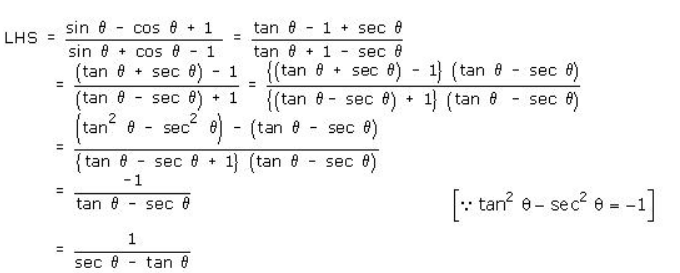
Q.SinA-cosA+1/sinA+cosA-1=tanA-1+secA/tanA+1-secA
<hr />Answer:
Posted by Abhay Singh 7 years, 2 months ago
- 1 answers
Posted by Anushka Dpsnk 7 years, 2 months ago
- 0 answers
Posted by Aarohi Singh 7 years, 2 months ago
- 4 answers
Posted by Niraj Chaurasiya 7 years, 2 months ago
- 0 answers
Posted by Pradeepa Govind 7 years, 2 months ago
- 2 answers
Posted by Nikhil Gangwani 7 years, 2 months ago
- 1 answers
Posted by Abdullah Shams 7 years, 2 months ago
- 1 answers
Posted by Aadesh Singh 7 years, 2 months ago
- 1 answers
Posted by R Means Räkésh 7 years, 2 months ago
- 1 answers
Janhvi Bora 7 years, 2 months ago
Posted by Anshika Pal???? 7 years, 2 months ago
- 3 answers
Neha Sirur 7 years, 2 months ago
Puja Sahoo? 7 years, 2 months ago
Posted by Varun Punia 7 years, 2 months ago
- 3 answers
Posted by Digraj Chouhan 7 years, 2 months ago
- 1 answers
Avinash Saigal 7 years, 2 months ago

myCBSEguide
Trusted by 1 Crore+ Students

Test Generator
Create papers online. It's FREE.

CUET Mock Tests
75,000+ questions to practice only on myCBSEguide app

Yogita Ingle 7 years, 2 months ago
Let us assume that √3 is a rational number
That is, we can find integers a and b (≠ 0) such that √3 = (a/b)
Suppose a and b have a common factor other than 1, then we can divide by the common factor, and assume that a and b are coprime.
√3b = a
⇒ 3b2=a2 (Squaring on both sides) → (1)
Therefore, a2 is divisible by 3
Hence a is also divisible by 3.
So, we can write a = 3c for some integer c.
Equation (1) becomes,
3b2 =(3c)2
⇒ 3b2 = 9c2
∴ b2 = 3c2
This means that b2 is divisible by 3, and so b is also divisible by 3.
Therefore, a and b have at least 3 as a common factor.
But this contradicts the fact that a and b are coprime.
This contradiction has arisen because of our incorrect assumption that √3 is rational.
So, we conclude that √3 is irrational.
0Thank You