
Ask questions which are clear, concise and easy to understand.
Ask QuestionPosted by Zainab Siddiqui 7 years, 2 months ago
- 0 answers
Posted by Priyanshi Chaurasia 7 years, 2 months ago
- 1 answers
Posted by Aadil Raza 6 years, 7 months ago
- 1 answers
Sia ? 6 years, 7 months ago
In equilateral {tex}\Delta ABC{/tex}, AD{tex}\perp{/tex}BC
and AB=BC=CA
Also BD={tex}\frac{BC}{2}{/tex}.....(1)
So, {tex}\Delta ABD{/tex} is right-angled triangle
By the Pythagoras theorem,
AB2 = AD2 + BD2
{tex}\Rightarrow{/tex} AB2 = AD2 + ({tex}\frac{BC}{2}{/tex})2
{tex}\Rightarrow{/tex} AB2 = AD2 + {tex}\frac{BC^2}{4}{/tex}
{tex}\Rightarrow{/tex} 4AB2 = 4AD2 + BC2
{tex}\Rightarrow{/tex} 4AB2 = 4AD2 + AB2 (AB = BC)
{tex}\Rightarrow{/tex} 4AB2 = 4AD2 + AB2
{tex}\Rightarrow{/tex} 4AB2 - AB2 = 4AD2
{tex}\Rightarrow{/tex} 3AB2 = 4AD2
Hence Proved.
Posted by Manisha Yadav 7 years, 2 months ago
- 3 answers
Ayush Dubey 7 years, 2 months ago
Posted by Manisha Yadav 7 years, 2 months ago
- 0 answers
Posted by Saqueeb Khan 7 years, 2 months ago
- 1 answers
Poonam Jyoti? 7 years, 2 months ago
Posted by Seema Singh 7 years, 2 months ago
- 1 answers
Rahul Raj 7 years, 2 months ago
Posted by Himanshu Tiwari 7 years, 2 months ago
- 1 answers
Gaurav Seth 7 years, 2 months ago
Angle BAC = Angle BDC (Angles in the same segment)
Angle BDC= 50 degree
In triangle BDC,
Angle BDC + Angle BCD + Angle DBC = 180 degree (Angle sum property)
50 degree + Angle BCD + 60 degree = 180 degree
110 degree + Angle BCD = 180 degree
Angle BCD = 70 degree
Posted by Payal Priyadarshani Pati 7 years, 2 months ago
- 5 answers
Aayushi Tyagi 7 years, 2 months ago
Ram Kushwah 7 years, 2 months ago
Here a=-1, d=4-(-1)=4+1=5 , l=149
so 149=-1+(n-1)x5
149=-1+5n-5
5n=149+6=155
so {tex}\begin{array}{l}n=\frac{155}5=31\\\end{array}{/tex}
Posted by Kiran Yadav 7 years, 2 months ago
- 0 answers
Posted by Parveen Kumar 7 years, 2 months ago
- 0 answers
Posted by Kiran Yadav 7 years, 2 months ago
- 2 answers
Posted by Md Sahil Khan 7 years, 2 months ago
- 1 answers
Poonam Jyoti? 7 years, 2 months ago
Posted by Cool Cool 7 years, 2 months ago
- 0 answers
Posted by Tarushi Khattar 6 years, 8 months ago
- 1 answers
Sia ? 6 years, 8 months ago
We have, {tex}(c^2-ab)x^2-2(a^2-bc)x+b^2-ac=0{/tex}
Here, {tex}A=(c^2-ab), B=-2(a^2-bc),C=b^2-ac{/tex}
Now, {tex}B^2-4AC =0{/tex}
{tex}4(a^2-bc)^2-4(c^2-ab)(b^2-ac)=0{/tex}
{tex}4(a^2-bc)^2=4(c^2-ab)(b^2-ac){/tex}
{tex}a^4-2a^2bc+b^2c^2=b^2c^2-ac^3-ab^3+a^2bc{/tex}
{tex}a^4-2a^2bc+ac^3+ab^3-a^2bc=0{/tex}
{tex}a^4-3a^2bc+ac^3+ab^3=0{/tex}
{tex}a(a^3-3abc+c^3+b^3)=0{/tex}
{tex}a=0 \ or \ a^3-3abc+c^3+b^3=0{/tex}
{tex}a=0\ or\ a^3+b^3+c^3=3abc{/tex}
Hence proved
Posted by Lakshya Kothari 7 years, 2 months ago
- 1 answers
Posted by Chada Madhuja 7 years, 2 months ago
- 3 answers
Manan Agarwal 7 years, 2 months ago
Posted by Anshika Pal???? 7 years, 2 months ago
- 2 answers
Posted by Himanshu Choubey 7 years, 2 months ago
- 1 answers
Rahul Raj 7 years, 2 months ago
Posted by Shriya ?? 7 years, 2 months ago
- 2 answers
Rahul Raj 7 years, 2 months ago
Posted by Sanyam Kaushik 7 years, 2 months ago
- 2 answers
Gaurav Seth 7 years, 2 months ago
R= 8cm
R=13cm
angle ODB= 90 degrees ( BD is tangent)
angle APB =90 degrees ( angle in semicircle)
angle DB0 =ANGLE PBA (COMMON)
SO, BY AA criteria tri APB similar to tri DBO
BY CPST ...... BD/BP=BO/AB= OD/ AP
OD/AP= BO/AB
8/AP=13/26
AP=16 cm
Posted by _T_A_N_U_78 ??? 7 years, 2 months ago
- 4 answers
Gaurav Seth 7 years, 2 months ago
Volume of roof= l x b x h
= 22X20 X h
height of roof= height of rainfall
volume of cylinder= 22/ 7 x 1x1 x35/10
and
volume of water on roof = volume of
Water in cylindrical tank
22 X 20 X h = 22/7 1 x 1x35/10
22 X 20 X h = 11
h = 11/440
h = 1/40 m
h = 0.025 m
= 2.5 cm
so the rainfall = 2.5 cm
Posted by Om Garg 6 years, 9 months ago
- 1 answers
Sia ? 6 years, 9 months ago
Consider the following figure:
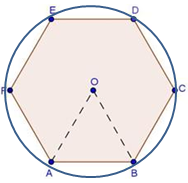
We know that the regular hexagon is a combination of 6 equilateral triangles.
{tex}\therefore{/tex} Area of a hexagon = 6 {tex}\times{/tex} Area of {tex}\Delta O A B{/tex}
{tex}\Rightarrow \text { Area of } \Delta O A B = \frac { 24 \sqrt { 3 } } { 6 } = 4 \sqrt { 3 } \mathrm { cm } ^ { 2 }{/tex}
{tex}\Rightarrow \frac { \sqrt { 3 } } { 4 } ( \text { side } ) ^ { 2 } = 4 \sqrt { 3 }{/tex}
{tex}\Rightarrow ( \text { side } ) ^ { 2 } = 4 \sqrt { 3 } \times \frac { 4 } { \sqrt { 3 } } = 16{/tex}
{tex}\Rightarrow{/tex} side = 4 cm
{tex}\Rightarrow{/tex} Radius of a circle = 4 cm
{tex}\therefore{/tex} Area of a circle {tex}= \pi r ^ { 2 } = 3.14 \times 4 \times 4 = 50.24 \mathrm { cm } ^ { 2 }{/tex}

myCBSEguide
Trusted by 1 Crore+ Students

Test Generator
Create papers online. It's FREE.

CUET Mock Tests
75,000+ questions to practice only on myCBSEguide app
