
Ask questions which are clear, concise and easy to understand.
Ask QuestionPosted by Aastha Sapate 7 years, 2 months ago
- 1 answers
Posted by Ravindra Singh 7 years, 2 months ago
- 2 answers
Gaurav Seth 7 years, 2 months ago
Q. If sec theta = x+1/4x ,prove that :
sec theta +tan theta=2x or 1/2x
Solution:

Puja Sahoo 7 years, 2 months ago
Posted by Jasline S.? 7 years, 2 months ago
- 3 answers
Puja Sahoo 7 years, 2 months ago
Kabir Baisla(बागपत) 7 years, 2 months ago
Posted by Debasish Panda 7 years, 2 months ago
- 5 answers
Posted by Tushar Choudhary 7 years, 2 months ago
- 1 answers
Posted by @Jay Bunkar 7 years, 2 months ago
- 2 answers
Posted by Mr. Singh 7 years, 2 months ago
- 2 answers
Anjali Kumari??? 7 years, 2 months ago
Posted by Arpita Gangwar 7 years, 2 months ago
- 1 answers
Saisha Sharma 7 years, 2 months ago
Posted by Sourav Kumar 7 years, 2 months ago
- 4 answers
Posted by Shreya Raj 7 years, 2 months ago
- 2 answers
Avinash Saigal 7 years, 2 months ago
Posted by Kiran Yadav 6 years, 9 months ago
- 1 answers
Sia ? 6 years, 9 months ago
GIVEN A {tex} \Delta{/tex}DEF and a point X inside it. Point X is joined to the vertices D, E and F. P is any point on DX. {tex} P Q \| D E{/tex} and {tex} Q R \| E F.{/tex}
TO PROVE {tex}P R \| D F{/tex}
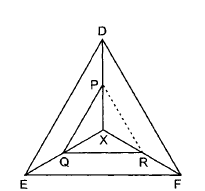
CONSTRUCTION Join PR.
PROOF In {tex} \Delta{/tex} XED, we have
{tex} P Q \| D E{/tex}
Therefore,by basic proportionality theorm,we have,
{tex} \therefore \quad \frac { X P } { P D } = \frac { X Q } { Q E }{/tex} ... (i)
In {tex} \Delta{/tex} XEF, we have,
{tex}Q R \| E F{/tex}
Therefore,by basic proportionality theorm,we have,
{tex}\therefore \quad \frac { \mathrm { XQ } } { \mathrm { Q } E } = \frac { \mathrm { X } R } { R F }{/tex} ... (ii)
From (i) and (ii), we have,
{tex}\frac { X P } { P D } = \frac { X R } { R F }{/tex}
Thus, in {tex}\Delta{/tex} XFD, points R and P are dividing sides XF and XD in the same ratio. Therefore, by the converse of Basic Proportionality Theorem, we have
{tex} P R \| D F{/tex}
Posted by #Tera_Yaar_Desi_Gujjar_Ravi ???? 7 years, 2 months ago
- 1 answers
_T_A_N_U_78 ??? 7 years, 2 months ago
Posted by _T_A_N_U_78 ??? 7 years, 2 months ago
- 5 answers
_T_A_N_U_78 ??? 7 years, 2 months ago
_T_A_N_U_78 ??? 7 years, 2 months ago
Anjali Kumari??? 7 years, 2 months ago
Posted by Shriya ?? 7 years, 2 months ago
- 3 answers
Sahil Rawal 7 years, 2 months ago
Abc . 7 years, 2 months ago
Posted by Vishu Ji 7 years, 2 months ago
- 2 answers
Abc . 7 years, 2 months ago
Posted by Vikram Singh Hada 7 years, 2 months ago
- 1 answers
Gaurav Seth 7 years, 2 months ago
If nth term of an A.P = 2n+1
then, first term of A.P = 2(1)+1
= 2+1
= 3
then, second term = 2 (2) + 1
》4+1
》5
third term = 2 (3) +1
》6+1
》7
sum of terms = 3+5+7
sum of terms = 15
Posted by Anushka Tiwari 7 years, 2 months ago
- 3 answers
Gaurav Seth 7 years, 2 months ago
Let a be the first term and d be the common difference of the given AP.
Then,
</header>
Let us now compute,

That is the sum of (m +n) terms is zero.
Posted by Pushpesh Thakur 7 years, 2 months ago
- 1 answers
Gaurav Seth 7 years, 2 months ago
Let the 1st AP be A =63,65,68.....
Let the 2nd AP be B = 3,7,17......
For A , common difference is : 65-63 = 2
For B ,common difference is : 10-3 = 7
Now Let the nth term be An and Bn respectively.
According to question
An = Bn
=> 63+(n-1)2 = 3+(n-1)7
=>60 + 2n-2 = 7n-7
=>65 = 5n
=> n = 13
Thus 13th term of both AP's will be same
Posted by K T 5 years, 11 months ago
- 2 answers
Posted by Abhishek Jain 7 years, 2 months ago
- 2 answers
Nitya Mishra 7 years, 2 months ago
Posted by Digraj Chouhan 7 years, 2 months ago
- 1 answers
Posted by Digraj Chouhan 7 years, 2 months ago
- 0 answers
Posted by Shriya ?? 7 years, 2 months ago
- 2 answers
Vinit Pandit????? 7 years, 2 months ago
Rahul Raj 7 years, 2 months ago
Posted by Aayush Sharma 7 years, 2 months ago
- 3 answers
Posted by Sachin Rawat 6 years, 8 months ago
- 1 answers
Sia ? 6 years, 8 months ago
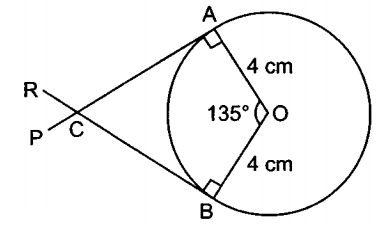
Steps of Construction:
- Draw a circle with centre O and radius = 4 cm.
- Draw any radius OA.
- Draw another radius OB such that {tex}\angle{/tex}AOB = 180° - 45° = 135°
- At point A draw AP {tex}\bot{/tex} OA.
- At point B draw BR {tex}\bot{/tex} OB, intersecting AP at C. AC and BC are required tangents.
Posted by Meemansha Kumari 6 years, 8 months ago
- 1 answers
Sia ? 6 years, 8 months ago
Let the required ratio be k:1.
Then, by the section formula, the coordinates of P are
{tex}P \left( \frac { 9 k + 15 } { k + 1 } , \frac { 20 k + 5 } { k + 1 } \right){/tex}
But, this point is given as P(11, y).
{tex}\therefore{/tex}{tex}\frac { 9 k + 15 } { k + 1 } = 11{/tex} {tex}\Rightarrow{/tex} 9k + 15 = 11k + 11 {tex}\Rightarrow{/tex} 2k = 4 {tex}\Rightarrow{/tex} k = 2
So, the required ratio is 2:1
Putting k = 2 in P, we get
{tex}y = \frac { 20 \times 2 + 5 } { ( 2 + 1 ) } = \frac { 45 } { 3 } = 15{/tex}
Hence, y = 15.
Posted by Mohd Junaid 7 years, 2 months ago
- 0 answers

myCBSEguide
Trusted by 1 Crore+ Students

Test Generator
Create papers online. It's FREE.

CUET Mock Tests
75,000+ questions to practice only on myCBSEguide app

Puja Sahoo 7 years, 2 months ago
3Thank You