
Ask questions which are clear, concise and easy to understand.
Ask QuestionPosted by Jashan Khakh 7 years, 2 months ago
- 0 answers
Posted by Himanshu Pareek 7 years, 2 months ago
- 3 answers
Posted by Naveen Girijannavar 7 years, 2 months ago
- 1 answers
Posted by Sajeel Ahmed 7 years, 2 months ago
- 3 answers
Posted by Ganesh Kumar Gautam 7 years, 2 months ago
- 3 answers
Sanskaar Kushwaha 7 years, 2 months ago
Anushka Jugran ? 7 years, 2 months ago
Posted by Shriya ?? 7 years, 2 months ago
- 7 answers
Shriya ?? 7 years, 2 months ago
Posted by Shreya Verma 7 years, 2 months ago
- 2 answers
Varun Punia 7 years, 2 months ago
Ram Kushwah 7 years, 2 months ago
Let the unit digit =x then 10th digit=3x (given)
number =3xx10+x=31x----------------(1)
if digitd are reversed then
number=10x+3x=13x--------------(2)
as per given
31x-54=13x
18x=54. x=3
so number is 93
Posted by Gujjar Gujjar 7 years, 2 months ago
- 2 answers
Gujjar Gujjar 7 years, 2 months ago
Posted by Rajat Dubey 7 years, 2 months ago
- 2 answers
Vanshika Singh 7 years, 2 months ago
Posted by Durga Appa 7 years, 2 months ago
- 2 answers
Posted by Pankaj Kumar Gupt 7 years, 2 months ago
- 0 answers
Posted by Abhay Pratap 7 years, 2 months ago
- 0 answers
Posted by Gagan Mehta 7 years, 2 months ago
- 2 answers
Ujjwal Pratap Singh 7 years, 2 months ago
Posted by Ranjana Sharma 6 years, 9 months ago
- 1 answers
Sia ? 6 years, 9 months ago
Given: The diagonals of a quadrilateral ABCD intersect each other at the point O such that {tex}\frac{{AO}}{{BO}} = \frac{{CO}}{{DO}}{/tex}
To prove: ABCD is trapezium.
Construction: Through O draw a line OE||BA intersecting AD at E.
Proof: In {tex}\triangle DBA{/tex}{tex}\because OE||BA{/tex}
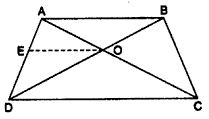
{tex}\therefore \frac{{DO}}{{BO}} = \frac{{DE}}{{AE}} \Rightarrow \frac{{CO}}{{AO}} = \frac{{DE}}{{AE}}{/tex}
{tex}\because \frac{{AO}}{{BO}} = \frac{{CO}}{{DO}}\,[Given]{/tex}
{tex}\Rightarrow \frac{{DO}}{{BO}} = \frac{{CO}}{{AO}} \Rightarrow \frac{{AO}}{{CO}} = \frac{{AE}}{{DE}}{/tex}.........[Taking reciprocals]
{tex}\therefore {/tex}In {tex}\triangle ADC{/tex}
OE {tex}\parallel{/tex} CD ...........[By converse basic proportionality theorem]
But OE {tex}\parallel{/tex} BA
BA {tex}\parallel{/tex} CD........[By construction]
The quadrilateral ABCD is a Trapezium.
Posted by Mansoon Mangrulkar 7 years, 2 months ago
- 3 answers
Ujjwal Pratap Singh 7 years, 2 months ago
Posted by Harshit Lakoji 6 years, 9 months ago
- 1 answers
Sia ? 6 years, 9 months ago
We have,
{tex}\mathrm { LHS } = \frac { \tan A } { 1 - \cot A } + \frac { \cot A } { 1 - \tan A }{/tex}
{tex}\Rightarrow \quad \mathrm { LHS } = \frac { \tan A } { 1 - \frac { 1 } { \tan A } } + \frac { \frac { 1 } { \tan A } } { 1 - \tan A }{/tex}
{tex}\Rightarrow \quad \text { LHS } = \frac { \tan A } { \frac { \tan A -1 } { \tan A } } + \frac { 1 } { \tan A ( 1 - \tan A ) }{/tex}
{tex}\Rightarrow \quad \mathrm { LHS } = \frac { \tan ^ { 2 } A } { \tan A - 1 } + \frac { 1 } { \tan A ( 1 - \tan A ) }{/tex}
{tex}\Rightarrow \quad \text { LHS } = \frac { \tan ^ { 2 } A } { \tan A - 1 } - \frac { 1 } { \tan A ( \tan A - 1 ) }{/tex}
{tex}\Rightarrow \quad \mathrm { LHS } = \frac { \tan ^ { 3 } A - 1 } { \tan A ( \tan A - 1 ) }{/tex} [Taking LCM]
{tex}\Rightarrow \quad \mathrm { LHS } = \frac { ( \tan A - 1 ) \left( \tan ^ { 2 } A + \tan A + 1 \right) } { \tan A ( \tan A - 1 ) }{/tex} [{tex}\because{/tex} a3 - b3 = ( a - b )(a2 + ab + b2)]
{tex}\Rightarrow \quad \mathrm { LHS } = \frac { \tan ^ { 2 } A + \tan A + 1 } { \tan A }{/tex}
{tex}\Rightarrow \quad \mathrm { LHS } = \frac { \tan ^ { 2 } A } { \tan A } + \frac { \tan A } { \tan A } + \frac { 1 } { \tan A }{/tex}
{tex}\Rightarrow{/tex} LHS = tanA + 1 + cotA = RHS [ since (1/tanA) =cotA ]
Posted by Deepashree Banuprasad 7 years, 2 months ago
- 3 answers
Priyanka S 7 years, 2 months ago
Posted by Vishal Kumar 7 years, 2 months ago
- 3 answers
Priyanka S 7 years, 2 months ago
Posted by Kumar Vaibhav 7 years, 2 months ago
- 2 answers
Tanya Zanzad 7 years, 2 months ago
Posted by Kunal Singh 7 years, 2 months ago
- 0 answers
Posted by Snehal M. S 6 years, 9 months ago
- 1 answers
Sia ? 6 years, 9 months ago
Surface area to colour = surface area of hemisphere + curved surface area of cone
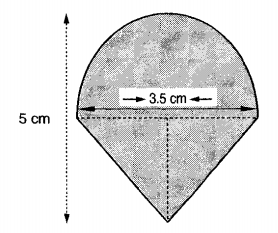
Diameter of hemisphere = 3.5 cm
So radius of hemispherical portion of the lattu = r = {tex}\frac { 3.5 } { 2 } \mathrm { cm }{/tex} = 1.75
r = Radius of the concial portion = {tex}\frac{3.5}2{/tex} = 1.75
Height of the conical portion = height of top - radius of hemisphere = {tex}{/tex} 5 - 1.75 = 3.25 cm
Let I be the slant height of the conical part. Then,
{tex}l^2=h^2+r^2{/tex}
{tex}\begin{array}{l}l^2=(3.25)^2+(1.75)^2\\\Rightarrow l^2\;=10.5625+3.0625\\\Rightarrow l^2=13.625\\\Rightarrow l=\sqrt{13.625}\\\Rightarrow l=3.69\end{array}{/tex}
Let S be the total surface area of the top. Then,
{tex}S = 2 \pi r ^ { 2 } + \pi r l{/tex}
{tex}\Rightarrow \quad S = \pi r ( 2 r + l ){/tex}
{tex}\begin{array}{l}\Rightarrow S=\frac{22}7\times1.75(2\times1.75+3.7)\\\;\;\;\;=\;5.5(3.5+3.7)\\=5.5(7.2)\\=39.6\;cm^2\end{array}{/tex}
Posted by Sagar Gangar 7 years, 2 months ago
- 1 answers
Yogita Ingle 7 years, 2 months ago
If a square is inscribed in a circle, then the diagonals of the square are diameters of the circle.
Let the diagonal of the square be d cm.
Thus, we have:
Radius, r = <nobr>d/2</nobr><amp-mathml data-formula="\[\frac{d}{2}\]" inline="" layout="container"></amp-mathml> cm
Area of the circle = <nobr>πr2</nobr><amp-mathml data-formula="\[\pi r^{2}\]" inline="" layout="container"></amp-mathml> = <nobr>π(d2/4)cm2</nobr>
We know:
d = <nobr>2× √ Side</nobr><amp-mathml data-formula="\[\sqrt{2} \times Side\]" inline="" layout="container"></amp-mathml>
<nobr>⇒Side=d/√2 cm</nobr>
Area of the square = <nobr>(Side)2</nobr>
<nobr>=(d/√2)2</nobr><amp-mathml data-formula="\[= \left ( \frac{d}{\sqrt{2}} \right ) ^{2}\]" inline="" layout="container"></amp-mathml>
<nobr>=(d2/2)cm2</nobr>
Ratio of the area of the circle to that of the square :
<nobr>=πd2/4 / d2/2</nobr><amp-mathml data-formula="\[= \frac{\pi \frac{d^{2}}{4}}{\frac{d^{2}}{2}}\]" inline="" layout="container"></amp-mathml> = <nobr>π/2</nobr>
Thus, the ratio of the area of the circle to that of the square is <nobr>π:2</nobr>
Posted by Anshika Pal???? 7 years, 2 months ago
- 4 answers
Arohi . 7 years, 2 months ago
Anshika Pal???? 7 years, 2 months ago
Anshika Pal???? 7 years, 2 months ago
Posted by Prashant Rai 7 years, 2 months ago
- 0 answers
Posted by Priyanka S 6 years, 8 months ago
- 1 answers
Sia ? 6 years, 8 months ago
According to the question,
Height of an inverted cone = 12 cm
Radius of an inverted cone = 9 cm
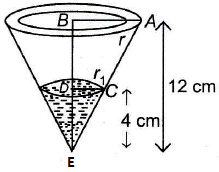
{tex}\triangle \mathrm { ABE } \sim \triangle \mathrm { CDE }{/tex}
{tex}\therefore \frac { \mathrm { AB } } { \mathrm { CD } } = \frac { \mathrm { BE } } { \mathrm { DE } }\\ \Rightarrow \frac { 9 } { \mathrm { CD } } = \frac { 12 } { 4 } {/tex}
{tex}\Rightarrow CD = 3\ cm{/tex}
Slant height of the cone = {tex}\sqrt { 12 ^ { 2 } + 9 ^ { 2 } } = \sqrt { 144 + 81 } = \sqrt { 225 }{/tex}{tex}= 15 \ cm{/tex}
CSA {tex}= \pi r l = \pi \times 9 \times 15 = 135 \pi{/tex} cm2
Slant height of the conical part containing water = {tex}\sqrt { 4 ^ { 2 } + 3 ^ { 2 } }{/tex} {tex}= 5 \ cm{/tex}
CSA of conical part containing water = {tex}\pi \times 3 \times 5{/tex}= 15{tex}\pi{/tex} cm2
Surface area not in contact with water = 135 {tex}\pi{/tex} cm2 - 15 {tex}\pi{/tex} cm2
= 120{tex}\pi{/tex} cm2
= {tex}120 \times \frac { 22 } { 7 }{/tex} cm2
{tex}= 377.14 {/tex}cm2
Posted by Ultra Dost A,T Kt 7 years, 2 months ago
- 2 answers
Ultra Dost A,T Kt 7 years, 2 months ago
Posted by Durga Appa 7 years, 2 months ago
- 2 answers
Ram Kushwah 7 years, 2 months ago
points are (4,k) and (1,0)
distance d2=(4-1)2+k2=52=25
or 32+k2-=25
k2 =16
So K= -4 or 4
Gaurav Seth 7 years, 2 months ago
By applying distance formula , find AB.
the value of k is 4
Posted by Udit Kapoor 7 years, 2 months ago
- 4 answers
Ram Kushwah 7 years, 2 months ago
Let the numbers are a-d,,a, a+d
so a-d+a +a+d=24
3a=24 , a=8
and (8-d)x 8x(8+d)=440
8(64-d2)=440
512-8d2=440
8d2=72 do d= 3
hence the no are 5,8 and 11
Puja Sahoo? 7 years, 2 months ago

myCBSEguide
Trusted by 1 Crore+ Students

Test Generator
Create papers online. It's FREE.

CUET Mock Tests
75,000+ questions to practice only on myCBSEguide app
