
Ask questions which are clear, concise and easy to understand.
Ask QuestionPosted by Ashwin Edakkara 7 years, 2 months ago
- 1 answers
Posted by Younus Khan 7 years, 2 months ago
- 1 answers
Gaurav Seth 7 years, 2 months ago
Let speed of A be Km/h and speed of B be km/h
And we know that distance =80km
80=(a-b) ×8 and 80=(a+b)×(4/3)
a-b=10 and a+b=60
a= 35 , b=25
Posted by Rohini Sv0 7 years, 2 months ago
- 4 answers
Anshika & Aliens???? 7 years, 2 months ago
Anshika & Aliens???? 7 years, 2 months ago
Anshika & Aliens???? 7 years, 2 months ago
Posted by Tushar Kalyan 7 years, 2 months ago
- 2 answers
Posted by Jatin Singh 7 years, 2 months ago
- 2 answers
Sneha Singh 7 years, 2 months ago
Niteesh Siva 7 years, 2 months ago
Posted by Sumit Vishwakarma 7 years, 2 months ago
- 1 answers
Yogita Ingle 7 years, 2 months ago
Volume of hemisphere = 2425 1/2 cu cm or 2425.5 cu cm.
Volume of hemisphere = 2/3πr³
2425.5 = 2/3× 22/7× r³
r³ = (2425.5×21)/44
r³ = 50935.5/44
r³ = 1157.625
r = 10.5 cm
Now,
Curved Surface Area of hemisphere = 2πr²
= 2 × 22/7 × 10.5 × 10.5
= 693 sq cm
CSA of hemisphere is 693 sq cm.
Posted by Jyotsana Arya 7 years, 2 months ago
- 2 answers
Ram Kushwah 7 years, 2 months ago
MID POINT OF LINE JOINING Q(-5,4) R(-1,0) is
{(-5-1)/2,(4+0)/2) or (-3,2)
So
a/3= - 3
a= -3 x 3 = - 9
Posted by Om Jalgaonkar 7 years, 2 months ago
- 1 answers
Yogita Ingle 7 years, 2 months ago
We Have Formula.
H.C.F multiply L.C.M = Product of two Numbers.
HCF × LCM = Product of two numbers
Therefore,
12 × L.C.M = 1800
Hence, L.C.M = 1800/12
= 15
Posted by Gsff Fffg 7 years, 2 months ago
- 2 answers
Posted by .. .. 7 years, 2 months ago
- 2 answers
Posted by Naitik Garg 7 years, 2 months ago
- 2 answers
Yogita Ingle 7 years, 2 months ago
R = 14 cm
r = 10.5 cm
Let height of frustum be h cm
∴ Volume held by bucket = 14245 cm³
Also,
Volume of frustum = π(R²+Rr+r²)h/3
⇒ 14245 = 22× (196+ 147+110.25 )× h/(3× 7)
⇒ 453.25 h = 14245*21/22
⇒ 453.25 h = 13597. 5
⇒ h = 13597.5/453.25 = 30cm
Posted by Akash Kumar 7 years, 2 months ago
- 2 answers
Gaurav Seth 7 years, 2 months ago
Basic Proportionality Theorem
Refer the below attachment.

Posted by Hardik Rathi 7 years, 2 months ago
- 1 answers
Gaurav Seth 7 years, 2 months ago
There is a mistake in ques. You havnt wrote powers.
Answering as per write question.
f(x) = 2x3 - 6x2 + 5x - 7
Let α, β and γ be the zeroes.
Then, α = a - b, β = a and γ = a + b
We know that if α, β and γ are the zeroes of a cubic polynomial,
α + β + γ = -b/a
(a - b) + a + (a + b) = -(-6)/2
3a = 3
a = 1
So, the value of a = 1
Posted by Punitha Valli V 6 years, 7 months ago
- 1 answers
Sia ? 6 years, 7 months ago
|PQ| = |PR
{tex}\begin{aligned} \sqrt { [ x - ( a + b ) ] ^ { 2 } + [ y - ( b - a ) ] ^ { 2 } } = \sqrt { [ x - ( a - b ) ] ^ { 2 } + [ y - ( b + a ) ] ^ { 2 } } \end{aligned}{/tex}
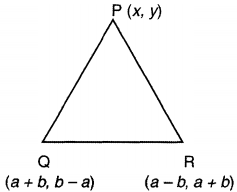
Squaring, we get
[x - (a + b)]2 + [y - (b - a)]2 = [x - (a - b)]2 + [y - (a + b)]2
or, [x - (a + b)]2 - [x - a + b]2 = (y - a - b)2 - (y - b + a)2
or, (x - a - b + x - a + b) ( x - a - b - x + a - b)
= (y - a - b + y - b + a)(y - a - b - y + b - a)
or, (2x - 2a) (- 2b) = (2y - 2b) (- 2a)
or, (x - a)b = (y - b)a
or, bx = ay.
Hence Proved.
Posted by Shivam Singh Yadav 7 years, 2 months ago
- 3 answers
Posted by Shivam Singh Yadav 7 years, 2 months ago
- 3 answers
Posted by Sujan Nepal 7 years, 2 months ago
- 3 answers
Aryan Khare 7 years, 2 months ago
@ Aashu 7 years, 2 months ago
Fizza Hussain 7 years, 2 months ago
Posted by Siddhant Nanjol 7 years, 2 months ago
- 1 answers
Om Pawar 7 years, 2 months ago
Posted by Sreelakshmi Raj 7 years, 2 months ago
- 2 answers
Jiya Thakur 7 years, 2 months ago
Posted by Sachin Patidar 7 years, 2 months ago
- 0 answers
Posted by Divyanshu Singh 7 years, 2 months ago
- 1 answers
Posted by Avanish Yadav 7 years, 2 months ago
- 2 answers
Avanish Yadav 7 years, 2 months ago
Posted by Anjali Yadav 7 years, 2 months ago
- 1 answers
Asmit Ganguly 7 years, 2 months ago
Posted by Aniket Jain 7 years, 2 months ago
- 0 answers
Posted by Shiv Maurya 7 years, 2 months ago
- 1 answers
Akshaya Chandrasekar 7 years, 2 months ago
Posted by Arbiya Banu 7 years, 2 months ago
- 1 answers
Shivam Tripathi 7 years, 2 months ago
Posted by Abhishek Jain 7 years, 2 months ago
- 2 answers
Posted by Ashutosh Kumar 6 years, 7 months ago
- 1 answers
Sia ? 6 years, 7 months ago
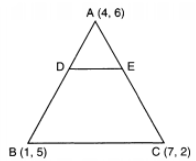
Area of a triangle having vertices (x1, y1), (x2, y2) and (x3, y3) is given by
Area = {tex}\frac { 1 } { 2 } \left[ x _ { 1 } \left( y _ { 2 } - y _ { 3 } \right) + x _ { 2 } \left( y _ { 3 } - y _ { 1 } \right) + x _ { 3 } \left( y _ { 1 } - y _ { 2 } \right) \right]{/tex}
{tex}\therefore{/tex} Area of {tex}\triangle{/tex} ABC is given by
Area = {tex}\frac 12{/tex}[4(5 - 2)+ 1 (2 - 6)+ 7(6 - 5)]
Area = {tex}\frac 12{/tex}[12 + (-4) + 7]
Area = {tex}\frac{1}{2}[12-4+7]{/tex}
Area = {tex}\frac{15}{2}{/tex} sq units.
Area of {tex}\triangle{/tex}ABC = {tex}\frac{15}{2} sq\ units{/tex}
In {tex}\triangle{/tex}ADE and {tex}\triangle{/tex}ABC,
{tex}\frac { A D } { A B } = \frac { A E } { E C } = \frac { 1 } { 3 }{/tex}
and {tex}\angle D A E = \angle B A C{/tex} (Common)
{tex}\therefore{/tex} {tex}\triangle A D E \sim \triangle A B C{/tex} (By SAS)
{tex}\therefore{/tex} {tex}\frac { \text { Area } \Delta A D E } { \text { Area } \Delta A B C } = \left( \frac { A D } { A B } \right) ^ { 2 } = \left( \frac { 1 } { 3 } \right) ^ { 2 } = \frac { 1 } { 9 }{/tex}
{tex}\therefore{/tex} {tex}\frac { \text { Ar } \Delta A D E } { \left( \frac { 15 } { 2 } \right) } = \frac { 1 } { 9 }{/tex}
{tex}\therefore{/tex} Area {tex}\triangle A D E = \frac { 15 } { 2 \times 9 } = \frac { 5 } { 6 }{/tex}Sq units
Area of {tex}\triangle{/tex}ADE : Area of {tex}\triangle{/tex}ABC = {tex}\frac { 5 } { 6 } : \frac { 15 } { 2 } {/tex}= 1 : 9

myCBSEguide
Trusted by 1 Crore+ Students

Test Generator
Create papers online. It's FREE.

CUET Mock Tests
75,000+ questions to practice only on myCBSEguide app

Aryan Khare 7 years, 2 months ago
0Thank You