
Ask questions which are clear, concise and easy to understand.
Ask QuestionPosted by Munni Tamta 7 years, 2 months ago
- 2 answers
Posted by Puneeth Bn 7 years, 2 months ago
- 2 answers
Posted by Diksha Deps 7 years, 2 months ago
- 2 answers
Posted by Sanjay Kumar Singh 7 years, 2 months ago
- 0 answers
Posted by Naved N433 7 years, 2 months ago
- 5 answers
Sneha Singh 7 years, 2 months ago
Posted by Vaishnav Sengar 7 years, 2 months ago
- 0 answers
Posted by Vanshika Sheokand 7 years, 2 months ago
- 1 answers
Top Ten Pedia 7 years, 2 months ago
Posted by Manpreet Kaur 7 years, 2 months ago
- 2 answers
Sneha Singh 7 years, 2 months ago
Vanshika Sheokand 7 years, 2 months ago
Posted by Manpreet Kaur 7 years, 2 months ago
- 0 answers
Posted by Chhaya Patel 5 years, 11 months ago
- 2 answers
Dhanya Shree K 7 years, 2 months ago
Posted by Seeta Bhagat 7 years, 2 months ago
- 1 answers
Baamaa'S Beta 7 years, 2 months ago
Posted by Varsha Harish 6 years, 9 months ago
- 1 answers
Sia ? 6 years, 9 months ago
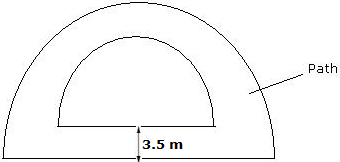
Let x be the radius of the semi-circular path.
Given, perimeter of circular path = 72
{tex} \Rightarrow 2r + \pi r = 72{/tex}
{tex} \Rightarrow r\left( {2 + \pi } \right) = 72{/tex}
{tex} \Rightarrow r\left( {2 + \frac{{22}}{7}} \right) = 72{/tex}
{tex} \Rightarrow r \times \frac{{36}}{7} = 72{/tex}
{tex}\therefore {/tex} Radius of semi-circular grassy plot = 14m
Since a path of width 3.5 m runs around a semi-circular grassy plot whose Perimeter is 72 m
Then, radius of outer semi-circle = 14m + 3.5m = 17.5m
Area of the path = Area of outer semi-circle-Area of inner semi-circle
{tex} = \frac{1}{2}\pi {\left( {17.5} \right)^2} - \frac{1}{2}\pi {\left( {14} \right)^2}{/tex}
{tex} = \frac{1}{2} \times \frac{{22}}{7}\left[ {{{\left( {17.5} \right)}^2} - {{\left( {14} \right)}^2}} \right]{/tex}
{tex} = \frac{{11}}{7}\left[ {31.5 \times 3.5} \right]{/tex}
= 173.25m2
Posted by Chhaya Patel 7 years, 2 months ago
- 0 answers
Posted by ????? ❤️ 7 years, 2 months ago
- 0 answers
Posted by Bhavana B 7 years, 2 months ago
- 1 answers
Posted by Priya Sharma 7 years, 2 months ago
- 2 answers
Shreya Sharma 7 years, 2 months ago
Posted by Bhavishya Kumar 7 years, 2 months ago
- 2 answers
Posted by Abishay Narain 7 years, 2 months ago
- 0 answers
Posted by Dev Raj 7 years, 2 months ago
- 6 answers
Hema Pandey 7 years, 2 months ago
Hema Pandey 7 years, 2 months ago
Hema Pandey 7 years, 2 months ago
Posted by Hema Pandey 6 years, 9 months ago
- 1 answers
Sia ? 6 years, 9 months ago
Let a be the first term and d be the common difference of the given A.P. Then,
pth term = q {tex}\Rightarrow{/tex}a + (p-1) d = q ...(i)
qth term = p {tex}\Rightarrow{/tex}a + (q-1) d = p ...(ii)
Subtracting equation (ii) from equation (i), we get
(p - q) d = (q - p) {tex}\Rightarrow{/tex} d = -1
Putting d = - 1 in equation (i), we get
a + ( p-1) × (-1) = q
⇒ a = (p + q - 1)
nth term = a + (n -1 )d
= (p + q - 1)+ (n -1) × (-1)
= p + q - 1 -n + 1
= (p + q - n)
Posted by Akshat Bhatt 7 years, 2 months ago
- 0 answers
Posted by Prince Kumar 7 years, 2 months ago
- 1 answers
Hema Pandey 7 years, 2 months ago
Posted by Hema Pandey 7 years, 2 months ago
- 2 answers
Baamaa'S Beta 7 years, 2 months ago
Posted by Anshika / U Can Call Me Alien ????? 7 years, 2 months ago
- 3 answers
Honey ??? 7 years, 2 months ago
Baamaa'S Beta 7 years, 2 months ago
Posted by Raina Ahlawat 7 years, 2 months ago
- 4 answers
Krishna Kireeti 7 years, 2 months ago
Posted by Sudhanshu Kumar 7 years, 2 months ago
- 2 answers
Posted by Tejas Mane 7 years, 2 months ago
- 1 answers
Posted by Mahendra Rao 7 years, 2 months ago
- 3 answers
Anshika / U Can Call Me Alien ????? 7 years, 2 months ago
Anshika / U Can Call Me Alien ????? 7 years, 2 months ago

myCBSEguide
Trusted by 1 Crore+ Students

Test Generator
Create papers online. It's FREE.

CUET Mock Tests
75,000+ questions to practice only on myCBSEguide app

Raghav Hr 81 Alla Bhaman 7 years, 2 months ago
1Thank You