
Ask questions which are clear, concise and easy to understand.
Ask QuestionPosted by Gungun._ Lalwani? 7 years, 1 month ago
- 3 answers
Abhinav Dutta 7 years, 1 month ago
Irfan Alam 7 years, 1 month ago
Posted by Gungun._ Lalwani? 7 years, 1 month ago
- 6 answers
Poonam Jyoti? 7 years, 1 month ago
Honey ??? 7 years, 1 month ago
Gungun._ Lalwani? 7 years, 1 month ago
Honey ??? 7 years, 1 month ago
Posted by Utsa Purkayastha 7 years, 1 month ago
- 1 answers
Prashant Parihar 7 years, 1 month ago
Posted by Anjali Kumari? 7 years, 1 month ago
- 5 answers
Bhuvnesh Rajpurohit 7 years, 1 month ago
Affu 😊 7 years, 1 month ago
Ayush Verma 7 years, 1 month ago
Posted by Abhishek Maurya 7 years, 1 month ago
- 1 answers
Posted by Private Kumar 7 years, 1 month ago
- 1 answers
Posted by Shivang Viz 7 years, 1 month ago
- 1 answers
Anshika / U Can Call Me Alien ???? 7 years, 1 month ago
Posted by Sameer Pratap Singh 7 years, 1 month ago
- 2 answers
Yogita Ingle 7 years, 1 month ago
Covalent bond: The bond formed by mutual sharing of valency electrons in order to get stable electronic configuration of nearest inert gas is called covalent bond. Generally this bond is formed between non metals.
Based on type of atoms participated in the bonding, covalent bond is classified into two types. They are (i) polar covalent bonding (ii) Non-polar covalent bonding
Khushi Chaudhary 7 years, 1 month ago
Posted by Priyam Singh 7 years, 1 month ago
- 2 answers
Gaurav Seth 7 years, 1 month ago
Let x be any positive integer
Then x = 5q or x = 5q+1 or x = 5q+4 for integer x.
If x = 5q, x2 = (5q)2 = 25q2 = 5(5q2) = 5n (where n = 5q2 )
If x = 5q+1, x2 = (5q+1)2 = 25q2+10q+1 = 5(5q2+2q)+1 = 5n+1 (where n = 5q2+2q )
If x = 5q+4, x2 = (5q+4)2 = 25q2+40q+16 = 5(5q2 + 8q + 3)+ 1 = 5n+1 (where n = 5q2+8q+3 )
<font face="Cambria Math, serif"><font style="box-sizing: inherit; outline: none; max-width: 100%; overflow: hidden; color: rgba(0, 0, 0, 0.87); font-size: 16px; font-style: normal; font-variant-ligatures: normal; font-variant-caps: normal; font-weight: 400; letter-spacing: normal; orphans: 2; text-align: start; text-indent: 0px; text-transform: none; white-space: normal; widows: 2; word-spacing: 0px; -webkit-text-stroke-width: 0px; text-decoration-style: initial; text-decoration-color: initial;">∴</font></font>in each of three cases x2 is either of the form 5q or 5q+1 or 5q+4 and for integer q.
Posted by Priyam Singh 7 years, 1 month ago
- 2 answers
Posted by Anubav Shaw 7 years, 1 month ago
- 1 answers
Gaurav Seth 7 years, 1 month ago
Depreciation after 1st year =600,000 × (15/100) = Rs 90,000
Depreciation after 2nd year =600,000 × (13.5/100) = Rs 81,000
Depreciation after 10th year =600,000 × 1.5/100 = Rs 9,000
Total depreciation = 90000 + 81000 + 72000+ …+ 9000
Here a = 90000, d = 81000 – 90000 = – 9000, t10 = 9000
Sum of n terms of AP is
= 5 × 99000 = 495000
Value at the end of 10 years = Rs 600000 – Rs 495000 = Rs 1,05,000
Posted by Abhinav Sharma 5 years, 11 months ago
- 3 answers
Bhuvnesh Rajpurohit 7 years, 1 month ago
Posted by Durgesh Kumar Singh 6 years, 7 months ago
- 1 answers
Sia ? 6 years, 7 months ago
LHS = (1 + tan{tex}\theta{/tex} + cot{tex}\theta{/tex})(sin{tex}\theta{/tex} - cos{tex}\theta{/tex})
{tex}= \left( 1 + \frac { \sin \theta } { \cos \theta } + \frac { \cos \theta } { \sin \theta } \right) ( \sin \theta - \cos \theta ){/tex}
{tex}= \left( \frac { \cos \theta \sin \theta + \sin ^ { 2 } \theta + \cos ^ { 2 } \theta } { \cos \theta \sin \theta } \right) ( \sin \theta - \cos \theta ){/tex}
{tex}= \frac { ( \cos \theta \sin \theta + 1 ) } { \cos \theta \sin \theta } ( \sin \theta - \cos \theta ){/tex}
RHS = {tex}\left( \frac { \sec \theta } { \ cosec ^ { 2 } \theta } - \frac { \cos e c \theta } { \sec ^ { 2 } \theta } \right) = \left( \frac { \frac { 1 } { \cos \theta } } { \frac { 1 } { \sin ^ { 2 } \theta } } - \frac { \frac { 1 } { \sin \theta } } { \frac { 1 } { \cos ^ { 2 } \theta } } \right){/tex}
{tex}= \left( \frac { \sin ^ { 2 } \theta } { \cos \theta } - \frac { \cos ^ { 2 } \theta } { \sin \theta } \right) = \frac { \sin ^ { 3 } \theta - \cos ^ { 3 } \theta } { \cos \theta \sin \theta }{/tex}
{tex}= \frac { ( \sin \theta - \cos \theta ) \left( \sin ^ { 2 } \theta + \cos ^ { 2 } \theta + \cos \theta \sin \theta \right) } { \cos \theta \sin \theta }{/tex} [{tex}\because{/tex} a3 - b3 = (a - b) (a2 + ab + b2) ]
{tex}= \frac { ( \sin \theta - \cos \theta ) ( 1 + \cos \theta \sin \theta ) } { \cos \theta \sin \theta }{/tex}
{tex}\therefore{/tex} LHS = RHS
Posted by Divyanshi Varshney 7 years, 1 month ago
- 1 answers
Durgesh Kumar Singh 7 years, 1 month ago
Posted by Aditi Sharma 7 years, 1 month ago
- 2 answers
Abhinav Nk 7 years, 1 month ago
Posted by Deepthi ? 7 years, 1 month ago
- 0 answers
Posted by Abhishek Dubey 7 years, 1 month ago
- 0 answers
Posted by Akash Jinaralakar 6 years, 7 months ago
- 1 answers
Sia ? 6 years, 7 months ago
Let y-axis divides the line segment joining the points
(5, - 6) and (- 1, - 4) in the ratio k: 1
and the coordinates of the required point be (0, y).
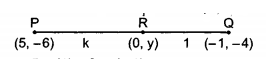
Then, 0 = {tex}\frac { 5 \times ( 1 ) + k \times ( - 1 ) } { k + 1 }{/tex}
{tex}\Rightarrow{/tex} 5 - k = 0
{tex}\Rightarrow{/tex} k = 5
Thus, y-axis divides the line segment joining the points (- 5 , 6) and (- 1, -4) in the ratio 5 : 1.
Posted by Roushan & Suraj 6 years, 7 months ago
- 1 answers
Sia ? 6 years, 7 months ago
Given,
Volume of gold = 1 cm3 = 1000 mm3 ......(1)
Diameter of wire = 0.1 mm
Radius of wire = {tex}\frac { 0.1 } { 2 }{/tex} = 0.05 mm
Let, the length of the wire = h mm
According to the question,
Volume of wire = Volume of gold
{tex}\Rightarrow {/tex} πr2h = 1000 .( Since, wire is cylindrical & from (1) )
{tex}\Rightarrow π× ( 0.05 ) ^ { 2 } \times h{/tex} = 1000
{tex}\Rightarrow \frac { 22 } { 7 } \times 0.0025 \times h{/tex} = 1000
{tex}\Rightarrow h = \frac { 1000 \times 7 } { 22 \times 0.0025 }{/tex}mm
{tex}\Rightarrow{/tex} h = 127272.72 mm
{tex}\Rightarrow{/tex} h = 127.27 m(approx.)
Posted by Siva Siva 7 years, 1 month ago
- 0 answers
Posted by Anjali Kotwani 7 years, 1 month ago
- 3 answers
Bhuvnesh Rajpurohit 7 years, 1 month ago
Posted by Mohammed Fazlur Rehmaan 7 years, 1 month ago
- 1 answers
Aryan Pratap 7 years, 1 month ago
Posted by Vinod Kumar 7 years, 1 month ago
- 1 answers
Nithin Goud 7 years, 1 month ago
Posted by Rohan Bagri 7 years, 1 month ago
- 1 answers
Muskaan Smile 7 years, 1 month ago
Posted by Divya Sharma 7 years, 1 month ago
- 0 answers
Posted by Aditi Singh 7 years, 1 month ago
- 1 answers
Posted by Tarun Thakur 7 years, 1 month ago
- 3 answers

myCBSEguide
Trusted by 1 Crore+ Students

Test Generator
Create papers online. It's FREE.

CUET Mock Tests
75,000+ questions to practice only on myCBSEguide app

Yogita Ingle 7 years, 1 month ago
Let the cost of pen be x and pencil be y,
5x+6y=9 ...(i)
and 3x+2y-=5 ...(ii)
solving (i) and (ii) by eliminatory method we get;
5x+6y=9
3x+2y=5( Multiply by 3)
-> 9x+6y=15 ...(iii)
From (i) and (iii)
5x + 6y= 9
9x + 6y= 15
(-) (-) (-)
------------------------
4x = 6
------------------------
or x= 1.5
Substituting the value of x in (ii) we get
3(1.5)+ 2y=5
⇒ 4.5+2y=5
⇒ 2y= 5-4.5
⇒ y=0.5/2
⇒y =0.25
Therefore cost of pen is Rs1.5 and that of pencil is Rs 0.25.
1Thank You