
Ask questions which are clear, concise and easy to understand.
Ask QuestionPosted by Yogesh Parihar 5 years, 11 months ago
- 1 answers
Posted by Janvi Jain 7 years, 1 month ago
- 0 answers
Posted by ????? ??? 6 years, 7 months ago
- 1 answers
Sia ? 6 years, 7 months ago
Let us suppose that P be the initial position of the plane and let Q be the final position of the plane respectively and suppose A be the point of observation. Let ABC be the horizontal line through A.
According to question, it is given that angles of elevation of the plane in two positions P and Q from a point A are 60° and 30° respectively.
{tex} \therefore \quad \angle P A B = 60 ^ { \circ } , \angle Q A B = 30 ^ { \circ }.{/tex}It is also given that PB = 1500{tex} \sqrt { 3 }{/tex} metres
Now, In {tex} \Delta A B P,{/tex} we have
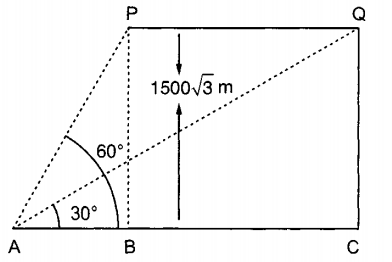
{tex} \tan 60 ^ { \circ } = \frac { B P } { A B }{/tex}
{tex} \Rightarrow \quad \sqrt { 3 } = \frac { 1500 \sqrt { 3 } } { A B }{/tex}
{tex} \Rightarrow{/tex} AB = 1500 m
Again, In {tex} \Delta A C Q,{/tex}we have
{tex} \tan 30 ^ { \circ } = \frac { C Q } { A C }{/tex}
{tex} \Rightarrow \quad \frac { 1 } { \sqrt { 3 } } = \frac { 1500 \sqrt { 3 } } { A C }{/tex}
{tex} \Rightarrow \quad A C = 1500 \times 3 = 4500 \mathrm { m }{/tex}
{tex} \therefore{/tex} PQ = BC = AC - AB = 4500 - 1500 = 3000 m
Therefore, the plane travels 3000 m in 30 seconds.
Hence, speed of plane is = {tex} \frac { 3000 } { 30 } = 100 \mathrm { m } / \mathrm { sec } {/tex}
Posted by Diksha?.. Atm..?? 7 years, 1 month ago
- 1 answers
Honey ??? 7 years, 1 month ago
Posted by Bhavishya Kumar 7 years, 1 month ago
- 0 answers
Posted by Dhanya Rajeev 7 years, 1 month ago
- 0 answers
Posted by Tanish Singh 7 years, 1 month ago
- 1 answers
Posted by Bijaykumar Chhatria 7 years, 1 month ago
- 3 answers
Puja Sahoo? 7 years, 1 month ago
Yogita Ingle 7 years, 1 month ago
(a + b)3 = a3 + 3a2b + 3ab2 + b3 ; (a + b)3 = a3 + b3 + 3ab(a + b)
(a – b)3 = a3 – 3a2b + 3ab2 – b3
Posted by Harpreet Singh 7 years, 1 month ago
- 1 answers
Puja Sahoo? 7 years, 1 month ago
Posted by Krishnamani Tiwari 7 years, 1 month ago
- 1 answers
Posted by Krishnamani Tiwari 7 years, 1 month ago
- 1 answers
Posted by Dolly Kumari 7 years, 1 month ago
- 2 answers
Pooja Singh??? 7 years, 1 month ago
Pooja Singh??? 7 years, 1 month ago
Posted by Shruti Vishwakarma 7 years, 1 month ago
- 2 answers
Posted by Abhishek Keshri 7 years, 1 month ago
- 1 answers
Posted by Nikita Sharma 6 years, 7 months ago
- 1 answers
Sia ? 6 years, 7 months ago
According to the question, {tex}\triangle ABC {/tex} is an equilateral triangle.
In {tex}\triangle{/tex}ABD, using Pythagoras theorem,
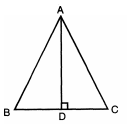
{tex}\Rightarrow{/tex} AB2 = AD2 + BD2
{tex}\Rightarrow{/tex} BC2 = AD2 + BD2, (as AB = BC = CA)
{tex}\Rightarrow{/tex} (2 BD)2 = AD2 + BD2, (perpendicular is the median in an equilateral triangle)
{tex}\Rightarrow{/tex} 4BD2 - BD2 = AD2
{tex}\therefore{/tex} 3BD2 = AD2
Posted by Ayush Singh 7 years, 1 month ago
- 3 answers
Posted by Ashish Kumar 7 years, 1 month ago
- 1 answers
Posted by Sameer Joshi 7 years, 1 month ago
- 4 answers
Gungun._ Lalwani? 7 years, 1 month ago
Gungun._ Lalwani? 7 years, 1 month ago
Posted by Nithin Goud 7 years, 1 month ago
- 0 answers
Posted by Rohitman Jorwal 7 years, 1 month ago
- 0 answers
Posted by Shareef Khan 7 years, 1 month ago
- 1 answers
Yogita Ingle 7 years, 1 month ago
n term sum = 3n²/2 + 13n/2
as we know that nth term = (Sum of nth term ) -( sum of (n-1)th term)
method 1
so 25th term = (sum of 25 terms) - ( sum of 24 terms)
=(3×(25)²/2 +(13×25)/2) - ( 3×(24)²/2 + (13×24)/2)
= 1100 - 1020
= 80
method 2
1st term = 8
sum of 2 terms = 19
2nd term = 19 - 8= 11
so. difference = 11- 8 = 3
25th term = [8 + (25 -1)×3] = 80
Posted by Dinesh Sharma 7 years, 1 month ago
- 2 answers
Aryan Kumar 7 years, 1 month ago
Posted by Rishabh R 7 years, 1 month ago
- 2 answers
Dinesh Sharma 7 years, 1 month ago

myCBSEguide
Trusted by 1 Crore+ Students

Test Generator
Create papers online. It's FREE.

CUET Mock Tests
75,000+ questions to practice only on myCBSEguide app

Sia ? 6 years, 7 months ago
Let AB be a chord of a circle with centre O, and let AP and BP be the tangents at A and B respectively. Let the two tangents AP and BP meets at P.
Now Join OP. Suppose OP meets AB at C and the chord AB=AC+BC.
We have to prove that {tex}\angle P A C = \angle P B C{/tex}
In two triangles PCA and PCB, we have
PA = PB [{tex} \because{/tex}Tangents from an external point are equal]
{tex}\angle A P C = \angle B P C{/tex} [{tex} \because {/tex} PA and PB are equally inclined to OP]
and, PC = PC [Common]
So, by SAS-criterion of congruence, we obtain
{tex}\Delta P A C \cong \Delta P B C{/tex}
{tex}\Rightarrow \quad \angle P A C = \angle P B C{/tex}
0Thank You