
Ask questions which are clear, concise and easy to understand.
Ask QuestionPosted by Sanket Appa 6 years, 10 months ago
- 2 answers
Posted by Zabir Hussain 6 years, 10 months ago
- 0 answers
Posted by Sonam Sharma 6 years, 6 months ago
- 1 answers
Sia ? 6 years, 6 months ago
Let n = 4q + 1 (an odd integer)
{tex}\therefore \quad n ^ { 2 } - 1 = ( 4 q + 1 ) ^ { 2 } - 1{/tex}
{tex}= 16 q ^ { 2 } + 1 + 8 q - 1 \quad \text { Using Identity } ( a + b ) ^ { 2 } = a ^ { 2 } + 2 a b + b ^ { 2 }{/tex}
{tex}= 16{q^2} + 8q{/tex}
{tex}= 8 \left( 2 q ^ { 2 } + q \right){/tex}
= 8m, which is divisible by 8.
Posted by Mahi Shiv 6 years, 10 months ago
- 1 answers
Sonam Sharma 6 years, 10 months ago
Posted by Sonam Sharma 6 years, 10 months ago
- 2 answers
Khushboo Giri 6 years, 10 months ago
Yogita Ingle 6 years, 10 months ago
let root 5 be rational
then it must in the form of p/q [q is not equal to 0][p and q are co-prime]
root 5=p/q
=> root 5 ×q = p
squaring on both sides
=> 5×q×q = p×p ------> 1
p×p is divisible by 5
p is divisible by 5
p = 5c [c is a positive integer] [squaring on both sides ]
p×p = 25c×c --------- > 2
sub p×p in 1
5×q×q = 25×c×c
q×q = 5×c×c
=> q is divisble by 5
thus q and p have a common factor 5
there is a contradiction
as our assumsion p &q are co prime but it has a common factor
so √5 is an irrational
Posted by Samrat Kkkkk 6 years, 10 months ago
- 2 answers
Ram Kushwah 6 years, 10 months ago
AB=AC
AB^2=AC^2
(0-3)^2+(2-p)^2=(o-p)^2+(2-5)^2
9+4+p^2-4p=p^2+9
-4p=-4
p=1
Posted by Sanjeev Kumar 6 years, 10 months ago
- 1 answers
Posted by Gaurav Motwani 6 years, 10 months ago
- 2 answers
Ram Kushwah 6 years, 10 months ago
Pl check your question is not complete.
If roots are equal then
b^2=4ac
2^2=4 x p x -3
p=-1/3
Dia Khurana@1608 6 years, 10 months ago
Posted by Eklavya Vats 6 years, 10 months ago
- 1 answers
Posted by Shivani Anjal 6 years, 10 months ago
- 2 answers
Posted by Divanshu Rawat 6 years, 10 months ago
- 3 answers
Aditya Singh 6 years, 10 months ago
Gaurav Seth 6 years, 10 months ago
Let Sm and Sn be the sum of the first m and first n terms of the A.P. respectively. Let, a be the first terms and d be a common difference.
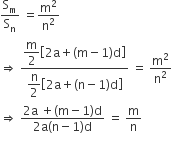
⇒[2a+(m−1)d]
n =[2a(n−1)d]m
⇒2an+mnd−nd=2am+mnd−md
⇒md−nd=2am−2an
⇒(m−n)d=2a(m−n)
⇒d=2a
Now, the ratio of its mth and nth terms is
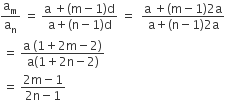
Thus, the ratio of its mth and nth terms is 2m – 1 : 2n – 1.
Posted by Rajput Singh 6 years, 10 months ago
- 1 answers
Khushboo Giri 6 years, 10 months ago
Posted by Navjot Kaur 6 years, 10 months ago
- 2 answers
Vikram Singh 6 years, 10 months ago
Posted by Nyajir Lomi 6 years, 10 months ago
- 1 answers
Posted by Kunalgarg Kunakgarg 6 years, 10 months ago
- 3 answers
Yogita Ingle 6 years, 10 months ago
Median
- A line segment passing through a vertex to the midpoint of an opposite side is called a median.
- The point where the 3 medians meet is called the centroid of the triangle.
- Each median of a triangle divides the triangle into two smaller triangles which have equal area.
Altitude
- An altitude passing through a vertex and is at right-angle at the opposite side.
- The point where the 3 altitudes meet is called the ortho-center of the triangle.
- The altitude of a triangle may lie inside or outside the triangle.
Babji Dandu 6 years, 10 months ago
Laxmikant Dhanka 6 years, 10 months ago
Posted by Sasibhusan Behera 6 years, 10 months ago
- 3 answers
Kratika Nyati 6 years, 10 months ago
Posted by Yash Chaudhary 6 years, 10 months ago
- 2 answers
Khushboo Giri 6 years, 10 months ago
Yogita Ingle 6 years, 10 months ago
According to Euclid division lemma , a = bq + r where 0 ≤ r < b
Here we assume b = 8 and r ∈ [1, 7 ] means r = 1, 2, 3, .....7
Then, a = 8q + r
Case 1 :- when r = 1 , a = 8q + 1
squaring both sides,
a² = (8q + 1)² = 64²q² + 16q + 1 = 8(8q² + 2q) + 1
= 8m + 1 , where m = 8q² + 2q
case 2 :- when r = 2 , a = 8q + 2
squaring both sides,
a² = (8q + 2)² = 64q² + 32q + 4 ≠ 8m +1 [ means when r is an even number it is not in the form of 8m + 1 ]
Case 3 :- when r = 3 , a = 8q + 3
squaring both sides,
a² = (8q + 3)² = 64q² + 48q + 9 = 8(8q² + 6q + 1) + 1
= 8m + 1 , where m = 8q² + 6q + 1
You can see that at every odd values of r square of a is in the form of 8m +1
But at every even Values of r square of a isn't in the form of 8m +1 .
Also we know, a = 8q +1 , 8q +3 , 8q + 5 , 9q +7 are not divisible by 2 means these all numbers are odd numbers
Hence , it is clear that square of an odd positive is in form of 8m +1.
Posted by Shivam Upadhyay 6 years, 10 months ago
- 1 answers
Raj Dhali 6 years, 10 months ago
Posted by Uday Chopra 6 years, 10 months ago
- 2 answers
Kitzz Perey 6 years, 10 months ago
Posted by Kuldeep Prajapati 6 years, 10 months ago
- 4 answers
Anjali Mahlawat 6 years, 10 months ago
Posted by Pallavi Pallavi 6 years, 10 months ago
- 1 answers
Posted by Virendra Singh 6 years, 10 months ago
- 5 answers
Jais Ravi 6 years, 10 months ago
Neha Diwach 6 years, 10 months ago
Posted by Rajneesh Kaurav 6 years, 10 months ago
- 1 answers
Dia Khurana@1608 6 years, 10 months ago
Posted by Urmila Gandhi 6 years, 10 months ago
- 1 answers
Puja Sahoo? 6 years, 10 months ago
Posted by Rajani Vs 6 years, 10 months ago
- 1 answers
Posted by Ritika Bisht 6 years, 10 months ago
- 1 answers

myCBSEguide
Trusted by 1 Crore+ Students

Test Generator
Create papers online. It's FREE.

CUET Mock Tests
75,000+ questions to practice only on myCBSEguide app

Yogita Ingle 6 years, 10 months ago
245 = 5 × 7 × 7
285 = 3 × 5 × 19
Therefore, HCF = 5
2Thank You