
Ask questions which are clear, concise and easy to understand.
Ask QuestionPosted by Piyush Bothra 6 years, 10 months ago
- 5 answers
Ram Kushwah 6 years, 10 months ago
{tex}\begin{array}{l}2\mathrm a^2\mathrm x^2+\mathrm b(6\mathrm a^2+1)\mathrm x+3\mathrm b^2=0\\2\mathrm a^2\mathrm x^2+6\mathrm a^2\mathrm x+\mathrm{bx}+3\mathrm b^2=0\\2\mathrm a^2\mathrm x(\mathrm x+3\mathrm b)+\mathrm b(\mathrm x+3\mathrm b)=0\\(\mathrm x+3\mathrm b)(2\mathrm a^2\mathrm x+\mathrm b)=0\\\mathrm x=-3\mathrm b,-\frac{\mathrm b}{2\mathrm a^2}\end{array}{/tex}
Posted by Jot Virk?♠ 6 years, 10 months ago
- 2 answers
Ram Kushwah 6 years, 10 months ago
on x axis y= 0
let the coordinates are O (x,0),A(2,5),B=(-2,9)
{tex}\begin{array}{l}\mathrm{OA}=\mathrm{OB}\\\mathrm{OA}^2=\mathrm{OB}^2\\(\mathrm x-2)^2+(0-5)^2=(\mathrm x+2)^2+(0-9)^2\\\mathrm x^2-4\mathrm x+4+25=\mathrm x^2+4\mathrm x+4+81\\-8\mathrm x=81-25=56\\\mathrm x=-7\\\mathrm{hence}\;\mathrm{the}\;\mathrm{point}\;\mathrm O\;(-7,0)\end{array}{/tex}
Puja Sahoo? 6 years, 10 months ago
Posted by Naveen Panchal 6 years, 10 months ago
- 3 answers
Posted by Jot Virk?♠ 6 years, 10 months ago
- 2 answers
Shivay Brahmåñ 6 years, 10 months ago
Puja Sahoo? 6 years, 10 months ago
Posted by Surya Shubham 6 years, 10 months ago
- 2 answers
Gungun ❤❤❤ 6 years, 10 months ago
Posted by ????? ??? 6 years, 10 months ago
- 1 answers
Sneha Singh 6 years, 10 months ago
Posted by Gaurav Singhal 6 years, 6 months ago
- 1 answers
Sia ? 6 years, 6 months ago
Given,
tan A = n tan B
{tex} \Rightarrow{/tex} tanB = {tex}\frac{1}{n}{/tex}tan A
{tex}\Rightarrow{/tex} cotB = {tex}\frac { n } { \tan A }{/tex}..........(1)
Also given,
sin A = m sin B
{tex}\Rightarrow{/tex} sin B = {tex}\frac{1}{m}{/tex}sin A
{tex}\Rightarrow{/tex} cosec B = {tex}\frac { m } { \sin A }{/tex}.....(2)
We know that, cosec2B - cot2B = 1, hence from (1) & (2) :-
{tex} \quad \frac { m ^ { 2 } } { \sin ^ { 2 } A } - \frac { n ^ { 2 } } { \tan ^ { 2 } A } = 1{/tex}
{tex}\Rightarrow \quad \frac { m ^ { 2 } } { \sin ^ { 2 } A } - \frac { n ^ { 2 } \cos ^ { 2 } A } { \sin ^ { 2 } A } = 1{/tex}
{tex}\Rightarrow \quad \frac { m ^ { 2 } - n ^ { 2 } \cos ^ { 2 } A } { \sin ^ { 2 } A } = 1{/tex}
{tex}\Rightarrow{/tex} m2 - n2cos2A = sin2A
{tex}\Rightarrow{/tex} m2 - n2cos2A = 1 - cos2A
{tex}\Rightarrow{/tex} m2 - 1 = n2cos2A - cos2A
{tex}\Rightarrow{/tex} m2 - 1 = (n2 - 1) cos2A
{tex}\Rightarrow \quad \frac { m ^ { 2 } - 1 } { n ^ { 2 } - 1 } ={/tex} cos2A
Posted by Anjali Mishra 6 years, 10 months ago
- 1 answers
Gaurav Seth 6 years, 10 months ago
Secθ+tanθ=p ----------------------(1)
∵, sec²θ-tan²θ=1
or, (secθ+tanθ)(secθ-tanθ)=1
or, secθ-tanθ=1/p ----------------(2)
Adding (1) and (2) we get,
2secθ=p+1/p
or, secθ=(p²+1)/2p
∴, cosθ=1/secθ=2p/(p²+1)
∴, sinθ=√(1-cos²θ)
=√[1-{2p/(p²+1)}²]
=√[1-4p²/(p²+1)²]
=√[{(p²+1)²-4p²}/(p²+1)²]
=√[(p⁴+2p²+1-4p²)/(p²+1)²]
=√(p⁴-2p²+1)/(p²+1)
=√(p²-1)²/(p²+1)
=(p²-1)/(p²+1)
∴, cosecθ=1/sinθ=1/[(p²-1)/(p²+1)]=(p²+1)/(p²-1)
Posted by ????? ??? 6 years, 10 months ago
- 2 answers
Gaurav Seth 6 years, 10 months ago
Multiply both numerator and denominator of the fraction by the conjugate of the denominator to clear the square root from the denominator.

Posted by #Itz_Ur_Desi_Gujjar_Ravi ???? 6 years, 10 months ago
- 3 answers
#Itz_Ur_Desi_Gujjar_Ravi ???? 6 years, 10 months ago
Posted by Riya Pandey 6 years, 10 months ago
- 2 answers
Sharma Satvik 6 years, 10 months ago
Posted by Deepak Kumar Singh 6 years, 10 months ago
- 1 answers
Gaurav Seth 6 years, 10 months ago
sec + tan = p
Sec = p - tan
sec^2 = (p - tan)^2
sec^2 = p^2 + tan^2 - 2ptan
sec^2 - tan^2 = p^2 - 2ptan
p^2 - 2ptan - 1 = 0
(p^2 - 1)/2p = tan
Sec + (p^2 - 1)/2p = p
Sec = p - (p^2 - 1)/2p = (p^2 + 1 )/2p
Cos = 2p/(p^2+1)
cos^2 = 4p^2/(p^2+1)^2
sin^2 = 1 - 4p^2/(p^2+1)^2
sin^2 =[ (p^2+1)^2 - 4p^2]/(p^2+1)^2
sin^2 = (p^2–1)^2/(p^2+1)^2
Sin = (p^2–1)/(p^2+1)
Posted by Vivek R Vive 6 years, 10 months ago
- 3 answers
Farhat Shaikh Shaikh 6 years, 10 months ago
Ritik Sharma 6 years, 10 months ago
Posted by Shuaib Ks 6 years, 10 months ago
- 0 answers
Posted by Shubham Singh 6 years, 10 months ago
- 1 answers
Misha Yadav 6 years, 10 months ago
Posted by Anu Rao 6 years, 10 months ago
- 2 answers
Khushboo Giri 6 years, 10 months ago
Khushboo Giri 6 years, 10 months ago
Posted by Shivay Brahmåñ 6 years, 10 months ago
- 1 answers
Khushboo Giri 6 years, 10 months ago
Posted by Arun Tiwari 6 years, 6 months ago
- 1 answers
Sia ? 6 years, 6 months ago
It is given that
f(x) = 3x3 - 2x2+ 5x - 5
q(x) = (x2 - x + 2)
r(x) = (-7)
According to division algorithm,
f(x) = p(x).q(x) + r(x)
{tex}\Rightarrow{/tex}3x3 - 2x2 + 5x - 5 = p(x).(x2 - x + 2) + (-7)
{tex}\Rightarrow{/tex}3x3 - 2x2 + 5x - 5 + 7 = p(x)(x2 - x + 2)
{tex}\Rightarrow{/tex} p(x) = {tex}\frac { 3 x ^ { 3 } - 2 x ^ { 2 } + 5 x + 2 } { x ^ { 2 } - x + 2 }{/tex}

{tex}\therefore{/tex} p(x) = 3x + 1
Posted by Deepika R 6 years, 10 months ago
- 1 answers
Shyam Thakur 6 years, 10 months ago
Posted by Aastha . 6 years, 6 months ago
- 1 answers
Posted by Simar Singh 6 years, 6 months ago
- 1 answers
Sia ? 6 years, 6 months ago

Clearly, {tex}BD=\frac{BC}{2}=\frac{a}{2}{/tex} [In an equilateral triangle , altitude bisects the base]
In {tex}\triangle ABC{/tex}, {tex}\angle ADB=90^o{/tex}
Using pythgoras theorem,
AB2 = AD2 + BD2
{tex}\Rightarrow a^2=AD^2+(\frac{a}{2})^2{/tex}
{tex}\Rightarrow a^2=AD^2+(\frac{a^2}{4}){/tex}
{tex}\Rightarrow a^2 - (\frac{a^2}{4})=AD^2{/tex}
{tex}\Rightarrow (\frac{4a^2 - a^2}{4})=AD^2{/tex}
{tex}\Rightarrow AD=\frac{\sqrt3 a }{2}{/tex}
{tex}\therefore \triangle ABC{/tex} and {tex}\triangle ADE{/tex} are equilateral triangles and so equiangular.
{tex}\therefore \triangle ABC \sim \triangle ADE{/tex}
{tex}\frac{ar(\triangle ADE)}{ar(\triangle ABC)}=\frac{AD^2}{AB^2}{/tex}
{tex}\frac{ar(\triangle ADE)}{ar(\triangle ABC)}=\frac{\frac{\sqrt{3}a}{2}}{a^2}{/tex}
{tex}\frac{ar(\triangle ADE)}{ar(\triangle ABC)}=\frac{3}{4}{/tex}
Posted by Divya Nishad 6 years, 10 months ago
- 1 answers
Areeba Siddiqui 6 years, 10 months ago
Posted by Priya Jain 6 years, 10 months ago
- 3 answers
Posted by Ravi Yadav 6 years, 10 months ago
- 1 answers
Posted by Krishna Priya Vijayan 6 years, 10 months ago
- 1 answers
Posted by Geetanand Yadav 6 years, 10 months ago
- 3 answers
Gaurav Seth 6 years, 10 months ago
The velocity gained by the accelerating electrons in uniform electric field inside the conductor is drift velocity. The average velocity, acquired by free electrons along the length of a metallic conductor, due to existing electric field is called drift velocity.
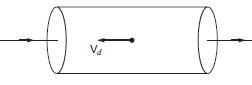
Let ‘n’ be the number density of free electrons in a conductor of length ‘l’ and area of cross-section ‘A’.
Total charge in the conductor, Q = Ne
= (nAl)e
Time taken, t is given by,

Therefore, the current flowing across the conductor is given by,
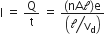
That is,
 , which is the amount of current flowing through a conductor in terms of drift velocity.
Posted by Areeba Siddiqui 6 years, 6 months ago
- 1 answers
Sia ? 6 years, 6 months ago
Let n be any positive integer. Applying Euclids division lemma with divisor = 5, we get
{tex}\style{font-family:Arial}{\begin{array}{l}n=5q+1,5q+2,5q+3\;and\;5q+4\;\\\end{array}}{/tex}
Now (5q)2 = 25q2 = 5m, where m = 5q2, which is an integer;
{tex}\style{font-family:Arial}{\begin{array}{l}(5q\;+\;1)^{\;2}\;=\;25q^2\;+\;10q\;+\;1\;=\;5(5q^2\;+\;2q)\;+\;1\;=\;5m\;+\;1\\where\;m\;=\;5q^2\;+\;2q,\;which\;is\;an\;integer;\\\;(5q\;+\;2)^2\;=\;25q^2\;+\;20q\;+\;4\;=\;5(5q^2\;+\;4q)\;+\;4\;=\;5m\;+\;4,\\\;where\;m\;=\;5q^2\;+\;4q,\;which\;is\;an\;integer;\\\;(5q\;+\;3)^{\;2}\;=\;25q^2\;+\;30q\;+\;9\;=\;5(5q^2\;+\;6q+\;1)\;+\;4\;=\;5m\;+\;4,\\\;where\;m\;=\;5q^2\;+\;6q\;+\;1,\;which\;is\;an\;integer;\\\;(5q\;+\;4)^2\;=\;25q^2\;+\;40q\;+\;16\;=\;5(5q^2\;+\;8q\;+\;3)\;+\;1\;=\;5m\;+\;1,\;\\where\;m\;=\;5q^2\;+\;8q\;+\;3,\;which\;is\;an\;integer\\\end{array}}{/tex}
Thus, the square of any positive integer is of the form 5m, 5m + 1 or 5m + 4 for some integer m.
It follows that the square of any positive integer cannot be of the form 5m + 2 or 5m + 3 for some integer m.
Posted by Tanishka Gupta 6 years, 10 months ago
- 0 answers
Posted by Areeba Siddiqui 6 years, 10 months ago
- 5 answers
Areeba Siddiqui 6 years, 10 months ago

myCBSEguide
Trusted by 1 Crore+ Students

Test Generator
Create papers online. It's FREE.

CUET Mock Tests
75,000+ questions to practice only on myCBSEguide app

Puja Sahoo? 6 years, 10 months ago
1Thank You