
Ask questions which are clear, concise and easy to understand.
Ask QuestionPosted by Arpit Mishra 6 years, 10 months ago
- 1 answers
Posted by Pravendra Jeriya 6 years, 10 months ago
- 3 answers
Posted by Gaurav Dadhich 6 years, 6 months ago
- 1 answers
Sia ? 6 years, 6 months ago
The sum of the measures of the interior angles of a polygon with n sides is (n – 2)180.
Posted by Isha Panwar 6 years, 10 months ago
- 1 answers
Posted by Nancy Jain 6 years, 10 months ago
- 1 answers
Cbse Teacher 6 years, 10 months ago
Posted by Yash Jurel 6 years, 6 months ago
- 1 answers
Sia ? 6 years, 6 months ago
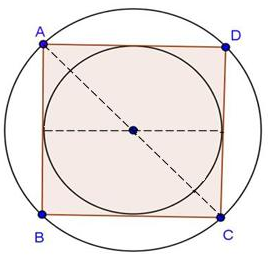
Side of square = 10cm
For incircle
diameter of circle = side of square
{tex}\Rightarrow r = \frac{{10}}{2} = 5cm{/tex}
{tex} \therefore {/tex} Area of incircle {tex}= \pi {r^2}{/tex}
{tex}= 3.14 \times 5 \times 5{/tex}
78.50 cm2
For circumcircle
AC will be the diameter because {tex} \angle B = 90^\circ {/tex}
Now, In {tex} \triangle ABC{/tex}, by pythagoras theorem
AC2 = AB2 + BC2
{tex}\Rightarrow {/tex} AC2 = 102 + 102
{tex}\Rightarrow {/tex} AC2 = 200
{tex}\Rightarrow AC = \sqrt {200} = 10\sqrt 2 cm{/tex}
{tex} \therefore {/tex} Area of circumcircle {tex}= \pi {r^2}{/tex}
{tex}= 3.14 \times {\left( {5\sqrt 2 } \right)^2}{/tex}
{tex}= 3.14 \times 50{/tex}
= 157cm2
Posted by Esha Sharma 6 years, 10 months ago
- 3 answers
Twinkle Star ( Atul )....... ?? 6 years, 10 months ago
Cbse Teacher 6 years, 10 months ago
Posted by Diwakar Rajput ??? 6 years, 10 months ago
- 3 answers
Posted by Friend Anjali Bisht 6 years, 10 months ago
- 1 answers
Shivay Brahmåñ 6 years, 10 months ago
Posted by Shaksi Kumari 6 years, 10 months ago
- 2 answers
Posted by Shweta Kashyap 6 years, 10 months ago
- 2 answers
Yogita Ingle 6 years, 10 months ago
First find length of each sides of ∆
Let A( 4 , 0) B(0, 0) and C (0 , 3)
use distance formula,
AB =√(4²+0) =4
BC= √(0+3²) = 3
CA =√(4²+3²) =5
now ,
perimeter of ∆ = 3 + 4 + 5= 12 unit
Shashank Mishra 6 years, 10 months ago
Posted by Sukhman Kaur Randhawa 6 years, 10 months ago
- 4 answers
Elina ❤️ 6 years, 10 months ago
Posted by Himanshu Nandmehal 6 years, 10 months ago
- 1 answers
Sia ? 6 years, 6 months ago
Get NCERT solutions here : <a href="https://mycbseguide.com/ncert-solutions.html">https://mycbseguide.com/ncert-solutions.html</a>
Posted by Himanshu Nandmehal 6 years, 10 months ago
- 1 answers
Posted by Harshita Saxena 6 years, 10 months ago
- 2 answers
Posted by Sujal Bhardwaj 6 years, 6 months ago
- 1 answers
Sia ? 6 years, 6 months ago
Suppose x and y be two cars starting from points A and B respectively.
Let the speed of the car X be x km/hr and that of the car Y be y km/hr.
Case I: When two cars move in the same directions:
Suppose two cars meet at point Q, then,
Distance travelled by car X = {tex}AQ{/tex}
Distance travelled by car Y = {tex}BQ{/tex}
Distance travelled by car X in 8 hours = 8x km.
{tex}AQ = 8x{/tex}
Distance travelled by car Yin 8 hours = 8y km.
{tex}BQ = 8y{/tex}
Clearly {tex}AQ - BQ = AB{/tex}
{tex}8x - 8y = 80{/tex}
{tex}\Rightarrow {/tex} {tex}x - y = 10{/tex} ...(i)
Case II: When two cars move in opposite direction
Suppose two cars meet at point P, then,
Distance travelled by X car X = AP
Distance travelled by Y car Y = BP
we can write it as 1 hour = {tex}\frac{{20}}{{60}}{/tex}hours.
Therefore, Distance travelled by a car Y in {tex}\frac{4}{3}{/tex}hrs = {tex}\frac{4}{3}{/tex}x km.
AP + BP = AB
{tex}\frac{4}{3}x{/tex} km + {tex}\frac{4}{3} y{/tex} km = 80
{tex}\frac{4}{3}{/tex}{tex}(x + y) = 80{/tex}
{tex}( x + y ) = 80{/tex} × {tex}\frac{3}{4}{/tex}
{tex}x + y = 60{/tex} ...(ii)
By solving equations (i) and (ii), we get, {tex}x = 35.{/tex}
By substituting x = 35 in equation (ii), we get
{tex}x + y = 60{/tex}
{tex}35 + y = 60{/tex}
{tex}y = 60 - 35{/tex}
{tex}y = 25.{/tex}
Hence, speed of car X {tex}= 35\ km/hr.{/tex}
Speed of car Y ={tex} 25\ km/hr.{/tex}
Posted by Vikas Kashyav 6 years, 6 months ago
- 1 answers
Sia ? 6 years, 6 months ago
Given: A circle with centre O. A tangent CD at C.
Diameter AB is produced to D.
BC and AC chords are joined, ∠BAC = 30°
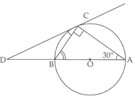
To prove: BC = BD
Proof: DC is tangent at C and, CB is chord at C.
Therefore, ∠DCB = ∠BAC [∠s in alternate segment of a circle]
⇒ ∠DCB = 30° …(i) [∵ ∠BAC = 30° (Given)]
AOB is diameter. [Given]
Therefore, ∠BCA = 90° [Angle in s semi circle]
Therefore, ∠ABC = 180° - 90° - 30° = 60°
In ΔBDC,
Exterior ∠B = ∠D + ∠BCD
⇒ 60° = ∠D + 30°
⇒ ∠D = 30° …(ii)
Therefore, ∠DCB = ∠D = 30° [From (i), (ii)]
⇒ BD = BC [∵ Sides opposite to equal angles are equal in a triangle]
Hence, proved.
Posted by Manav Kumar 6 years, 10 months ago
- 1 answers
Posted by Sanju Ramesh 6 years, 10 months ago
- 1 answers
Yogita Ingle 6 years, 10 months ago
Given that distance between the points P (2, -3) and Q (10, y) is 10
Therefore using distance formula
√(2 -10)2 + (-3-y)2 = 10
√ (-8)2 + ( 3 + y)2 = 10
squaring on both side
64 + (y +3)2 = 100
(y + 3)2 = 36
y + 3 = ± 6
y+3=6
or y+3= -6
Therefore, y=3 or y= -9
Posted by Sunny Jha 6 years, 10 months ago
- 2 answers
Posted by Ankul Prajapati 6 years, 10 months ago
- 1 answers
Shashank Mishra 6 years, 10 months ago
Posted by Gurjant Singh 6 years, 6 months ago
- 1 answers
Sia ? 6 years, 6 months ago

P is midpoint of QR
or, {tex}\frac { a } { 3 } = \frac { - 5 + ( - 1 ) } { 2 }{/tex}
or, {tex}\frac { a } { 3 } = \frac { - 6 } { 2 }{/tex}
or, a = -9
Posted by Jiya Jiya 6 years, 6 months ago
- 1 answers
Sia ? 6 years, 6 months ago
Given that -5 is the root of {tex}2 x^{2}+p x-15=0{/tex}
Put x = -5 in {tex}2 x^{2}+p x-15=0{/tex}
{tex}\Rightarrow{/tex} {tex}2(-5)^{2}+p(-5)-15=0{/tex}
{tex}\Rightarrow{/tex} {tex}50-5 p-15=0{/tex}
{tex}\Rightarrow{/tex} {tex}35 - 5p = 0 {/tex}
{tex}\Rightarrow{/tex} {tex}5p = 35 {/tex}
{tex}\therefore{/tex} {tex}p = 7{/tex}
Hence the quadratic equation p {tex}(x^2 + x) + k = 0{/tex} becomes, {tex}7\left(x^{2}+x\right)+k=0{/tex}
{tex}7 x^{2}+7 x+k=0{/tex}
Here {tex}a = 7,\ b = 7\ and\ c = k{/tex} Given that this quadratic equation has equal roots
{tex}\therefore{/tex} {tex}b^{2}-4 a c=0{/tex}
{tex}\Rightarrow{/tex} {tex}7^{2}-4(7)(\mathrm{k})=0{/tex}
{tex}\Rightarrow{/tex} {tex}49 - 28k = 0 {/tex}
{tex}\Rightarrow{/tex} {tex}49 = 28k {/tex}
{tex}\therefore{/tex} k = {tex}\frac{49} {28}{/tex} = {tex}\frac{7} {4}{/tex}
Posted by Anish Gupta 6 years, 10 months ago
- 2 answers
Posted by Samrat Kkkkk 6 years, 10 months ago
- 1 answers
Gaurav Seth 6 years, 10 months ago
Let the speed of the stream be s km/h.
Speed of the motor boat 24 km / h
Speed of the motor -boat upstream 24 s
Speed of the motor boat downstream 24 s
According to the given condition,
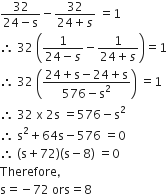
Since, speed of the stream cannot be negative, the speed of the stream is 8 km/h.
Posted by Ved Patel 6 years, 10 months ago
- 2 answers
Geetanand Yadav 6 years, 10 months ago
Posted by Rakesh Kumar 6 years, 10 months ago
- 0 answers
Posted by Rakesh Kumar 6 years, 10 months ago
- 0 answers

myCBSEguide
Trusted by 1 Crore+ Students

Test Generator
Create papers online. It's FREE.

CUET Mock Tests
75,000+ questions to practice only on myCBSEguide app

Prem Raj 6 years, 10 months ago
0Thank You