
Ask questions which are clear, concise and easy to understand.
Ask QuestionPosted by Nikhil Kumar 6 years, 4 months ago
- 1 answers
Posted by Md Sohel 6 years, 9 months ago
- 1 answers
Anushka Jugran ? 6 years, 9 months ago
Posted by Diksha Rathour 6 years, 9 months ago
- 3 answers
Affu 😊 6 years, 9 months ago
Posted by Jatin Agrawal 6 years, 9 months ago
- 1 answers
Posted by Ayush Jain 6 years, 9 months ago
- 2 answers
Posted by Iqra Shireen 6 years, 9 months ago
- 2 answers
Honey ??? 6 years, 9 months ago
Posted by Pranav Soan 6 years, 9 months ago
- 4 answers
Abhishek Patel 6 years, 9 months ago
Posted by Iqra Shireen 6 years, 9 months ago
- 2 answers
Posted by Mantasha Rahmani 6 years, 9 months ago
- 4 answers
Posted by Aditya Ramola 6 years, 9 months ago
- 0 answers
Posted by Manas Gupta 6 years, 9 months ago
- 5 answers
Siddhartha Jain 6 years, 9 months ago
Posted by Rohit Yadav 6 years, 9 months ago
- 1 answers
Posted by Riya Chaudhary 6 years, 9 months ago
- 1 answers
Kaira Chauhan 6 years, 9 months ago
Posted by Bavtosh Palai 6 years, 9 months ago
- 2 answers
Minal . 6 years, 9 months ago
Posted by Harsh Singh 6 years, 9 months ago
- 4 answers
Posted by S.P Singh 6 years, 4 months ago
- 1 answers
Sia ? 6 years, 4 months ago
Given that at the foot of a mountain the elevation of its summit is 45°; after ascending 1000 m towards the mountain up a slope of 30° inclination, the elevation is found to be 60°. We have to find the height of the mountain.
Let F be the foot and S be the summit of the mountain FOS. Then {tex}\angle O F S = 45 ^ { \circ }{/tex}and therefore, {tex}\angle O S F = 45 ^ { \circ }.{/tex}Consequently, OF = OS = h km (say). Let FP = 1000 m = 1 km be the slope so that {tex}\angle O F P = 30 ^ { \circ }.{/tex}Draw PM {tex}\perp {/tex}OF. join PS. It is given that {tex}\angle M P S = 60 ^ { \circ }.{/tex}
In {tex}\triangle F P L,{/tex}we have
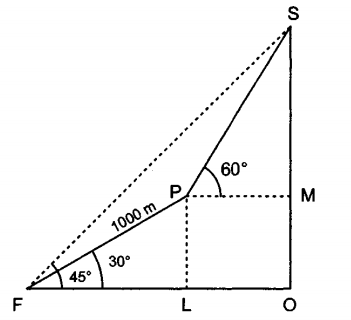
{tex}\sin 30 ^ { \circ } = \frac { P L } { P F }{/tex}
{tex}\Rightarrow \quad P L = P F \sin 30 ^ { \circ } = \left( 1 + \frac { 1 } { 2 } \right) \mathrm { km } = \frac { 1 } { 2 } \mathrm { km }{/tex}
{tex}\therefore \quad O M = P L = \frac { 1 } { 2 } \mathrm { km }{/tex}
{tex}\Rightarrow \quad M S = O S - O M = \left( h - \frac { 1 } { 2 } \right) \mathrm { km }{/tex} ...(i)
Also, {tex}\cos 30 ^ { \circ } = \frac { F L } { P F }{/tex}
{tex}\Rightarrow \quad F L = P F \cos 30 ^ { \circ } = \left( 1 \times \frac { \sqrt { 3 } } { 2 } \right) \mathrm { km } = \frac { \sqrt { 3 } } { 2 } \mathrm { km }{/tex}
Now, h = OS = OF = OL + LF
{tex}\Rightarrow \quad h = O L + \frac { \sqrt { 3 } } { 2 }{/tex}
{tex}\Rightarrow \quad O L = \left( h - \frac { \sqrt { 3 } } { 2 } \right) \mathrm { km }{/tex}
{tex}\Rightarrow \quad P M = \left( h - \frac { \sqrt { 3 } } { 2 } \right) \mathrm { km }{/tex} ...(ii)
In {tex}\triangle S P M,{/tex} we have
{tex}\tan 60 ^ { \circ } = \frac { S M } { P M }{/tex}
{tex}\Rightarrow{/tex} SM = PM . tan60 °
{tex}\Rightarrow \quad \left( h - \frac { 1 } { 2 } \right) = \left( h - \frac { \sqrt { 3 } } { 2 } \right) \sqrt { 3 }{/tex}
{tex}\Rightarrow \quad h - \frac { 1 } { 2 } = h \sqrt { 3 } - \frac { 3 } { 2 }{/tex}
{tex}\Rightarrow \quad \sqrt { 3 } h - h = \frac { 3 } { 2 } - \frac { 1 } { 2 }{/tex}
{tex}\Rightarrow \quad h ( \sqrt { 3 } - 1 ) = 1{/tex}
{tex}\Rightarrow \quad h = \frac { 1 } { \sqrt { 3 } - 1 } = \frac { \sqrt { 3 } + 1 } { ( \sqrt { 3 } - 1 ) ( \sqrt { 3 } + 1 ) } = \frac { \sqrt { 3 } + 1 } { 2 } = \frac { 2.732 } { 2 } = 1.366 \mathrm { km }{/tex}
Hence, the height of the mountain is 1.366 km.
Posted by Kashish Jain 6 years, 9 months ago
- 2 answers
Siddhartha Jain 6 years, 9 months ago
Posted by Deepanshu Singh 6 years, 9 months ago
- 2 answers
Harsimran Singh? 6 years, 9 months ago
Posted by Jumana Gohar 6 years, 9 months ago
- 2 answers
Anushka Jugran ? 6 years, 9 months ago
Posted by Amit Sharma 6 years, 9 months ago
- 3 answers
Posted by Keerthana Arun 6 years, 9 months ago
- 3 answers
S.P Singh 6 years, 9 months ago
=3/4 + 3/4 + 1
=3+3+4/4
=10/4
=5/2
Posted by Durga Appa 6 years, 9 months ago
- 3 answers
Posted by Vidhi Agarwal 6 years, 9 months ago
- 0 answers
Posted by Sangita Singh 6 years, 9 months ago
- 1 answers
Jaimina Gharia 6 years, 9 months ago
Posted by Rupam Gogoi 6 years, 9 months ago
- 1 answers
Posted by Jasbir Singh 6 years, 9 months ago
- 3 answers
Nidhi Chaudhary 6 years, 9 months ago
Posted by Dikshita? Bunkar 6 years, 9 months ago
- 2 answers

myCBSEguide
Trusted by 1 Crore+ Students

Test Generator
Create papers online. It's FREE.

CUET Mock Tests
75,000+ questions to practice only on myCBSEguide app

Sia ? 6 years, 4 months ago
In {tex}\triangle {/tex}AOB and {tex}\triangle {/tex}COD
{tex}\angle{/tex} AOB = {tex}\angle{/tex} COD [Vertically opposite angles]
{tex}\frac{{AO}}{{OC}} = \frac{{BO}}{{OD}} \Rightarrow \frac{{AO}}{{OB}} = \frac{{OC}}{{OD}}{/tex}[Given]
{tex}\therefore {/tex} {tex}\triangle {/tex}AOB {tex} \sim {/tex} {tex}\triangle {/tex}COD [By SAS similarity]
{tex}\therefore {/tex}{tex}\frac{{AO}}{{OC}} = \frac{{BO}}{{OD}} = \frac{{AB}}{{CD}}{/tex}
{tex}\frac{1}{2} = \frac{{AB}}{{DC}}\left[ {\frac{{AO}}{{OC}} = \frac{{BO}}{{OD}} = \frac{1}{2}} \right]{/tex}is given
{tex}\Rightarrow {/tex} {tex}\frac{1}{2} = \frac{5}{{DC}}{/tex}
{tex}\Rightarrow {/tex} DC = 10 cm
0Thank You