
Ask questions which are clear, concise and easy to understand.
Ask QuestionPosted by Mayank ... 6 years, 10 months ago
- 0 answers
Posted by Hiten Jain 6 years, 10 months ago
- 2 answers
Pranav Bhutada 6 years, 10 months ago
Posted by Aniket Dhama 6 years, 10 months ago
- 1 answers
Posted by Harsh Rathote 6 years, 10 months ago
- 1 answers
Gaurav Seth 6 years, 10 months ago
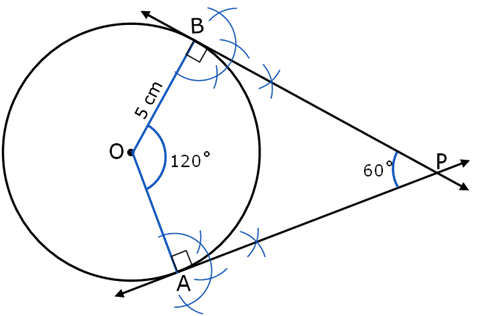
Steps of construction:
- Draw circle with centre O and radius OA = 5 cm, .
- Mark another point B on the circle such that ∠AOB = 120°, supplementary to the angle between the tangents. Since the angle between the tangents to be constructed is 60°.
∴ ∠AOB = 180° – 60° = 120°.
3.Construct angles of 90° at A and B and extend the lines so as to intersect at point P.
4. Thus, AP and BP are the required tangents to the circle.
Posted by Vedansh Chauhan 6 years, 10 months ago
- 1 answers
Posted by Sandhya Chauhan 6 years, 10 months ago
- 1 answers
Gaurav Seth 6 years, 10 months ago
Pythagoras Theorem
Statement: In a right angled triangle, the square of the hypotenuse is equal to the sum of squares of the other two sides.
Given: A right triangle ABC right angled at B.
To prove: AC2 = AB2 + BC2
Construction: Draw BD AC
AC

Proof :
We know that: If a perpendicular is drawn from the vertex of the right angle of a right triangle to the hypotenuse, then triangles on both sides of the perpendicular are similar to the whole triangle and to each other.
 ADB
ADB ABC
ABC
So, (Sides are proportional)
Or, AD.AC = AB2 ... (1)
Also,BDCABC
So,
Or, CD. AC = BC2 ... (2)
Adding (1) and (2),
AD. AC + CD. AC = AB2 + BC2
AC (AD + CD) = AB2 + BC2
AC.AC = AB2 + BC2
AC2 = AB2 + BC2
Hence Proved.
Posted by Vasu Rathore 6 years, 10 months ago
- 0 answers
Posted by Dev Raj 6 years, 10 months ago
- 4 answers
Gaurav Seth 6 years, 10 months ago
We know that, the lengths of tangents drawn from an external point to a circle are equal.
∴ TP = TQ
In ΔTPQ,
TP = TQ
⇒ ∠TQP = ∠TPQ ...(1) (In a triangle, equal sides have equal angles opposite to them)
∠TQP + ∠TPQ + ∠PTQ = 180º (Angle sum property)
∴ 2 ∠TPQ + ∠PTQ = 180º (Using(1))
⇒ ∠PTQ = 180º – 2 ∠TPQ ...(1)
We know that, a tangent to a circle is perpendicular to the radius through the point of contact.
OP ⊥ PT,
∴ ∠OPT = 90º
⇒ ∠OPQ + ∠TPQ = 90º
⇒ ∠OPQ = 90º – ∠TPQ
⇒ 2∠OPQ = 2(90º – ∠TPQ) = 180º – 2 ∠TPQ ...(2)
From (1) and (2), we get
∠PTQ = 2∠OPQ
Parneet Kaur 6 years, 10 months ago
Vikram Singh 6 years, 10 months ago
Posted by Maanvendra Singh Rathore 6 years, 10 months ago
- 2 answers
Posted by Krish Agrawal 6 years, 10 months ago
- 1 answers
Posted by Pawan Othwal 6 years, 10 months ago
- 0 answers
Posted by Payal Thakur 6 years, 4 months ago
- 1 answers
Sia ? 6 years, 4 months ago
Given: Let, ABCD is a rhombus and since diagonals of a rhombus bisect each other at {tex} 90 ^ { \circ }{/tex}
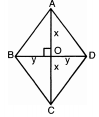
To Prove: {tex} \therefore A B ^ { 2 } + B C ^ { 2 } + C D ^ { 2 } + A D ^ { 2 } = A C ^ { 2 } + B D ^ { 2 }{/tex}
Proof :
{tex}\therefore {/tex}{tex}A O = O C {/tex}
{tex}\Rightarrow A O ^ { 2 } = O C ^ { 2 }{/tex}
{tex}B O = O D {/tex}
{tex}\Rightarrow B O ^ { 2 } = O D ^ { 2 }{/tex}
and {tex}\angle A O B = 90 ^ { \circ }{/tex}
{tex}\therefore {/tex} {tex} A B ^ { 2 } = O A ^ { 2 } + B O ^ { 2 }{/tex}
Similarly, {tex} A D ^ { 2 } = x ^ { 2 } + y ^ { 2 } {/tex}
{tex}BC ^ { 2 } = x ^ { 2 } + y ^ { 2 } {/tex}
{tex}C D ^ { 2 } = x ^ { 2 } + y ^ { 2 } {/tex}
{tex} \therefore A B ^ { 2 } + B C ^ { 2 } + C D ^ { 2 } + D A ^ { 2 } = 4 A O ^ { 2 } + 4 D O ^ { 2 }{/tex}
{tex} = ( 2 A O ) ^ { 2 } + ( 2 D O ) ^ { 2 }{/tex}
{tex} = ( 2 x ) ^ { 2 } + ( 2 y ) ^ { 2 }{/tex}
{tex} \therefore A B ^ { 2 } + B C ^ { 2 } + C D ^ { 2 } + A D ^ { 2 } = A C ^ { 2 } + B D ^ { 2 }{/tex}
Hence proved.
Posted by Arsh Virdi 6 years, 10 months ago
- 2 answers
Posted by Rajpal Nadha 6 years, 10 months ago
- 1 answers
Posted by Abhishek Singh 6 years, 10 months ago
- 0 answers
Posted by Dalvir Singh 6 years, 10 months ago
- 0 answers
Posted by Adarsh Kumar 6 years, 10 months ago
- 1 answers
Posted by Anjali Soni 6 years, 4 months ago
- 1 answers
Sia ? 6 years, 4 months ago
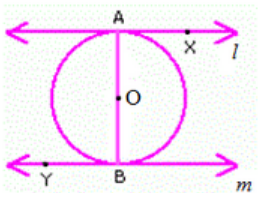
Given: l and m are the tangent to a circle such that l || m, intersecting at A and B respectively.
To prove: AB is a diameter of the circle.
Proof:
A tangent at any point of a circle is perpendicular to the radius through the point of contact.
{tex}\therefore{/tex} {tex}\angle X A O = 90 ^ { \circ }{/tex}
and {tex}\angle Y B O = 90 ^ { \circ }{/tex}
Since {tex}\angle X A O + \angle Y B O = 180 ^ { \circ }{/tex}
An angle on the same side of the transversal is 180°.
Hence the line AB passes through the centre and is the diameter of the circle.
Posted by Poojamit Joshi 6 years, 10 months ago
- 0 answers
Posted by Raj Pal Singh 6 years, 10 months ago
- 0 answers
Posted by Mehak Rathore 6 years, 10 months ago
- 1 answers
Posted by Deepti Kukreja 6 years, 10 months ago
- 2 answers
Payal Thakur 6 years, 10 months ago
Payal Thakur 6 years, 10 months ago
Posted by Mohd Mubeen Khan 6 years, 10 months ago
- 2 answers
Posted by Kunal Agarwal 6 years, 10 months ago
- 4 answers
Posted by Mehak Grover 6 years, 10 months ago
- 1 answers

myCBSEguide
Trusted by 1 Crore+ Students

Test Generator
Create papers online. It's FREE.

CUET Mock Tests
75,000+ questions to practice only on myCBSEguide app
