
Ask questions which are clear, concise and easy to understand.
Ask QuestionPosted by Babula Babula Bisoye 6 years, 10 months ago
- 1 answers
Posted by Milin Tyagi 6 years, 4 months ago
- 1 answers
Sia ? 6 years, 4 months ago
Steps of construction:-
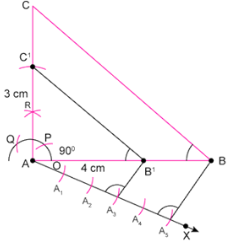
Steps of construction:-
- Draw AB = 4 cm
- Draw RA perpendicular to AB, and mark C on it such that AC = 3 cm.
- Join BC, ABC is the original triangle
- Draw any ray AX making acute angle {tex}\angle BAX{/tex} with AB.
- Mark five points using a compass , A1, A2 ,….., A5 on AX such that AA1 = A1A2 = A2A3 = A3A4= A4A5
- Join BA5, and draw a line parallel to it passing from A3, intersecting AB at B'.
- Draw line parallels to CB through B' to intersect AC at C'.
- {tex}\triangle{/tex}AB'C' is the required triangle.
Posted by Sumit Kumar 6 years, 10 months ago
- 1 answers
Posted by Yuvraj Kumar 6 years, 4 months ago
- 1 answers
Sia ? 6 years, 4 months ago
When two coins are tossed simultaneously
Total number of outcomes = {HH, HT, TH, TT}
Total number of outcomes = 4
Favourable outcomes = {HT, TH} = 2
Probability of getting exactly one head ={tex}\frac { 2 } { 4 } = \frac { 1 } { 2 }{/tex}
Posted by Sahil Vazadaka 6 years, 10 months ago
- 0 answers
Posted by Md Suleman 6 years, 10 months ago
- 0 answers
Posted by Mandeep Kaushik 6 years, 4 months ago
- 1 answers
Sia ? 6 years, 4 months ago
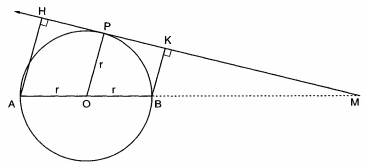
Clearly,{tex}\angle M P O = 90 ^ { \circ }{/tex}
Since {tex}B K \perp H M , A H \perp H M \text { and } O P \perp H M{/tex}. Therefore, AH||OP||BK .
Let AH = x, BK = y and OP = r. Further, let MB = z.
In {tex}\Delta M K B{/tex} and {tex}\Delta M H A{/tex},we have
{tex}\angle M K B = \angle M H A{/tex}= 90°
and {tex}\angle B M K = \angle A M H{/tex} [Common]
So, by AA criterion of similarity, we have
{tex}\Delta M K B \sim \Delta M H A{/tex}
{tex}\Rightarrow \quad \frac { B K } { A H } = \frac { M B } { M A }{/tex}
{tex}\Rightarrow \frac { y } { x } = \frac { z } { 2 r + z }{/tex}
{tex}\Rightarrow 2 r y + y z = z x{/tex}
{tex}\Rightarrow z = \frac { 2 r y } { x - y }{/tex}...(i)
In {tex}\Delta M K B{/tex} and {tex}\Delta M P O{/tex}, We have
{tex}\angle M K B = \angle M P O = 90 ^ { \circ }{/tex}
{tex}\angle B M K = \angle O M P{/tex} [Common]
So, by AA criterion of similarly, we obtain
{tex}\Delta M K B \sim \Delta M P O{/tex}
{tex}\Rightarrow \quad \frac { B K } { O P } = \frac { B M } { O M }{/tex}
{tex}\Rightarrow \frac { y } { r } = \frac { z } { r + z }{/tex}
{tex}\Rightarrow r y + y z = r z{/tex}
{tex}\Rightarrow \quad z = \frac { ry } { r - y }{/tex}...(ii)
From (i) and (ii), we get
{tex}\frac { r y } { r - y } = \frac { 2 r y } { x - y }{/tex}
{tex}\Rightarrow 2 r - 2 y = x - y{/tex}
{tex}\Rightarrow 2 r = x + y{/tex}
Thus, AB = AH +BK.
Posted by Deepak Kumar 6 years, 10 months ago
- 0 answers
Posted by Sambhav Is Here 6 years, 10 months ago
- 0 answers
Posted by Devanand Ray Ray 6 years, 4 months ago
- 1 answers
Sia ? 6 years, 4 months ago
2x2 + kx +3=0
We know that quadratic equation has two equal roots only when the value of discriminant is equal to zero.
Comparing equation 2x 2 +kx +3=0 with general quadratic equation ax2 + bx + c =0, we get a = 2, b = k and c = 3
Discriminant = b2 − 4ac = k2 - 4(2)(3) = k2 - 24
Putting discriminant equal to zero
k2 - 24 = 0 ⇒ k2 = 24
{tex}\Rightarrow k = \pm \sqrt { 24 } = \pm 2 \sqrt { 6 } \Rightarrow k = 2 \sqrt { 6 } , - 2 \sqrt { 6 }{/tex}
Posted by Ayush Handa 6 years, 10 months ago
- 2 answers
Posted by Akansha Sharma 6 years, 10 months ago
- 0 answers
Posted by Suraj Jaiswal 6 years, 10 months ago
- 0 answers
Posted by Suraj Jaiswal 6 years, 10 months ago
- 1 answers
Posted by Devanand Ray Ray 6 years, 10 months ago
- 0 answers
Posted by Khan Fardin 6 years, 10 months ago
- 0 answers
Posted by Ankit Raj 6 years, 10 months ago
- 0 answers
Posted by Suryansh Singh 6 years, 10 months ago
- 2 answers
Mayank ... 6 years, 10 months ago
Posted by Tajender Singh 6 years, 10 months ago
- 1 answers
Archi Mehta 6 years, 10 months ago
Posted by Ayush Garg 6 years, 10 months ago
- 1 answers
Posted by Archi Jain 6 years, 10 months ago
- 1 answers
Posted by Mayank ... 6 years, 10 months ago
- 1 answers
Vikram Singh 6 years, 10 months ago

myCBSEguide
Trusted by 1 Crore+ Students

Test Generator
Create papers online. It's FREE.

CUET Mock Tests
75,000+ questions to practice only on myCBSEguide app

Khushi ? 6 years, 10 months ago
0Thank You