
Ask questions which are clear, concise and easy to understand.
Ask QuestionPosted by Abhishek Kumar 6 years, 10 months ago
- 1 answers
Posted by Archit Singh 6 years, 4 months ago
- 1 answers
Sia ? 6 years, 4 months ago
Speed of motorboat in still water = 15 km/hr
Let Speed of the stream = x km/ hr
Then speed downstream = (15+x) km /hr
and speed upstream = (15-x) km /hr
According to the question
{tex}{30 \over 15+x} +{30 \over 15-x} = 4{1 \over 2}{/tex}
{tex}\implies 30 [{15 - x +15 +x \over (15+x) (15- x)}] = {9 \over 2}{/tex}
{tex}\implies {30 \times 30 \over 225 - x^2} = {9 \over 2}{/tex}
{tex}\implies {900 \over 225 - x^2} = {9 \over 2}{/tex}
{tex}\implies{/tex}- 9x2 + 2025 = 1800
{tex}\implies{/tex} - 9x2 = 1800 - 2025
{tex}\implies{/tex} 9x2 = 225
{tex}\implies{/tex} x2 = 25
{tex}\implies{/tex} {tex}x = \pm 5{/tex}
Speed of the motorboat cannot be negative. So, x = 5
Hence, speed of the stream = 5 km /hr.
Posted by Sarthak Khandelwal 6 years, 10 months ago
- 4 answers
Posted by Nitin Sah 6 years, 4 months ago
- 1 answers
Sia ? 6 years, 4 months ago
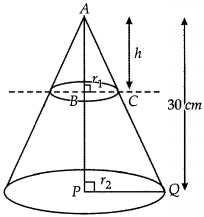
According to the question, The height of a cone is 30 cm. From its topside a small cone is cut by a plane parallel to its base.
Let the radii of smaller cone and original cone be r1 and r2 respectively and the height of smaller cone be h.
{tex}\triangle A B C \sim \triangle A P Q{/tex}
{tex}\Rightarrow \quad \frac { h } { 30 } \sim \frac { r _ { 1 } } { r _ { 2 } }{/tex} ...(1)
Volume smaller cone {tex}= \frac { 1 } { 27 } \times{/tex} Volume of original cone
{tex}\Rightarrow \quad \frac { 1 } { 3 } \pi r _ { 1 } ^ { 2 } \times h = \frac { 1 } { 27 } \times \frac { 1 } { 3 } \pi r _ { 2 } ^ { 2 } \times 30{/tex}
{tex}\Rightarrow \quad \left( \frac { r _ { 1 } } { r _ { 2 } } \right) ^ { 2 } \times \frac { h } { 30 } = \frac { 1 } { 27 }{/tex}
{tex}\Rightarrow \quad \left( \frac { h } { 30 } \right) ^ { 2 } \times \frac { h } { 30 } = \frac { 1 } { 27 }{/tex}
{tex}\left( \mathrm { Using } \frac { h } { 30 } = \frac { r _ { 1 } } { r _ { 2 } } \text { From } ( \mathrm { i } ) \right){/tex}
{tex}\Rightarrow \quad \left( \frac { h } { 30 } \right) ^ { 3 } = \frac { 1 } { 27 }{/tex}
{tex}\Rightarrow \quad h ^ { 3 } = \frac { 30 \times 30 \times 30 } { 27 }{/tex}
h = 10 cm
Hence, required height = (30 - 10) = 20 cm
Posted by H@Rdik K@Shy@P. Csk Is Best 6 years, 10 months ago
- 1 answers
Posted by Jaswinder Kaur 6 years, 10 months ago
- 1 answers
Posted by Vishal Kujur 6 years, 10 months ago
- 0 answers
Posted by Prince Kumar Shukla 6 years, 10 months ago
- 3 answers
Posted by Vivek Yadav 6 years, 10 months ago
- 2 answers
Miss Angel 6 years, 10 months ago
Posted by Nisha Kr 6 years, 10 months ago
- 2 answers
Tanmay Dhelia 6 years, 10 months ago
Posted by Devender Kumar Sharma 6 years, 10 months ago
- 1 answers
Posted by Mehta Ram 6 years, 10 months ago
- 4 answers
Garima Choudhary 6 years, 10 months ago
Fatma Naayab 6 years, 10 months ago
Sneha Singh?????? 6 years, 10 months ago
Posted by Anita L K 5 years, 9 months ago
- 3 answers
Ankit Tarar 6 years, 10 months ago
Arpan Sinha 6 years, 10 months ago
Posted by Arpit Verma 6 years, 10 months ago
- 0 answers
Posted by Sandeep Gaur 6 years, 10 months ago
- 0 answers
Posted by Ayush Yadav 6 years, 10 months ago
- 1 answers
Posted by Manoj Cruze 6 years, 10 months ago
- 0 answers
Posted by Ali Asger Shaikh 6 years, 10 months ago
- 0 answers
Posted by Ali Asger Shaikh 6 years, 10 months ago
- 0 answers
Posted by Jaat Dhama 6 years, 4 months ago
- 1 answers
Sia ? 6 years, 4 months ago
Let A be the event of getting the sum as a prime number i.e. 2,3,5,7,11
Elementary events favourable to event A are:
(1, 1), (1, 2), (2, 1), (1, 4), (4, 1), (2, 3), (3, 2), (1, 6), (6, 1),
(2, 5), (5, 2), (3, 4), (4,3) , (6,5) and (5, 6).
Favourable number of elementary events = 15
Hence, required probability{tex}= \frac { 15 } { 36 } = \frac { 5 } { 12 }{/tex}
Posted by Neeraj Yadav 6 years, 10 months ago
- 4 answers
Posted by Sinila Anees 6 years, 4 months ago
- 1 answers
Sia ? 6 years, 4 months ago
A cylinder and a cone have equal heights and equal radii of their bases.
So, As per given condition
{tex}\frac{Curved \ surface \ area \ of \ cylinder}{Curved \ surface \ area \ of \ cone}{/tex} = {tex}\frac{2 \pi rh}{\pi rl}{/tex} = {tex}\frac{2 \pi rh}{\pi r \sqrt{r^{2}+h^{2}}}{/tex}
{tex}\frac{8}{5}{/tex} = {tex}\frac{2 h}{\sqrt{r^{2}+h^{2}}}{/tex}
{tex}\Rightarrow{/tex}{tex}\frac{64}{25}{/tex} = {tex}\frac{4h^2}{r^2 + h^2}{/tex}
{tex}\Rightarrow{/tex}64r2 + 64h2 = 100h2
{tex}\Rightarrow{/tex} 64r2 = 100h2 - 64h2
{tex}\Rightarrow{/tex}64r2 = 36h2
{tex}\Rightarrow{/tex}{tex}\frac{r^2}{h^2}{/tex} = {tex}\frac{36}{64}{/tex} = {tex}\frac{9}{16}{/tex}
{tex}\Rightarrow{/tex}{tex}\frac{r}{h}{/tex} = {tex}\frac{3}{4}{/tex}
{tex}\therefore{/tex}r : h = 3 : 4
Posted by Athrav Arora 6 years, 4 months ago
- 1 answers
Sia ? 6 years, 4 months ago
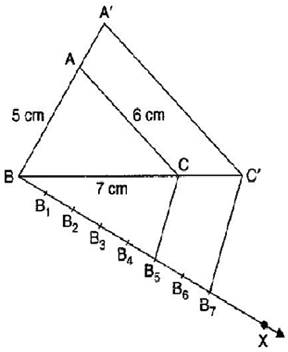
To construct: To construct a triangle of sides 5 cm, 6 cm and 7 cm and then a triangle similar to it whose sides are of {tex}\frac{7}{5}{/tex} the corresponding sides of the first triangle.
Steps of construction:
- Draw a triangle ABC of sides 5 cm, 6 cm and 7 cm.
- From any ray BX, making an acute angle with BC on the side opposite to the vertex A.
- Locate 7 points B1, B2, B3, B4, B5, B6 and B7 on BX such that BB1 = B1 B2 = B2 B3 = B3 B4 = B4 B5 = B5 B6 = B6 B7.
- Join B5 C and draw a line through the point B7, draw a line parallel to B5 C intersecting BC at the point C'.
- Draw a line through C' parallel to the line CA to intersect BA at A'.
Then, A'BC' is the required triangle.
Justification :
{tex}\because CA||C'A'{/tex} [By construction]
{tex}\therefore {/tex} {tex}\triangle ABC \sim \triangle A'BC'{/tex} [AA similarity]
{tex}\therefore \frac{{A'B}}{{AB}} = \frac{{A'C'}}{{AC}} = \frac{{BC'}}{{BC}}{/tex} [By Basic Proportionality Theorem]
{tex}\because {B_7}C'||{B_5}C{/tex} [By construction]
{tex}\therefore \triangle B{B_7}C' \sim \triangle B{B_5}C{/tex} [AA similarity]
But {tex}\frac{{B{B_5}}}{{B{B_7}}} = \frac{5}{7}{/tex} [By construction]
Therefore, {tex}\frac{{BC}}{{BC'}} = \frac{5}{7} \Rightarrow \frac{{BC'}}{{BC}} = \frac{7}{5}{/tex}
{tex}\therefore \frac{{AB}}{{AB}} = \frac{{A'C'}}{{AC}} = \frac{{BC'}}{{BC}} = \frac{7}{5}{/tex}
Posted by Rishi Jain 6 years, 10 months ago
- 1 answers
Posted by Sinila Anees 6 years, 4 months ago
- 1 answers
Sia ? 6 years, 4 months ago
AC = {tex}\sqrt{\mathrm{AB}^{2}+\mathrm{BC}^{2}}{/tex}
= {tex}\sqrt{14^{2}+48^{2}}{/tex} = {tex}\sqrt{2500}{/tex} = 50 cm
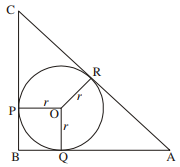
{tex}\angle{/tex}OQB = 90o {tex}\Rightarrow{/tex} OPBQ is a square
{tex}\Rightarrow{/tex} BQ = r
QA = 14 - r = AR (tangents from a external point are equal in length)
Again PB = r,
PC = 48 - r {tex}\Rightarrow{/tex} RC = 48 - r (tangents from a external point are equal in length)
AR + RC = AC {tex}\Rightarrow{/tex} 14 - r + 48 - r = 50
{tex}\Rightarrow{/tex} r = 6 cm.
Posted by Suma Nagashayana 6 years, 10 months ago
- 1 answers
Nikhil 6 years, 10 months ago
Posted by Golden Golden (Nick Name) 6 years, 10 months ago
- 0 answers
Posted by Tushar Tomar 6 years, 10 months ago
- 1 answers
Posted by Aryan Gaur 6 years, 10 months ago
- 0 answers

myCBSEguide
Trusted by 1 Crore+ Students

Test Generator
Create papers online. It's FREE.

CUET Mock Tests
75,000+ questions to practice only on myCBSEguide app

Aman Kumar 6 years, 10 months ago
0Thank You