
Ask questions which are clear, concise and easy to understand.
Ask QuestionPosted by Arpit Bansal 6 years, 9 months ago
- 1 answers
Posted by Seema Khan 6 years, 9 months ago
- 6 answers
Posted by Alok Behera 6 years, 9 months ago
- 1 answers
Posted by Ģøłù Ķúmãř 6 years, 4 months ago
- 1 answers
Sia ? 6 years, 4 months ago
According to the question, we have to show that every positive integer is either even or odd.
Let us assume that there exists a smallest positive integer that is neither odd nor even, say n. Since n is the least positive integer which is neither even nor odd, n - 1 must be either odd or even.
Case 1: If n - 1 is even, n - 1 = 2k for some k.
But this implies n = 2k + 1
This implies n is odd.
Case 2: If n - 1 is odd, n - 1 = 2k + 1 for some k.
But this implies n = 2k + 2 = 2(k + 1)
This implies n is even.
Therefore,In both cases , we arrive at a contradiction.
Thus, every positive integer is either even or odd
Posted by Mohamed Fazil 6 years, 9 months ago
- 0 answers
Posted by Aryan Mishra 6 years, 4 months ago
- 1 answers
Sia ? 6 years, 4 months ago
Here f(x) = x3 + 13x2 + 32x + 20
-2 is a zero of f(x), so x+2 will be factor of f(x)
On long division of f(x) by x+2 we get
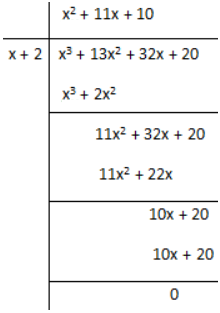
So, f(x) = x3 + 13x2 + 32x + 20
= (x2 + 11x + 10)(x + 2)
= (x2 + 10x + x + 10)(x + 2)
= (x + 10)(x + 1)(x + 2)
Hence f(x)=0 if x+10 =0 or x+1=0 or x+2=0
Therefore, the zeroes of the polynomial are -1, -10, -2.
Posted by Abhishek Mishra 6 years, 9 months ago
- 0 answers
Posted by Sanjaykumar Rana 6 years, 9 months ago
- 0 answers
Posted by ?????? ?? 6 years, 9 months ago
- 0 answers
Posted by Sagar Saroha 6 years, 9 months ago
- 0 answers
Posted by ?????? ?? 6 years, 9 months ago
- 1 answers
Posted by Shivani Yadav 6 years, 9 months ago
- 3 answers
Posted by ????? ?????? 6 years, 9 months ago
- 2 answers
Koleti Sravani 6 years, 9 months ago
Posted by Apsa Kanchikeri 6 years, 9 months ago
- 2 answers
Gungun Tyagi 6 years, 9 months ago
Posted by Sparsh Sharma 6 years, 4 months ago
- 1 answers
Sia ? 6 years, 4 months ago
0.2 x + 0.3 y = 1.3 ; 0.4 x + 0.5 y = 2.3
The given system of linear equations is:
0.2 x + 0.3 y = 1.3..............(1)
0.4 x + 0.5 y = 2.3...................(2)
From equation (1),
0.3 y = 1.3 - 0.2 x
{tex}\Rightarrow \quad y = \frac { 1.3 - 0.2 x } { 0.3 }{/tex}.........................(3)
Substituting this value of y in equation(2), we get
{tex}0.4 x + 0.5 \left( \frac { 1.3 - 0.2 x } { 0.3 } \right) = 2.3{/tex}
{tex}\Rightarrow{/tex}0.12 x + 0.65 - 0.1 x = 0.69
{tex}\Rightarrow{/tex}0.12 x - 0.1 x = 0.69 - 0.65
{tex}\Rightarrow{/tex}0.02 x = 0.04
{tex}\Rightarrow{/tex}{tex}\mathrm { x } = \frac { 0.04 } { 0.02 } = 2{/tex}
Substituting this value of x in equation(3), we get
{tex}y = \frac { 1.3 - 0.2 ( 2 ) } { 0.3 } = \frac { 1.3 - 0.4 } { 0.3 } = \frac { 0.9 } { 0.3 } = 3{/tex}
Therefore, the solution is x = 2, y = 3, we find that both equation (1) and (2) are satisfied as shown below:
0.2 x + 0.3 y = ( 0.2 )( 2 )+( 0.3)( 3 ) = 0.4 + 0.9 = 1.3
0.4 x + 0.5 y= ( 0.4 )( 2 ) + ( 0.5 )( 3 ) } = 0.8 + 1.5 = 2.3
This verifies the solution.
Posted by Jayanthi Amala 6 years, 9 months ago
- 0 answers
Posted by Shubham Nadhawale 6 years, 9 months ago
- 1 answers
Posted by Ashnoor Cheema 6 years, 9 months ago
- 3 answers
????? ?????? 6 years, 9 months ago
Harmanpreet Singh Sabharwal 6 years, 9 months ago
Posted by Om Mallick 6 years, 9 months ago
- 1 answers
Posted by Aashish Singh 6 years, 9 months ago
- 1 answers
Posted by Deepak Mishra 6 years, 9 months ago
- 2 answers
Yogita Ingle 6 years, 9 months ago
We Consider An positive integer as a.
On dividing a by b .
Here , let q is the quotient and r is the remainder.
Now, a = bq + r , 0 ≤ r < b ..... ( 1 )
[ by using Euclid's division lemma]
Here we putting b = 6 in eq ( 1 )
Here we find , a = 6q + r , 0 ≤ r < b ..... ( 2 )
so here possible values of r = 1 , 2, 3, 4, 5.
If r = 0, then find Equation (2) , a = 6q.
Here, 6q is is divisible by 2 , so 6q is here Even .
If r = 1 , then find Equation (2) , a = 6q + 1.
Here, 6q + 1 is not divisible by 2 , so 6q + 1 is here odd.
If r = 2 , then find Equation (2) , a = 6q + 2.
Here, 6q + 2 is not divisible by 2 , so 6q + 2 is here even.
If r = 3 , then find Equation (2) , a = 6q + 3.
Here, 6q + 3 is not divisible by 2 , so 6q + 3 is here odd.
If r = 4 , then find Equation (2) , a = 6q + 4.
Here, 6q + 4 is not divisible by 2 , so 6q + 4 is here even.
If r = 5 , then find Equation (2) , a = 6q + 5.
Here, 6q + 5 is not divisible by 2 , so 6q + 5 is here odd.
so , a is odd , so a cannot be 6q,6q+2, 6q+4.
Therefore any positive odd integer is of the form 6q+1 , 6q +3, 6q + 5.
Miss Angel Barsha 6 years, 9 months ago
Posted by Aman Yadav 6 years, 9 months ago
- 0 answers
Posted by Raj Raj 6 years, 9 months ago
- 1 answers
?#Busy# ?? 6 years, 9 months ago
Posted by Deepanshu Kumar 6 years, 9 months ago
- 1 answers
Gaurav Seth 6 years, 9 months ago
Let us assume that √3 is a rational number.
That is, we can find integers a and b (≠ 0) such that √3 = (a/b)
Suppose a and b have a common factor other than 1, then we can divide by the common factor, and assume that a and b are coprime.
√3b = a
⇒ 3b2=a2 (Squaring on both sides) → (1)
Therefore, a2 is divisible by 3
Hence ‘a’ is also divisible by 3.
So, we can write a = 3c for some integer c.
Equation (1) becomes,
3b2 =(3c)2
⇒ 3b2 = 9c2
∴ b2 = 3c2
This means that b2 is divisible by 3, and so b is also divisible by 3.
Therefore, a and b have at least 3 as a common factor.
But this contradicts the fact that a and b are coprime.
This contradiction has arisen because of our incorrect assumption that √3 is rational.
So, we conclude that √3 is irrational.
Posted by Kala Devi 6 years, 9 months ago
- 1 answers
Gaurav Seth 6 years, 9 months ago
(sin A + sec A)² + (Cos A + Cosec A)²
= Sin² A + sec² A + 2 Sin A Sec A + Cos² A + Cosec² A + 2 Cos A Cosec A
= Sin²A + COs²A + Sec²A + Cosec²A + 2 Sin A SecA + 2 Cos A Cosec A
= 1 + [ 1/Cos²A + 1/ Sin²A ] + [ 2 Sin A / Cos A + 2 Cos A / SIn A ]
= 1 + (Sin²A + COs²A)/ [Cos²A Sin²A ] + 2 [ SIn² A + Cos²A ] / [ SinA CosA
= 1 + 1/Cos²A 1/Sin²A + 2 1/SinA 1/CosA
= 1 + Sec²A Cosec²A + 2 COsecA Sec A
= (1 + SecA CosecA )²
====================
alternately,
(sin A + sec A)² + (Cos A + Cosec A)²
= (Sin A + 1/Cos A)² + (COs A + 1/ SinA)²
= (Sin A Cos A + 1)² / Cos² A + (SinA COsA + 1)² / Sin² A
= [ SIn A Cos A + 1]² [ 1/Cos² A + 1/Sin² A ]
= [ SIn A Cos A + 1]² [ Cos² A + Sin² A ] / [Sin²A Cos² A ]
= [ Sin A Cos A + 1 ]² / [Sin²A Cos² A ]
= [ (Sin A Cos A + 1) / (Sin A Cos A )]²
= (1 + 1/Sin A 1/Cos A)²
= (1 + Sec A Cosec A)²
Posted by Jitesh Uikey 6 years, 9 months ago
- 0 answers
Posted by Rohot Shrivastava 6 years, 9 months ago
- 3 answers
. . 6 years, 9 months ago
Puja Sahoo 6 years, 9 months ago
Posted by Deepanshu Kumar 6 years, 9 months ago
- 1 answers
. . 6 years, 9 months ago

myCBSEguide
Trusted by 1 Crore+ Students

Test Generator
Create papers online. It's FREE.

CUET Mock Tests
75,000+ questions to practice only on myCBSEguide app

Shaury Sharma 6 years, 9 months ago
0Thank You