
Ask questions which are clear, concise and easy to understand.
Ask QuestionPosted by Mithun Kr 6 years, 9 months ago
- 1 answers
Posted by M Ubaid 6 years, 9 months ago
- 2 answers
Posted by Shivam Kumar 6 years, 9 months ago
- 0 answers
Posted by Umtudokelombi Umtudokelombi 6 years, 4 months ago
- 1 answers
Sia ? 6 years, 4 months ago
The given equations are
{tex}\frac { x } { 3 } + \frac { y } { 4 } = 11{/tex}
{tex}\frac { 5 x } { 6 } - \frac { y } { 3 } = - 7{/tex}
Now {tex}\frac { x } { 3 } + \frac { y } { 4 } = 11{/tex}
{tex}\Rightarrow{/tex}{tex}\frac { 4 x + 3 y } { 12 } = 11{/tex} (by taking LCM)
{tex}4x + 3y = 132{/tex} ......(i)
{tex}\frac { 5 x } { 6 } - \frac { y } { 3 } = - 7{/tex}
{tex}\frac { 5 x - 2 y } { 6 } = - 7{/tex}(by taking LCM)
{tex}5x - 2y = -42{/tex}.........(ii)
Multiplying (i) by 2 and (ii) by 3, we get
{tex}8x + 6y = 264{/tex} ........(iii)
{tex}15x - 6y = -126{/tex} ........(iv)
Adding (iii) from (iv), we get
{tex}23x = 138{/tex} {tex}\Rightarrow{/tex} {tex}x = 6{/tex}
Substituting x = 6 in (i),we get
{tex}4 \times 6 + 3 y = 132 \Rightarrow 3 y = 132 - 24{/tex}
{tex}3y = 108{/tex}
{tex}y = 36{/tex}
{tex}\therefore{/tex} Solution is {tex}x = 6, y = 36{/tex}
Posted by Hemant Shourat Kumar 6 years, 9 months ago
- 0 answers
Posted by Chahat Bedi 6 years, 9 months ago
- 0 answers
Posted by Chahat Bedi 6 years, 9 months ago
- 1 answers
Yogita Ingle 6 years, 9 months ago
Let three consecutive positive integers be, n, n + 1 and n + 2.
'When a number is divided by 3, the remainder obtained is either 0 or 1 or 2.
∴ n = 3p or 3p + 1 or 3p + 2, where p is some integer.
If n = 3p, then n is divisible by 3.
If n = 3p + 1, ⇒ n + 2 = 3p + 1 + 2 = 3p + 3 = 3(p + 1) is divisible by 3.
If n = 3p + 2, ⇒ n + 1 = 3p + 2 + 1 = 3p + 3 = 3(p + 1) is divisible by 3.
So, we can say that one of the numbers among n, n + 1 and n + 2 is always divisible by 3.
⇒ n (n + 1) (n + 2) is divisible by 3.
Similarly, when a number is divided 2, the remainder obtained is 0 or 1.
∴ n = 2q or 2q + 1, where q is some integer.
If n = 2q ⇒ n and n + 2 = 2q + 2 = 2(q + 1) are divisible by 2.
If n = 2q + 1 ⇒ n + 1 = 2q + 1 + 1 = 2q + 2 = 2 (q + 1) is divisible by 2.
So, we can say that one of the numbers among n, n + 1 and n + 2 is always divisible by 2.
⇒ n (n + 1) (n + 2) is divisible by 2.
Hence n (n + 1) (n + 2) is divisible by 2 and 3.
∴ n (n + 1) (n + 2) is divisible by 6.
Posted by Chahat Bedi 6 years, 9 months ago
- 3 answers
Posted by Mohit Narula 6 years, 9 months ago
- 0 answers
Posted by Mmgzgvnngn Gb Ndgg 6 years, 9 months ago
- 3 answers
Yogita Ingle 6 years, 9 months ago
7×m + 7 = 77
7m + 7 = 77
7m = 77 - 7
7m = 70
m = 70/7
m = 10
Posted by Somu Jais 6 years, 9 months ago
- 4 answers
Piyush Pandey 6 years, 9 months ago
Yogita Ingle 6 years, 9 months ago
A fraction is written in the form of m/n , where n is not 0 and m & n are natural numbers. For example: 12/23, 10/32, 12/10, 4/21. A rational number can also be written in the form of m/n , where n is not 0 and m & n are integers. For example: 15/7, -18/13, 3/-7, -6/-12. All Fractions can be termed as Rational Numbers, however, all Rational Numbers cannot be termed as Fractions. Only those Rational Numbers in which ‘m’ and ‘n’ are positive integers are termed as Fractions.
Shaury Sharma 6 years, 9 months ago
Posted by Chahat Bedi 6 years, 9 months ago
- 1 answers
Dimpy Baweja 6 years, 9 months ago
Posted by Avni Garg 6 years, 9 months ago
- 1 answers
Yogita Ingle 6 years, 9 months ago
Let x be any positive integer. Then, it is of the form 3q or, 3q + 1 or, 3q + 2.
So, we have the following cases :
Case I : When x = 3q.
then, x3 = (3q)3 = 27q3 = 9 (3q3) = 9m, where m = 3q3.
Case II : When x = 3q + 1
then, x3 = (3q + 1)3
= 27q3 + 27q2 + 9q + 1
= 9 q (3q2 + 3q + 1) + 1
= 9m + 1, where m = q (3q2 + 3q + 1)
Case III. When x = 3q + 2
then, x3 = (3q + 2)3
= 27 q3 + 54q2 + 36q + 8
= 9q (3q2 + 6q + 4) + 8
= 9 m + 8, where m = q (3q2 + 6q + 4)
Hence, x3 is either of the form 9 m or 9 m + 1 or, 9 m + 8.
Posted by Avni Garg 6 years, 9 months ago
- 1 answers
Yogita Ingle 6 years, 9 months ago
Let x be any positive integer. Then, it is of the form 3q or, 3q + 1 or, 3q + 2.
So, we have the following cases :
Case I : When x = 3q.
then, x3 = (3q)3 = 27q3 = 9 (3q3) = 9m, where m = 3q3.
Case II : When x = 3q + 1
then, x3 = (3q + 1)3
= 27q3 + 27q2 + 9q + 1
= 9 q (3q2 + 3q + 1) + 1
= 9m + 1, where m = q (3q2 + 3q + 1)
Case III. When x = 3q + 2
then, x3 = (3q + 2)3
= 27 q3 + 54q2 + 36q + 8
= 9q (3q2 + 6q + 4) + 8
= 9 m + 8, where m = q (3q2 + 6q + 4)
Hence, x3 is either of the form 9 m or 9 m + 1 or, 9 m + 8.
Posted by Aastha Sharma 6 years, 9 months ago
- 2 answers
Riya Deepak 6 years, 9 months ago
Amira Roy❤ 6 years, 9 months ago
Posted by Manish Kumar 6 years, 9 months ago
- 1 answers
Gaurav Seth 6 years, 9 months ago
Answer is 5
Dividend = Divisor × Quotient + Remainder.
It is given that:
Divisor = 143
Remainder = 13
So, the given number is in the form of 143x + 31, where x is the quotient.
∴ 143x + 31 = 13 (11x) + (13 × 2) + 5 = 13 (11x + 2) + 5
Thus, the remainder will be 5 when the same number is divided by 13.
Posted by Rajinder Rana 6 years, 9 months ago
- 1 answers
Gaurav Seth 6 years, 9 months ago
1 because 1 is a natural number and 24x1 is divisible by 8.
so n=1
Posted by Rajinder Rana 6 years, 9 months ago
- 0 answers
Posted by Aman Verma 6 years, 9 months ago
- 0 answers
Posted by Rajesh Ambadkar 6 years, 9 months ago
- 0 answers
Posted by Ravi Kumar 6 years, 9 months ago
- 0 answers
Posted by Manohar Rg 6 years, 9 months ago
- 1 answers
Yogita Ingle 6 years, 9 months ago
Let the unit place digit be x
And tens place digit be y
No. Formed by x and y = 10y+x (I have multiplied y by ten because it is on tens place)
Now, no. Obtained by reversing digits = 10x+y
Here sum of digits = 8 (I)
And difference on reversing digits is 18
A/q
(10y+x) - (10x+y) = 18
Or, 10y+x-10x-y= 18
Or, 9y-9x = 18
Or, 9(y-x) = 18
Or y-x = 18/9= 2(ii)
On adding both the given equation
Now, y+x = 8
y-x = 2
------------------
2y. = 10
Or, y =5
Now putting the value of y in equation 1st
y+x=8
5+x=8
Or, x= 3
Now the formed no. = 53
Posted by Himanshu Raj 6 years, 4 months ago
- 1 answers
Sia ? 6 years, 4 months ago
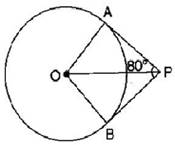
{tex}\angle{/tex}OPQ = 90o
[The tangent at any point of a circle is {tex}\perp{/tex} to the radius
through the point of contact]
{tex}\angle{/tex}OPA = {tex}\frac 12{/tex}{tex}\angle{/tex}BPA [Centre lies on the bisector of the
angle between the two tangents]
In {tex}\triangle{/tex}OPA,
{tex}\angle{/tex}OAP + {tex}\angle{/tex}OPA + {tex}\angle{/tex}POA = 180o [Angle sum property of a triangle]
{tex}\Rightarrow{/tex} 90o + 40o + {tex}\angle{/tex}POA = 180o
{tex}\Rightarrow{/tex} 130o + {tex}\angle{/tex}POA = 180o
{tex}\Rightarrow{/tex} {tex}\angle{/tex}POA = 50o
Posted by Onkar Khalsa 5 years, 9 months ago
- 0 answers
Posted by Ujjawal Saras 6 years, 4 months ago
- 1 answers
Sia ? 6 years, 4 months ago
2032 = 1651 {tex} \times{/tex} 1 + 381 .
1651 = 381 {tex} \times{/tex} 4 + 127
381 = 127 {tex} \times{/tex} 3 + 0.
Since the remainder becomes 0 here, so HCF of 1651 and 2032 is 127.
{tex} \therefore{/tex} HCF (1651, 2032) = 127.
Now,
{tex} 1651 = 381 \times 4 + 127{/tex}
{tex} \Rightarrow \quad 127 = 1651 - 381 \times 4{/tex}
{tex} \Rightarrow \quad 127 = 1651 - ( 2032 - 1651 \times 1 ) \times 4{/tex} [from 2032 = 1651 {tex} \times{/tex} 1 + 381]
{tex} \Rightarrow \quad 127 = 1651 - 2032 \times 4 + 1651 \times 4{/tex}
{tex} \Rightarrow \quad 127 = 1651 \times 5 + 2032 \times ( - 4 ){/tex}
Hence, m = 5, n = -4.
Posted by Anil Sharma 6 years, 9 months ago
- 0 answers
Posted by Akash Rawal 6 years, 9 months ago
- 2 answers
Posted by Manish Veema 6 years, 9 months ago
- 0 answers
Posted by Shaury Sharma 6 years, 9 months ago
- 0 answers

myCBSEguide
Trusted by 1 Crore+ Students

Test Generator
Create papers online. It's FREE.

CUET Mock Tests
75,000+ questions to practice only on myCBSEguide app

Aanchal Jain 6 years, 9 months ago
2Thank You