
Ask questions which are clear, concise and easy to understand.
Ask QuestionPosted by J M 6 years, 4 months ago
- 1 answers
Posted by Shivansh Handa 6 years, 4 months ago
- 1 answers
Sia ? 6 years, 4 months ago
If {tex}x^4+x^3+8x^2+ax +b{/tex} is exactly divisible by x2 + 1, the remainder after division should be zero.
Now let us perform long division
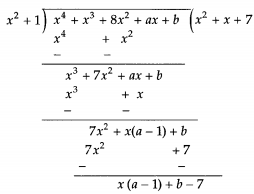
We get, remainder = x (a - 1) + (b - 7)
x (a - 1) + (b - 7 ) = 0
{tex}\Rightarrow{/tex} x (a - 1) + (b - 7) = 0x + 0
{tex}\Rightarrow{/tex} a - 1 = 0 and b - 7 = 0 [On equating the coefficients of like powers of x]
{tex}\Rightarrow{/tex}a = 1 and b = 7
Posted by Piyush Gupta 6 years, 8 months ago
- 2 answers
बबलु यादब 6 years, 8 months ago
Yogita Ingle 6 years, 8 months ago
We need to find the H.C.F. of 592 and 252 and express it as a linear combination of 592 and 252.
By applying Euclid’s division lemma
592 = 252 x 2 + 88
Since remainder ≠ 0, apply division lemma on divisor 252 and remainder 88
252 = 88 x 2 + 76
Since remainder ≠ 0, apply division lemma on divisor 88 and remainder 76
88 = 76 x 1 + 12
Since remainder ≠ 0, apply division lemma on divisor 76 and remainder 12
76 = 12 x 6 + 4
Since remainder ≠ 0, apply division lemma on divisor 12 and remainder 4
12 = 4 x 3 + 0.
Therefore, H.C.F. = 4.
Now, 4 = 76 – 12 x 6
= 76 – 88 – 76 x 1 x 6
= 76 – 88 x 6 + 76 x 6
= 76 x 7 – 88 x 6
= 252 – 88 x 2 x 7 – 88 x 6
= 252 x 7- 88 x 14- 88 x 6
= 252 x 7- 88 x 20
= 252 x 7 – 592 – 252 x 2 x 20
= 252 x 7 – 592 x 20 + 252 x 40
= 252 x 47 – 592 x 20
= 252 x 47 + 592 x (-20)
Hence obtained.
Posted by Tanisha . 6 years, 8 months ago
- 0 answers
Posted by Hemant Kumar 6 years, 8 months ago
- 0 answers
Posted by Prakash Pradhan 6 years, 8 months ago
- 1 answers
बबलु यादब 6 years, 8 months ago
Posted by Salma Gaur 6 years, 8 months ago
- 0 answers
Posted by Beauty? Queen Happy Birthday V.D.? 6 years, 8 months ago
- 3 answers
Yogita Ingle 6 years, 8 months ago
For a pair of given positive integers ‘a’ and ‘b’, there exist unique integers ‘q’ and ‘r’ such that
a=bq+r, where 0≤r<b
Explanation:
Thus, for any pair of two positive integers a and b; the relation
a=bq+r, where 0≤r<b
will be true where q is some integer.
Posted by Beauty? Queen Happy Birthday V.D.? 6 years, 8 months ago
- 1 answers
Posted by Tripti Sinha 6 years, 8 months ago
- 3 answers
Posted by Ananda Prsada Lenka 6 years, 8 months ago
- 2 answers
Yogita Ingle 6 years, 8 months ago
Let the digit in the ones place be x and tens place be y
Hence the two digit number = 10y + x
Given that the two digit number = 4 times sum of its digits
⇒ 10y + x = 4(x + y)
⇒ 10y + x = 4x + 4y
⇒ 3x – 6y = 0
⇒ 3x = 6y
∴ x = 2y → (1)
It is also given that the two digit number = 2 times product of its digits
⇒ 10y + x = 2xy
Divide by xy both the sides, we get
10/x + 1/y = 2
Put x = 2y from (i), we get
10/2y + 1/y = 2
5/y + 1/y = 2
6/y = y
∴ y = 3
Hence x = 6
The two digit number is (10y + x) = 10(3) + 6 = 36
Posted by Anandhu B 6 years, 4 months ago
- 1 answers
Sia ? 6 years, 4 months ago
x2 - 6
Let p(x) = x2 - 6
For zeroes of p(x), p(x) = 0
{tex}\Rightarrow x ^ { 2 } - 6 = 0 \Rightarrow ( x ) ^ { 2 } - ( \sqrt { 6 } ) ^ { 2 } = 0{/tex}
{tex}\Rightarrow ( x - \sqrt { 6 } ) ( x + \sqrt { 6 } ) = 0{/tex}
Using the identity a2 - b2 = (a - b) (a + b)
{tex}\Rightarrow x - \sqrt { 6 } = 0 \text { or } x + \sqrt { 6 } = 0{/tex}
{tex}\Rightarrow x = \sqrt { 6 } \text { or } x = - \sqrt { 6 } \Rightarrow x = \sqrt { 6 } , - \sqrt { 6 }{/tex}
So, the zeroes of x2 - 6 are {tex}\sqrt 6 {/tex} and {tex} - \sqrt 6 {/tex}
Sum of zeroes
{tex}= ( \sqrt { 6 } ) + ( - \sqrt { 6 } ) = 0 = \frac { - 0 } { 1 } = \frac { - \text { Coefficient of } x } { \text { Coefficient of } x ^ { 2 } }{/tex}
Product of zeroes
{tex}= ( \sqrt { 6 } ) \times ( - \sqrt { 6 } ) = - 6 = \frac { - 6 } { 1 } = \frac { \text { Constant term } } { \text { Coefficient of } \mathrm { x } ^ { 2 } }{/tex}
Hence the relation between zeroes and coefficient is verified.
Posted by Priyanshu Gamer 6 years, 8 months ago
- 1 answers
Sejal Kathait?????? 6 years, 8 months ago
Posted by Yashwini Sharma 6 years, 8 months ago
- 1 answers
Posted by Indu Goel 6 years, 4 months ago
- 1 answers
Sia ? 6 years, 4 months ago
Let the polynomial be p(x).
By remainder theorem, p(2) = 1 and p(3) = 3.
p(x) can be expressed as q(x) × (x-2) × (x-3) + Ax + B, where Ax + B is the remainder when divided by (x -2) (x - 3). [Assuming p(x) as a cubic polynomial]
But p(2) = 1 and P(3) = 3,
2A + B = 1 and 3A + B = 3,
Solving the equations 2A + B = 1 and 3A + B = 3, we get A = 2 and B = -3
Hence the remainder when p(x) is divided by is (2x - 3).
Posted by Ruchi Mishra 6 years, 4 months ago
- 1 answers
Sia ? 6 years, 4 months ago
We have,
{tex}\frac { \cos ^ { 2 } 20 ^ { \circ } + \cos ^ { 2 } 70 ^ { \circ } } { \sec ^ { 2 } 50 ^ { \circ } - \cot ^ { 2 } 40 ^ { \circ } }{/tex} +2 cosec258° - 2cot58° tan 32° - 4 tan13° tan37° tan45° tan53° tan77°
= {tex}\frac { \cos ^ { 2 } 20 ^ { \circ } + \cos ^ { 2 } \left( 90 ^ { \circ } - 20 ^ { \circ } \right) } { \sec ^ { 2 } 50 ^ { \circ } - \cot ^ { 2 } \left( 90 ^ { \circ } - 50 ^ { \circ } \right) }{/tex} + 2cosec258° - 2cot58° tan (90° - 58°)- 4tan13° tan37° tan45° tan(90° - 37°) tan(90° -13°)
= {tex}\frac { \cos ^ { 2 } 20 ^ { \circ } + \sin ^ { 2 } 20 ^ { \circ } } { \sec ^ { 2 } 50 ^ { \circ } - \tan ^ { 2 } 50 ^ { \circ } }{/tex} + 2cosec258° - 2cot258° - 4 tan13° tan37° tan45° cot37° cot13°
= {tex}\frac { 1 } { 1 }{/tex} + 2(cosec258° - cot258°) - 4(tan13° cot13°) (tan37° cot37°) tan45°
= 1 + 2 - 4 {tex}\times{/tex} 1 {tex}\times{/tex} 1 {tex}\times{/tex} 1 = 3 - 4 = -1
Posted by Arati Shaw 6 years, 8 months ago
- 0 answers
Posted by Priyanshi Jat 6 years, 8 months ago
- 1 answers
Anjali Sharma 6 years, 8 months ago
Posted by Monu Singh 6 years, 8 months ago
- 0 answers
Posted by Vinod Kumar Maurya 6 years, 8 months ago
- 0 answers
Posted by Aditya Singh 6 years, 8 months ago
- 0 answers
Posted by Atharva Parab 6 years, 8 months ago
- 2 answers
Amit Chaudhary 6 years, 8 months ago
Pooja Sah 6 years, 8 months ago
Posted by Anmoldeep Kaur 6 years, 8 months ago
- 2 answers
Posted by Karan Arora 6 years, 8 months ago
- 0 answers
Posted by Meena Verma 6 years, 8 months ago
- 1 answers
Posted by Diesel Electric Loco Shed 6 years, 8 months ago
- 0 answers
Posted by Aishwarya Nagpal 6 years, 8 months ago
- 2 answers
Yogita Ingle 6 years, 8 months ago
Let x = ones digit
and y = tens digit
then from "a two digit number is 4 more than 6 times the sum of its digits":
x + 10y = 6(x+y)+4
x + 10y = 6x+6y+4
10y = 5x+6y+4
4y = 5x+4. ......... (i)
and, from "if 18 is subtracted from the number,the digits are reversed.find the number"
x+10y -18 = y+10x
10y -18 = y+9x
9y -18 = 9x
y -2 = x
substitute the above into (i)
4y = 5x+4
4y = 5(y-2)+4
4y = 5y-10+4
4y = 5y-6
4y+6 = 5y
6 = y
substitute above into (i), we get
4y = 5x+4
4(6) = 5x+4
24 = 5x+4
20 = 5x
4 = x
The number is 64.

myCBSEguide
Trusted by 1 Crore+ Students

Test Generator
Create papers online. It's FREE.

CUET Mock Tests
75,000+ questions to practice only on myCBSEguide app

Sia ? 6 years, 4 months ago
{tex}3x - 2y + 3 = 0{/tex}........(i)
{tex}4x + 3y - 47 = 0{/tex}......(ii)
By cross multiplication, we have
{tex}\therefore \frac { x } { [ ( - 2 ) \times ( - 47 ) - ( 3 \times 3 ) ] }{/tex}{tex}= \frac { y } { [ ( 3 \times 4 ) - ( - 47 ) \times 3 ] }{/tex}{tex}= \frac { 1 } { [ 3 \times 3 - ( - 2 ) \times 4 ] }{/tex}
{tex}\Rightarrow \quad \frac { x } { ( 94 - 9 ) } = \frac { y } { ( 12 + 141 ) } = \frac { 1 } { ( 9 + 8 ) }{/tex}
{tex}\Rightarrow \quad \frac { x } { 85 } = \frac { 1 } { 17 } , \frac { y } { 153 } = \frac { 1 } { 17 }{/tex}
{tex}17x = 85, \ 17y = 153{/tex}
{tex}\Rightarrow \quad x = \frac { 85 } { 17 } , y = \frac { 153 } { 17 }{/tex}
Therefore, the solution is {tex}x = 5,\ y = 9{/tex}
0Thank You